
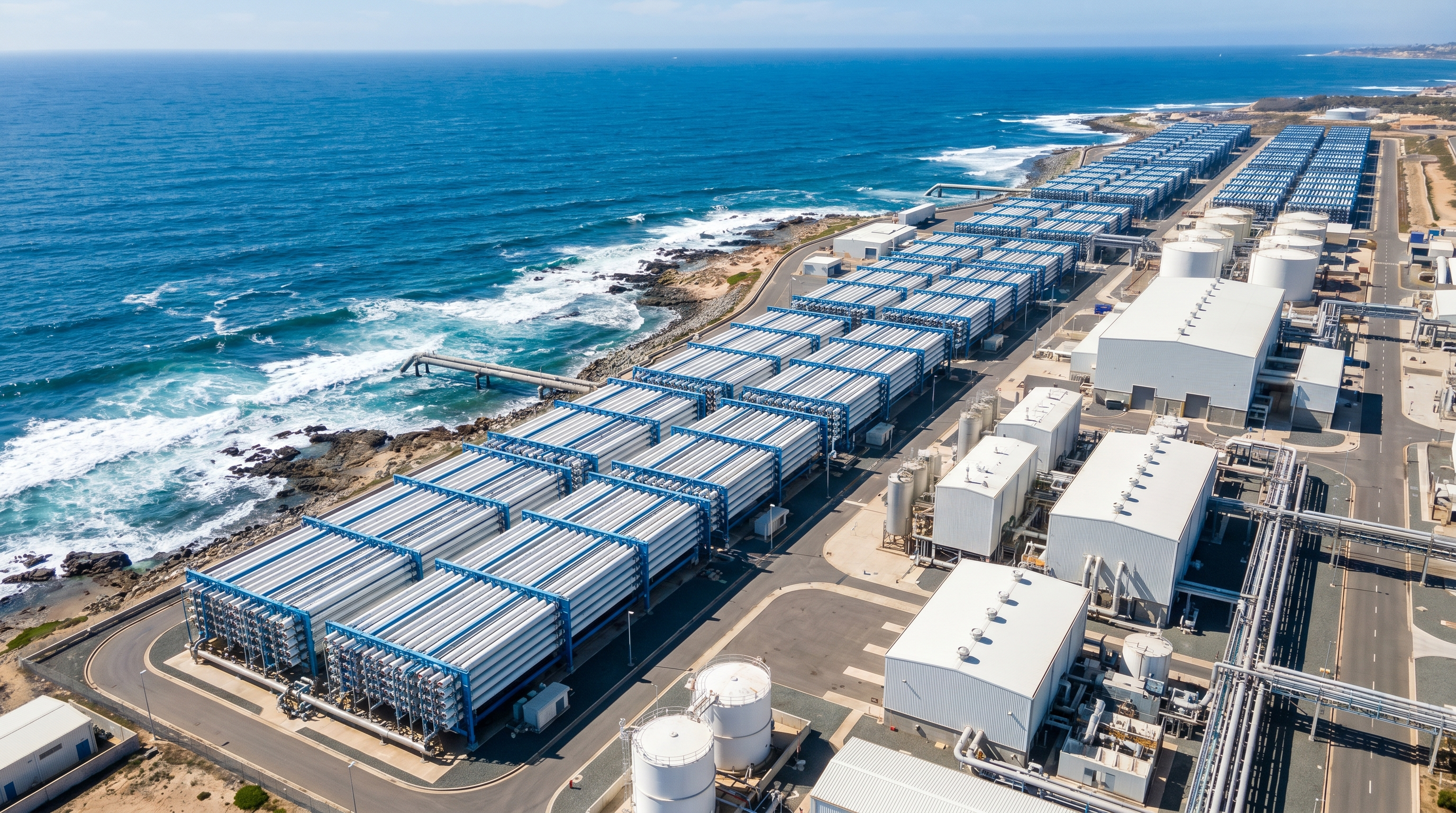
Containerized seawater desalination skid on a dock pad at a coastal marina

Seawater Reverse Osmosis Company | Desalination Watermakers

About Seawater Reverse Osmosis Company | Desalination Watermakers

AMPAC USA is a seawater reverse osmosis company specializing in the desalination of seawater by reverse osmosis for marine, industrial, and municipal applications, using high-quality membranes engineered to turn seawater into clean, potable water.

AMPAC USA has manufactured seawater desalination watermakers for over 30 years, supplying marine vessels, offshore platforms, coastal communities, and land-based installations across more than 100 countries. SWRO systems convert open-ocean seawater at 32,000 to 45,000 ppm TDS into drinking water meeting WHO standards, with output TDS consistently below 500 ppm.

The product line covers capacities from 100 GPD emergency portable watermakers for lifeboats and small vessels to 250,000+ GPD containerized systems for island municipalities and industrial facilities. All systems use high-rejection spiral-wound membranes designed for seawater applications, high-pressure pumps rated for marine duty, and stainless steel or FRP pressure vessels resistant to saltwater corrosion.

Pre-treatment is sized to the feed water source and installation environment. Offshore and marine installations typically require multimedia filtration for suspended solids, cartridge filtration before the high-pressure pump, and antiscalant dosing to prevent carbonate scale on the membrane surface. Land-based coastal installations fed from beach wells often have lower turbidity but higher biological load, requiring additional disinfection pre-treatment for reliable long-term performance.

The SeaPro marine watermaker line is engineered for installation in engine rooms and below-deck spaces: compact footprint, low vibration, and salt-resistant components throughout. Variable-output models allow operators to match production to actual daily consumption rather than running at full capacity continuously.

LandPro land-based desalination systems are available in modular containerized configurations for rapid deployment and easy transport. These systems arrive pre-assembled, pre-piped, and factory-tested, reducing on-site installation to a utilities connection. Remote monitoring via GSM or satellite telemetry is available for systems operating in locations without permanent on-site operators.

Contact AMPAC USA at (909) 548-4900 or request a quote online. Provide your target daily water output, feed water source, and installation location, and our team will size the appropriate system and provide preliminary engineering documentation.

How much does a seawater desalination system cost?

SWRO system pricing depends heavily on daily output capacity, installation type (marine vs. land-based), and site-specific engineering requirements. Compact marine watermakers start around $3,000 to $8,000 for systems producing 100 to 300 GPD. Larger coastal land-based systems at 10,000 to 50,000 GPD typically range from $50,000 to $200,000 installed, depending on pre-treatment requirements and whether energy recovery is included. AMPAC USA provides detailed quotes based on your specific site conditions, water quality, and capacity requirements.

What is the difference between marine and land-based SWRO systems?

Marine watermakers are engineered to withstand the constant motion, salt air, humidity, and vibration aboard vessels. They use corrosion-resistant alloys throughout, compact low-vibration pump designs, and control systems that handle interrupted operation safely. Land-based coastal systems don't need those specific marine tolerances but often handle higher feed water variability and require more robust pre-treatment for biofouling control. The core RO membrane and rejection performance is similar — what differs is the enclosure, mounting, control logic, and materials specification.

How much energy does a seawater watermaker use?

A standard SWRO system without energy recovery consumes roughly 6 to 10 kWh per cubic meter of fresh water produced. Modern systems with pressure exchangers or Pelton wheel energy recovery devices reduce that to 2.5 to 3.5 kWh per cubic meter — a 50 to 65 percent reduction in energy cost. AMPAC includes energy recovery as standard on land-based systems above 10,000 GPD. For smaller marine units where simplicity and reliability matter more than energy efficiency, non-recovery configurations remain common.

What regular maintenance does a seawater watermaker need?

Routine maintenance covers three areas. First, pre-filter cartridges — typically 5 or 20 micron — need changing every 200 to 500 operating hours depending on feed water clarity. Second, membranes should be chemically cleaned (CIP) when normalized permeate flow drops more than 10 to 15 percent from initial baseline, or at least annually. Third, high-pressure pump seals and O-rings need inspection each season or annually for continuous-use systems. Salt rinse cycles after use and proper preservation during lay-up extend membrane life significantly on marine units.

What output water quality does an AMPAC SWRO system produce?

AMPAC seawater desalination systems consistently produce permeate water with TDS below 500 ppm from open-ocean seawater at 32,000 to 45,000 ppm. With high-rejection membranes, output TDS is typically in the 200 to 400 ppm range — well within WHO potable water guidelines. Where an application requires lower TDS, a second-pass RO or mixed-bed deionization polishing stage can further reduce output to under 10 ppm. Salt rejection rates run 99.3 to 99.7 percent depending on membrane selection and operating conditions.

Reviewed by Sammy Farag, VP of Engineering at AMPAC USA.