

Models
Need an output between two models, or a different feed water? Send us your numbers
About Portable Reverse Osmosis System for Hemodialysis
Sizing a system? Send your flow rate and a feed-water analysis, and an AMPAC engineer will work out the configuration with you.
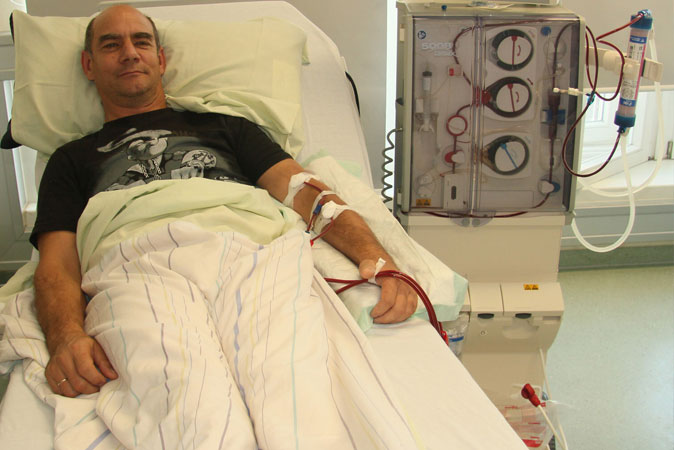
The reverse osmosis (RO) system uses a pump to push water through a semipermeable membrane or filter which removes almost all of the contaminants including bacteria and viruses. The product water is the ultra pure water which enters the hemodialysis machine and is used to mix the dialysate for your dialysis treatment.
Portable Reverse Osmosis System for Hemodialysis
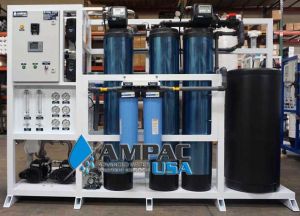
AMPAC USA designs and manufactures portable reverse osmosis system for hemodialysis applications, delivering ultra-pure dialysis water that meets AAMI/ISO standards for hemodialysis treatments. Our portable reverse osmosis units provide reliable, high-purity water for dialysis machines in hospitals, clinics, and home dialysis settings - wherever treatment is needed.
Key features of our portable reverse osmosis system for hemodialysis: compact, cart-mounted design for easy mobility; low noise level operation; dual-pass RO for ultra-low endotoxin output; heat disinfection capability for infection control; intuitive control panel with alarm monitoring; and compatibility with standard tap water feeds. All hemodialysis treatments require high quality water - AMPAC USA systems are built to deliver exactly that. Contact us for specifications and configurations.
Frequently Asked Questions
What water quality standard governs water used in hemodialysis treatment?
Hemodialysis water must meet AAMI/ANSI 13959 standards, which specify maximum contaminant levels for 28 chemical contaminants and require total viable bacterial counts below 100 CFU/mL with endotoxin below 0.25 EU/mL. These limits are stricter than drinking water standards because dialysis patients are exposed to 300-600 liters of water per week directly through the dialysate membrane, making trace contaminants clinically significant. Our hemodialysis water systems are designed and validated against current AAMI standards.
Why is single-pass RO insufficient for dialysis water in most clinical settings?
Single-pass RO typically reduces TDS by 90-95% but may not consistently achieve the bacterial and endotoxin levels required for dialysis water, particularly as membranes age or if bacterial growth occurs in downstream distribution loops. Most dialysis facilities now operate double-pass RO systems where the permeate from the first RO stage feeds a second RO array, achieving combined rejection of 99.5%+ and consistently low endotoxin levels. AMPAC USA builds both single-pass and double-pass systems based on facility size, water chemistry, and risk tolerance.
How should dialysis water distribution loops be designed to control bacterial growth?
Distribution loops must maintain continuous circulation at flow velocities above 1.5 feet per second and with loop temperatures either above 60 degrees C for hot-water sanitizable systems or maintained with periodic chemical or UV sanitization in ambient systems. Dead legs in distribution piping are a primary site for biofilm formation and must be eliminated in loop design. Our engineering team designs distribution systems with slope-to-drain capability and sampling ports at each station per AAMI TIR34 guidance.
How often do RO membranes in dialysis systems need replacement?
Membrane replacement frequency depends on feed water quality, system recovery rate, and sanitization protocol, but most dialysis RO membranes operate reliably for 2-5 years under proper pretreatment and regular sanitization. Hardness scaling is the most common cause of premature membrane failure in dialysis systems; a functioning upstream water softener with properly timed regeneration is essential. Our service program includes annual performance testing to catch declining rejection rates before they affect water quality.
Can a single AMPAC dialysis water system serve multiple treatment stations in a clinic?
Our central dialysis water systems are sized from 2,000 GPD for small 4-6 station clinics up to 50,000 GPD for large outpatient dialysis centers with 30 or more treatment stations. The distribution loop design, pump sizing, and storage capacity are all calculated based on the number of simultaneous treatments, treatment duration, and dialysate flow rate per machine, typically 500-800 mL/minute per station. We coordinate with the dialysis machine manufacturer specifications to confirm compatibility before finalizing system design.