

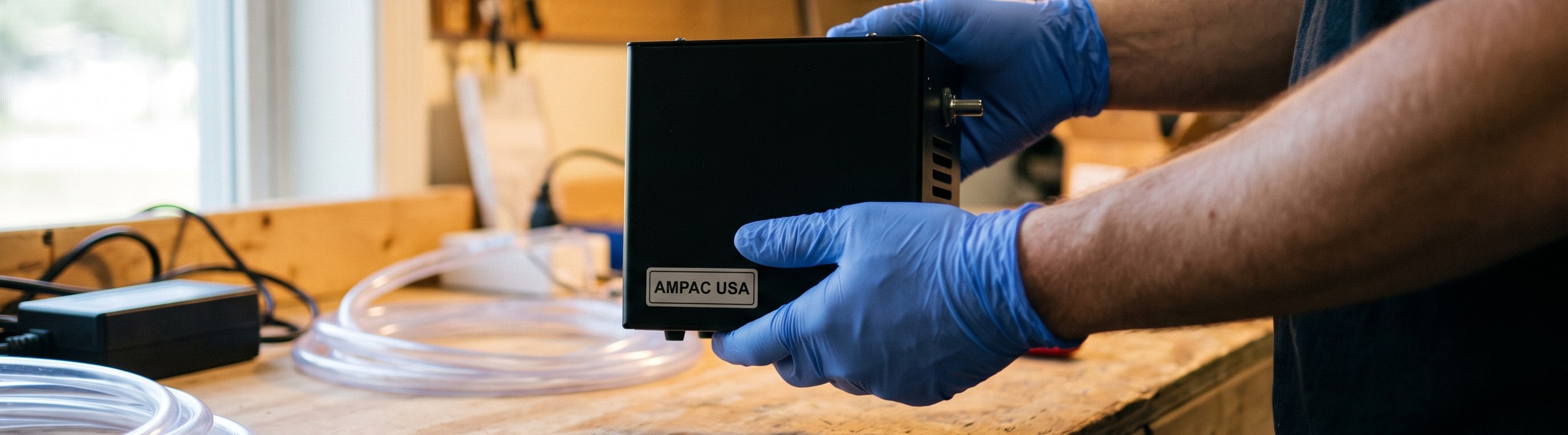
Ozone Generators is built to order
These systems are engineered around your water conditions, flow rate and site, so we do not list generic units online. Request a quote and an engineer will call you to size a system for your application.
About Buy ozone generators from Ampac USA
Sizing a system? Send your flow rate and a feed-water analysis, and an AMPAC engineer will work out the configuration with you.
Ozone generators produce ozone (O₃), one of the most powerful disinfection agents available for water treatment — approximately 3,000 times more effective than chlorine against bacteria and viruses, with the key advantage that ozone decomposes back to oxygen within minutes, leaving no chemical residue in treated water. Ozone inactivates pathogens including Cryptosporidium and Giardia that are resistant to chlorination, making it the preferred disinfection technology for bottled water production and sensitive process water applications.
AMPAC USA ozone generation systems address a wide range of applications: bottled water disinfection, cooling tower treatment, swimming pool and spa sanitation, aquaculture, food processing, and industrial process water. Ozone also oxidizes iron, manganese, and hydrogen sulfide in groundwater, converting dissolved forms to filterable particulates for easy removal by downstream filtration.
Our ozone systems range from compact point-of-use units for small water stores to large industrial generators handling high-volume commercial applications. All systems include contact chambers, off-gas destructors, and ozone residual monitors for safe, compliant operation. Contact AMPAC USA at (909) 548-4900 to size an ozone system for your application.
Frequently Asked Questions
How does ozone treat water and what problems does it solve?
Ozone (O3) is a powerful oxidant that destroys bacteria, viruses, and biofilm, oxidizes iron and manganese, reduces taste and odor compounds, and lowers total organic carbon (TOC). It is effective at very low concentrations (0.1-1.0 mg/L) and decomposes back to oxygen, leaving no chemical residue. Applications include distribution loop sanitation, bottled water production, and pre-treatment before activated carbon.
What ozone output range do your generators cover?
Our ozone generators range from 1 g/hr for small point-of-use systems up to 100 g/hr for large industrial water treatment loops. Output selection is based on water volume, contact time, ozone demand of the water (function of TOC and iron content), and target residual ozone concentration. For distribution loop sanitation, typical dosing is 0.2-0.5 mg/L at the return.
What is corona discharge ozone generation and why is it preferred?
Corona discharge passes dry air or oxygen through a high-voltage electrical field, splitting O2 molecules and recombining them as O3. It produces much higher ozone concentrations (1-5% by weight from air, 6-14% from oxygen feed) than UV ozone generators, making it cost-effective for industrial applications. UV ozone generators are limited to very small output and are generally used only for aquarium or small residential applications.
Is a contact tank required with an ozone system?
Yes, a contact tank is required. Ozone must have sufficient time to react with contaminants and decompose before water enters distribution. Minimum CT (concentration x time) values depend on the pathogen target. For Giardia inactivation at 0.5 mg/L ozone residual, you need approximately 10 minutes contact time at 10 degrees C. Tanks are typically baffled to prevent short-circuiting and maximize contact efficiency.
Does ozone residual carry through to the distribution system?
Ozone decomposes rapidly in water, with a half-life of 10-30 minutes depending on temperature, pH, and organic content. It does not provide a lasting distribution residual the way chlorine does. For applications requiring disinfection residual in distribution, ozone is typically followed by a chlorine or chloramine residual system. Ozone plus biologically active carbon filtration plus UV is a common chemical-free alternative for water stores and bottled water plants.
What safety precautions are needed when operating ozone generators?
Ozone is toxic at concentrations above 0.1 ppm in air (OSHA PEL). Equipment rooms must have adequate ventilation and continuous ambient ozone monitors with alarms. Ozone-resistant materials (PTFE, 316 SS, EPDM) must be used for all wetted components and off-gas piping. A catalytic ozone destruct unit should be installed on all system vents. Our systems ship with destruct units and safety documentation as standard.