

Models
-
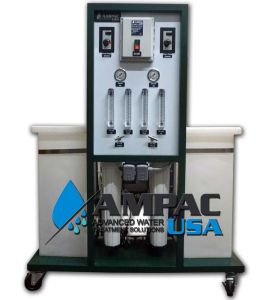
FO500
Forward Osmosis
The AMPAC USA Forward Osmosis 500 GPD system takes a fundamentally different approach to water purification than standard reverse osmosis.
500 GPD
View specifications -

FO1000
Forward Osmosis
The AMPAC USA Forward Osmosis 1000 GPD system purifies water and recovers valuable compounds using the natural osmotic pressure difference between a feed solution and a draw solution, rather than the hydraulic pressure that drives conventional reverse osmosis.
1,000 GPD
View specifications
Need an output between two models, or a different feed water? Send us your numbers
About Forward Osmosis Membranes & Systems
Sizing a system? Send your flow rate and a feed-water analysis, and an AMPAC engineer will work out the configuration with you.
Forward Osmosis Membranes
AMPAC USA has introduced Advanced Forward Osmosis Membranes for higher rejection of contaminants with the use of only natural osmotic pressure. These membranes are specially designed to reject contaminants and/or retain valuable compounds. Experts at our facility have now achieved higher rejections from the FO Membrane using just proteins in the active layer that are very selective to water molecules. This lowers the diffusion of draw solutes drastically. This process can be used individually or in combination with reverse osmosis for better water permeate results.
Forward Osmosis APPLICATIONS:
- It enables you to retain valuable compounds and aspects in the solution like aromas, nutrients, flavors, and colors. It is a very big asset for the dairy, beverage and brewing industry to retain components for mil protein, beer, fruit juices, and coffee.
- It is an essential part of the FO/RO process and acts as an important pre-treatment process before reverse osmosis. The presence of FO before RO protects the RO membrane with its low fouling propensity and acts as a double layer of filtration producing high quality permeate water.
- It can be used for zero or even minimal liquid discharge applications that result in higher water recovery with a minimum amount of wastewater to be treated.
Frequently Asked Questions
How does forward osmosis differ from reverse osmosis in terms of driving force?
Reverse osmosis uses hydraulic pressure, typically 150-1,200 psi depending on feed salinity, to push water through a membrane against the osmotic gradient. Forward osmosis uses a concentrated draw solution on the permeate side to create an osmotic pressure differential that pulls water naturally through the membrane, requiring little to no applied pressure. The tradeoff is that FO requires an additional step to recover clean water from the draw solution.
What draw solutions are used in AMPAC USA forward osmosis systems?
Our FO systems use ammonia-carbon dioxide draw solutions for applications where thermal regeneration is feasible, and sodium chloride or proprietary organic draw solutions where low-temperature operation is required. Draw solution selection depends on the application: food and pharmaceutical clients often prefer food-safe draw solutes, while industrial brine concentration projects tolerate a wider range of chemistries. We engineer the full draw solution recovery loop, not just the membrane stage.
What feed water TDS levels can forward osmosis handle compared to conventional RO?
FO membranes can process feed streams up to 70,000-100,000 mg/L TDS, well beyond the practical limit of high-pressure seawater RO membranes at roughly 45,000-50,000 mg/L. This makes FO useful for concentrating produced water from oil and gas operations, landfill leachate, and pharmaceutical process streams where conventional pressure-driven membranes fail or foul rapidly. AMPAC USA sizes FO systems based on feed osmotic pressure and target volume reduction ratio.
In what industries does AMPAC USA deploy forward osmosis systems?
We build FO systems for food and beverage concentration including juice, dairy, and coffee, pharmaceutical process water recovery, brine minimization in industrial wastewater, and fertilizer-drawn FO for irrigation. Each application uses a different draw solution and recovery scheme, and we engineer the full system rather than supplying membranes alone. Contact our engineering team with your feed water chemistry and product specification for a preliminary design.
How resistant are FO membranes to fouling compared to RO membranes?
FO membranes foul less severely than RO membranes for the same feed water because the absence of applied hydraulic pressure means foulants are not compacted against the membrane surface. Fouling is also more reversible under low-pressure osmotic conditions. That said, FO is not immune to scaling or biofouling, and our system designs include periodic osmotic backwashing, which can restore flux without chemical cleaning in many cases.