

Models
-
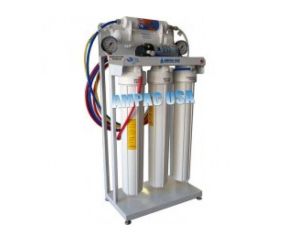
APRO100
Commercial Reverse Osmosis
100 GPD 380 LPD
View specifications -
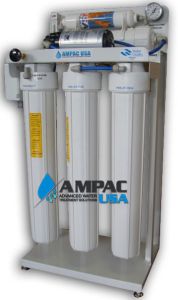
APRO200
Commercial Reverse Osmosis
200 GPD 750 LPD
View specifications -
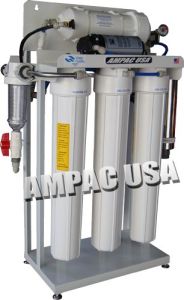
APRO300
Commercial Reverse Osmosis
300 GPD 1135 LPD
View specifications -
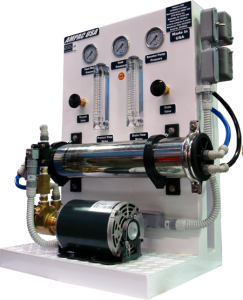
APRO1000
Commercial Reverse Osmosis
1,000 GPD 3780 LPD
View specifications -
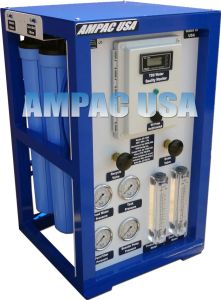
APRO1200
Commercial Reverse Osmosis
1,200 GPD 4500 LPD
View specifications -
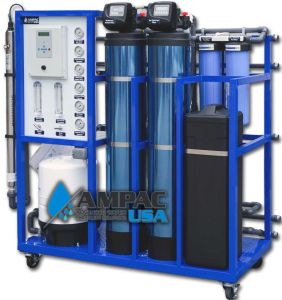
AP1500-LX
Commercial Turnkey Reverse Osmosis
1,500 GPD 5.7 m³/Day
View specifications -
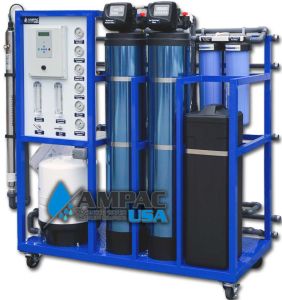
AP3000-LX
Commercial Turnkey Reverse Osmosis
3,000 GPD 11.4 m³/Day
View specifications
Need an output between two models, or a different feed water? Send us your numbers
About Whole House Reverse Osmosis Systems
Sizing a system? Send your flow rate and a feed-water analysis, and an AMPAC engineer will work out the configuration with you.
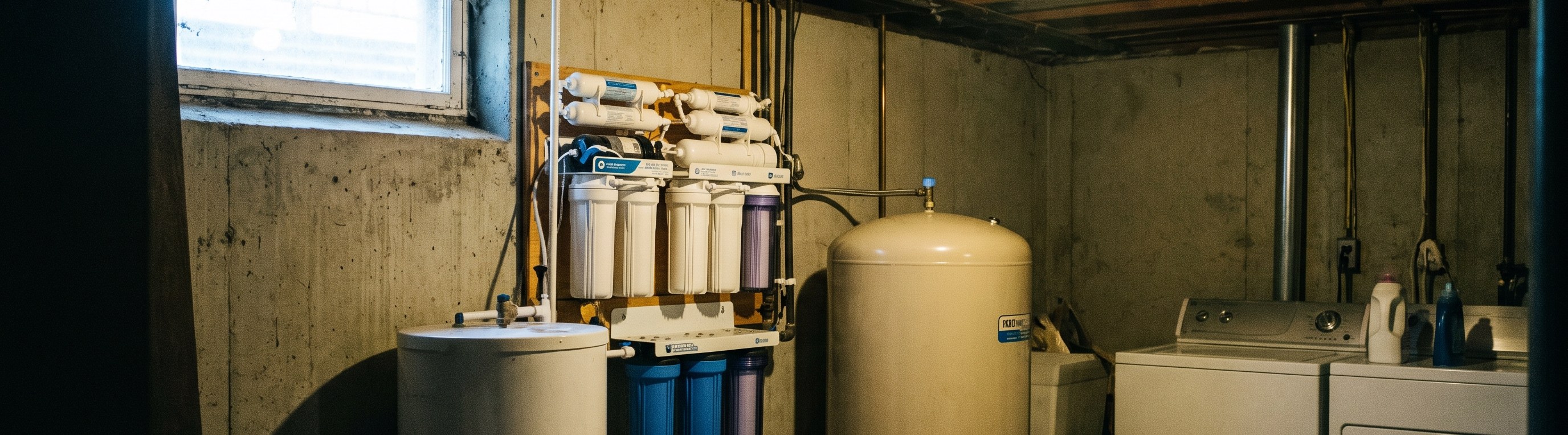
A whole house reverse osmosis system — also called a point-of-entry (POE) RO system — treats all the water entering a building before it reaches any fixture. Unlike under-sink units that protect a single tap, POE RO covers showers, laundry, dishwashers, ice makers, and every cold and hot water outlet simultaneously. AMPAC's whole house RO line is built for residential and light commercial buildings where source water TDS, hardness, or contamination levels make partial treatment inadequate.
Who Needs Point-of-Entry RO
The short answer: anyone on well water, agricultural-area groundwater, or municipal supply with TDS consistently above 500 mg/L. High TDS does not just affect taste — it accelerates scale buildup in water heaters, shortens appliance life, leaves residue on shower glass and fixtures, and can push sodium or nitrate levels into ranges that matter for infants and immunocompromised household members. Under-sink RO handles drinking water; whole house RO handles the rest.
Well Water vs City Water: Which Treatment Do You Need?
| Source | Typical Concern | Recommended Approach |
|---|---|---|
| Municipal (city) water | Chlorine, disinfection byproducts, moderate TDS (150-400 mg/L) | Carbon filtration + under-sink RO for drinking; softener for hardness |
| Private well water | High TDS, iron, hardness, nitrates, bacterial risk | Full pre-treatment train + whole house RO system |
| Agricultural-area groundwater | Nitrates, pesticide runoff, high TDS, arsenic | Whole house RO with iron and nitrate-specific pre-treatment |
| Coastal or brackish well | Chlorides, high TDS (1,000-3,000 mg/L) | Brackish-rated whole house RO at higher operating pressure |
Sizing Your Whole House RO System
General sizing rule: plan for 75-100 GPD per person for drinking and cooking needs, then multiply by 3-4x for whole-house coverage (showers, laundry, appliances). A 3-4 person household typically needs 300-500 GPD minimum; larger homes with irrigation or multiple bathrooms benefit from 750-1,000 GPD systems. AMPAC's whole house RO units are available from 300 GPD through 1,500 GPD in residential-rated configurations, with larger custom systems for estates and light commercial buildings.
Pre-Treatment for Well Water
Well water with iron above 0.1 mg/L, hydrogen sulfide, or biological contamination requires treatment upstream of any RO membrane. A standard pre-treatment train for whole house RO includes sediment filtration (25 micron to 5 micron), iron/manganese removal if indicated by water test, water softening for hardness above 7 gpg, and carbon block filtration before the RO membranes. AMPAC can specify a complete pre-treatment package matched to your water test results — contact our engineering team with your water analysis report and daily usage estimate for a system recommendation.
Every AMPAC whole house RO system uses FILMTEC membranes, ships factory-tested from our Woods Cross, Utah facility, and is backed by a 2-year parts warranty.
Whole House Reverse Osmosis: Common Questions
How much does a whole house reverse osmosis system cost?
Whole house RO system cost depends on daily output capacity, pre-treatment requirements, and installation complexity. Residential systems sized for a typical household (300-500 GPD) generally run $2,500 to $6,000 for the system alone, with fully installed pricing -- including pre-treatment, plumbing, and a permeate storage tank -- typically landing between $4,000 and $10,000. Larger 750-1,500 GPD systems for bigger homes or light commercial use cost more, primarily driven by membrane count and pump sizing. AMPAC provides a quote based on your water test results and daily usage estimate.
What's the difference between a whole house RO system and an under-sink RO system?
An under-sink reverse osmosis water filter treats water at a single point of use -- usually the kitchen tap -- and is sized for drinking and cooking water only. A whole house reverse osmosis system, sometimes called a whole home RO system or point-of-entry RO system, treats every gallon entering the building, so showers, laundry, dishwashers, and water heaters all receive filtered water. If your water test shows elevated TDS, hardness, or contamination affecting fixtures and appliances -- not just drinking water taste -- a whole house RO system is the right fix rather than an under-sink unit. See our comparison of reverse osmosis against other filtration methods for more detail on how RO stacks up.
Not sure whether you need a whole house RO system or a water softener? See our comparison guide.
How a whole house RO system works
Water passes through four stages before it reaches any tap in the building.
- Sediment pre-filtration. Sand, rust and silt are caught first. Grit that reaches the membrane scores it, and a scored membrane stops rejecting dissolved solids.
- Carbon pre-filtration. Chlorine destroys the polyamide film an RO membrane is made from, so carbon strips it out before the water gets there. On chloraminated municipal supplies this stage carries most of the load.
- The RO membrane. A high-pressure pump forces water through a semi-permeable membrane that passes water molecules and rejects almost everything larger. AMPAC systems take feed water up to 2,000 ppm TDS and deliver permeate between 50 and 200 ppm.
- Storage and repressurisation. The membrane makes water steadily through the day, not on demand, so permeate collects in a tank and a pump sends it to the house at normal working pressure.
Two stages are optional and depend on the water. Remineralisation adds calcium and magnesium back, which matters because RO strips them along with the contaminants and the result tastes flat. UV disinfection goes last, after the membrane, on wells and any supply where bacteria are a concern.
What the system rejects: dissolved salts, heavy metals such as lead and arsenic, nitrates, fluoride, PFAS, and most pharmaceutical residues. What it does not remove on its own is hardness at scale, which is why a softener often sits upstream of the RO on hard water, protecting the membrane and extending its life.
Which size fits your house?
Start with how much water the household uses. The table below assumes about 60 gallons per person per day indoors. For reference, the EPA puts average use at 82 gallons per person per day at home, with roughly 70% of that indoors. Irrigation usually bypasses the system, so garden watering does not count toward the size you need.
| System | Output per day | Typical fit |
|---|---|---|
| 100 GPD | 100 gallons | One or two people, or drinking and cooking water for a larger family |
| 200 GPD | 200 gallons | Two to three people |
| 300 GPD | 300 gallons | Four to five people, the usual choice for a family home |
| 800 GPD | 800 gallons | A large house, a second dwelling on the same supply, or light commercial use |
| 1,000 to 1,200 GPD | 1,000 to 1,200 gallons | High-demand households, or a small multi-unit building |
| 1,500 to 3,000 GPD | 1,500 to 3,000 gallons | Estates, multi-building properties and commercial sites |
Two things shift the answer. An RO system makes water steadily through the day rather than on demand, so a storage tank and a pressure pump carry the house through the morning and evening peaks. Feed water quality matters just as much: high TDS, hardness or iron cuts the recovery rate, so the same system yields less permeate and a hard-water well often needs the next size up.
Send us a water test and the number of people in the house and we will size it for you. Request a quote.
Frequently Asked Questions
How much does a whole-house reverse osmosis system cost?
Cost depends on system capacity, the quality of your incoming water, and what the installation needs. Larger homes need higher gallons-per-day capacity. Wells with high TDS, iron, or hardness need more pre-treatment. A storage tank and repressurization pump are part of the system, and installation adds to the total. AMPAC USA quotes each whole-house system to your household demand and water quality, so request a quote with your water test results for an accurate price.
Are whole-house reverse osmosis systems worth it?
They are worth it when the whole house needs treated water, typically homes on well water with high TDS, arsenic, nitrates, or other widespread contamination. If the goal is only better-tasting drinking water, a point-of-use RO system at one tap costs less. If the main problem is hard water, a softener may solve it without RO. A whole-house RO system also needs a storage tank, a repressurization pump, and regular membrane maintenance, so the benefit has to justify that.
What are the downsides of whole-house reverse osmosis?
The main downsides are cost, space, and maintenance. A whole-house system needs a storage tank and repressurization pump, so it takes more room than a filter. RO sends a portion of the incoming water to drain as concentrate. It also removes beneficial minerals along with contaminants, which some households add back with remineralization. Membranes typically last 2 to 5 years, and only with proper pre-treatment.
What is a whole-house RO system and who needs one?
A whole-house RO system treats all water entering the home at the point of entry, not just the drinking tap. It is designed for homes on well water with high TDS, arsenic, nitrates, or other pervasive contamination. Every tap, shower, dishwasher, and appliance receives purified water.
What flow rates do AMPAC USA whole-house RO systems produce?
AMPAC USA whole-house systems range from 500 to 5,000 gallons per day. Sizing depends on household water demand, which averages 50 to 100 gallons per person per day. A storage tank and repressurization pump are required to maintain steady pressure throughout the home.
Why does a whole-house RO system need a storage tank and repressurization pump?
RO membranes produce water slowly. A storage tank accumulates treated water between periods of high demand. The repressurization pump then delivers that stored water at normal household pressure. Without both components, flow at fixtures would be too slow for showers, laundry, or simultaneous use.
What pre-treatment does a whole-house RO system require?
Most installations benefit from sediment pre-filtration to protect the membrane and, for well water, a softener or iron filter to prevent membrane fouling. Iron above 0.1 mg/L and hardness above 7 GPG significantly shorten membrane life without upstream treatment.
How often does the RO membrane need replacement in a whole-house system?
With proper pre-treatment, membranes typically last 2 to 5 years. Systems handling very high TDS or iron may require earlier replacement. Monitoring permeate TDS with a handheld meter is the most reliable way to confirm membrane performance and schedule replacement at the right time.