

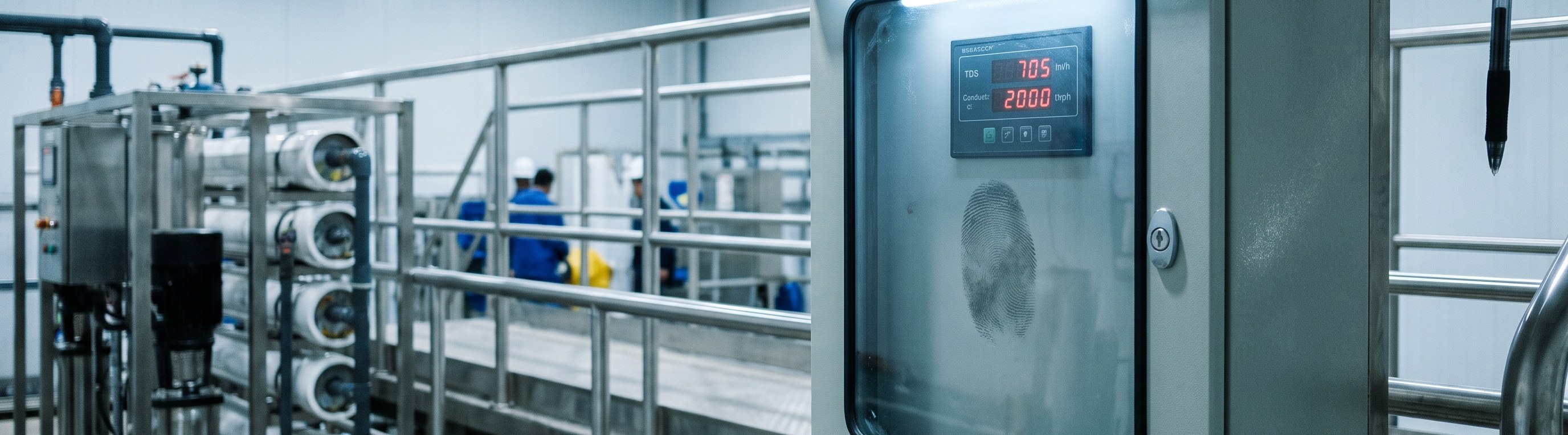
TDS-Conductivity Monitors is built to order
These systems are engineered around your water conditions, flow rate and site, so we do not list generic units online. Request a quote and an engineer will call you to size a system for your application.
About TDS-Conductivity Monitors
Sizing a system? Send your flow rate and a feed-water analysis, and an AMPAC engineer will work out the configuration with you.
TDS and conductivity monitors provide real-time measurement of total dissolved solids and electrical conductivity in reverse osmosis and water purification systems. Monitoring TDS is the primary method for verifying RO membrane performance — a properly functioning membrane reduces TDS by 90–99%. When permeate TDS rises toward feed water levels, it signals membrane fouling, scaling, or damage that requires attention before water quality degrades further.
AMPAC USA stocks digital handheld TDS meters, inline TDS probes, and dual-display monitors that simultaneously measure feed and permeate TDS, calculating rejection rate automatically. Conductivity monitors are preferred for industrial applications requiring precise ionic concentration measurement rather than an approximate TDS estimate. All monitors are compatible with AMPAC USA residential, commercial, and industrial RO systems and can be installed on feed, permeate, and reject lines.
Regular TDS monitoring is the simplest and most cost-effective way to maintain consistent water quality and extend membrane life. Contact us at (909) 548-4900 for selection assistance.
Frequently Asked Questions
What is the difference between TDS and electrical conductivity measurements?
Electrical conductivity (EC) measures the ability of water to conduct electricity, expressed in microsiemens per centimeter (uS/cm). TDS (Total Dissolved Solids) is calculated from conductivity by applying a conversion factor, typically 0.5-0.7 depending on the ion mix in the water. Conductivity is the direct measurement; TDS is a calculated estimate. For RO performance monitoring, conductivity is the more precise indicator of salt passage.
What measurement ranges do your TDS and conductivity monitors cover?
Our inline and portable monitors cover 0-9,999 ppm TDS and 0-19,999 microsiemens per centimeter conductivity. High-range models extend to 99,999 uS/cm for seawater and brine applications. For high-purity water applications such as semiconductor or pharmaceutical manufacturing, low-range units measure 0-10 uS/cm with resolution of 0.01 uS/cm. Selecting the correct range for your application is important for measurement accuracy.
How are TDS monitors used to verify RO system performance?
Operators monitor both feed water TDS and permeate TDS continuously to calculate percent rejection: rejection equals (1 minus permeate TDS divided by feed TDS) times 100. A new RO system with brackish water membranes should achieve 97-99% rejection. A drop of more than 1-2 percentage points from baseline indicates membrane fouling, scaling, or physical damage requiring investigation. Inline monitors with 4-20mA outputs enable SCADA-based automatic alarming.
Can TDS monitors detect problems with water softeners or DI systems?
Yes. A TDS monitor on the outlet of an ion exchange softener can detect hardness breakthrough before it reaches downstream equipment. For DI (deionization) systems, conductivity monitoring detects resin exhaustion. DI effluent should measure below 1 uS/cm (less than 0.5 ppm TDS) when resin is fresh. Rising conductivity at the DI outlet signals time to regenerate or replace the resin, protecting sensitive downstream equipment from hardness or ionic contamination.
Are your monitors suitable for continuous inline installation or only spot-checking?
We offer both configurations. Inline monitors with flow cells install directly in pipe runs (1/2-inch to 2-inch connections available) and provide continuous real-time readings with 4-20mA, RS-485, or relay outputs for PLC integration. Portable handheld units are calibrated instruments for field spot-checking, commissioning, and troubleshooting. Many facilities use inline monitors on critical streams and a portable unit for auxiliary checks throughout the plant.
How often do conductivity sensors need calibration?
Conductivity cells should be calibrated against a traceable standard solution every 3-6 months for process monitoring applications. Critical applications such as pharmaceutical water or semiconductor fab require monthly calibration verification. Cell constant drift occurs gradually due to fouling or electrode wear. Our inline sensors include tool-free removal for cleaning and recalibration without process shutdown. Calibration standard solutions (84 uS/cm and 1,413 uS/cm) are available separately.