
Models
-
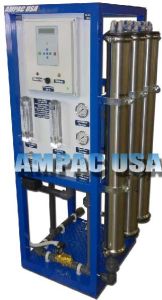
APRO6000
Commercial Reverse Osmosis
The AMPAC USA APRO6000 Commercial Reverse Osmosis system is built on more than 32 years of experience serving commercial pure-water users.
6,000 GPD 22,750 LPD
View specifications -
WFI-HP80
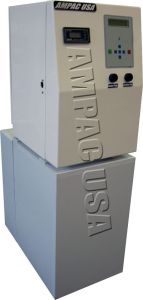
WFI-HP80
The AMPAC USA WFI-HP80 is a sophisticated water treatment system specifically engineered to produce exceptionally high purity water, meeting the stringent demands of biopharmaceutical applications.
View specifications -
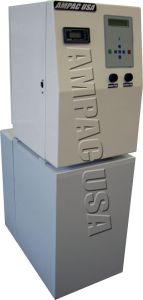
WFI-HP160
WFI-HP160
The AMPAC USA WFI-HP160 Biopharmaceutical High Purity Water Reverse Osmosis system is engineered to produce ultra-pure water specifically meeting the stringent requirements of the biopharmaceutical industry.
View specifications
Need an output between two models, or a different feed water? Send us your numbers
About Pharmaceutical Water Purification
Sizing a system? Send your flow rate and a feed-water analysis, and an AMPAC engineer will work out the configuration with you.
Pharmaceutical manufacturing uses water as both a raw ingredient and a critical cleaning agent. USP Purified Water and Water for Injection (WFI) standards exist because water quality directly affects drug safety and efficacy — trace endotoxins, dissolved ions, or microbial contamination in process water can compromise an entire production batch and trigger regulatory action. The standard is not advisory; it is a compliance requirement enforced through FDA, EMA, and WHO inspection programs.
USP Purified Water requires a total organic carbon (TOC) level below 500 ppb, conductivity below 1.3 µS/cm at 25°C, and a microbial limit of 100 CFU per milliliter. Water for Injection — used in parenteral formulations and in equipment cleaning that contacts injectable products — holds a tighter microbial limit of 10 CFU per 100 milliliters, with endotoxin below 0.25 EU/mL. Meeting these specifications consistently requires a validated treatment system with documented process control, regular testing, and periodic re-validation after any system modification.
AMPAC USA designs and manufactures ultrapure water systems for pharmaceutical and biotechnology manufacturing. Treatment sequences are engineered to the specific product type and production volume, typically incorporating softening, activated carbon filtration, two-pass RO, electrodeionization, and ultrafilter polishing. Systems are designed with FDA 21 CFR Part 11 compatibility where electronic records and audit trails are required. Documentation packages include instrument calibration records, factory acceptance testing data, and installation qualification support.
For facilities seeking to add or upgrade water purification capacity ahead of an FDA inspection or product launch, AMPAC provides accelerated procurement and delivery timelines. AMPAC also supplies replacement membranes, EDI modules, and cartridge elements for existing systems to maintain continuous compliance.
Contact AMPAC USA at (909) 548-4900 to discuss USP water system design, validation documentation, or equipment sourcing for your manufacturing operation.
Frequently Asked Questions
What are the USP water categories used in pharmaceutical manufacturing and how do they differ?
USP defines Purified Water for non-sterile applications with conductivity below 1.3 microsiemens per centimeter at 25 degrees C, Water for Injection with the same conductivity limit plus endotoxin below 0.25 EU/mL for parenteral use, and Highly Purified Water as a European Pharmacopoeia category between the two. The appropriate category depends on the application: oral dosage forms use Purified Water, while sterile injectables require WFI. AMPAC USA builds systems for all USP water types with appropriate documentation for regulatory submission.
What production methods are accepted for Water for Injection under current USP requirements?
USP Chapter 1231 recognizes distillation and membrane-based methods including reverse osmosis combined with ultrafiltration as acceptable for WFI production. The membrane route requires multistage RO, electrodeionization, and 10,000 MWCO ultrafiltration to achieve consistent endotoxin levels below 0.25 EU/mL with bacterial counts below 10 CFU/100mL. Our WFI systems are designed with the continuous recirculation loops, hot sanitization capability, and sample ports required for cGMP-compliant operation.
What documentation does AMPAC USA provide to support FDA and EMA regulatory submissions?
We provide design qualification documents, material certifications with USP Class VI or ISO 10993 biocompatibility data for wetted components, weld logs and boroscope records for orbital welds in stainless distribution systems, and factory acceptance test data for all system parameters. Site qualification support is available including IQ protocol execution, OQ test execution with witnessed data, and PQ support for extended performance demonstration periods. Our technical file is formatted for both US Drug Master File submissions and EU Technical Documentation.
What is electrodeionization and why is it used in pharmaceutical water systems?
Electrodeionization is a continuous ion removal process using ion exchange resin beds regenerated electrically rather than chemically, eliminating the need for acid and caustic regeneration chemicals in the polishing stage. EDI following RO consistently achieves resistivity above 18 megohm-cm and TOC below 50 ppb without the batch regeneration downtime of traditional mixed-bed DI. For pharmaceutical operations under cGMP, the elimination of regeneration chemical handling also reduces safety risk and chemical documentation burden.
What is the typical layout of a cGMP-compliant pharmaceutical water generation and distribution system?
A standard Purified Water system includes multimedia filtration, a water softener, 5-micron cartridge filtration, double-pass RO, EDI, and a 0.2-micron final filter before the distribution loop. The storage and distribution loop recirculates continuously through a UV unit at 40,000 microwatt-seconds per square centimeter with use-point drop pipes terminated in self-draining valves. AMPAC USA integrates PLC controls with 21 CFR Part 11 compliant data acquisition for all critical process parameters, alarm history, and sanitization cycle documentation.