

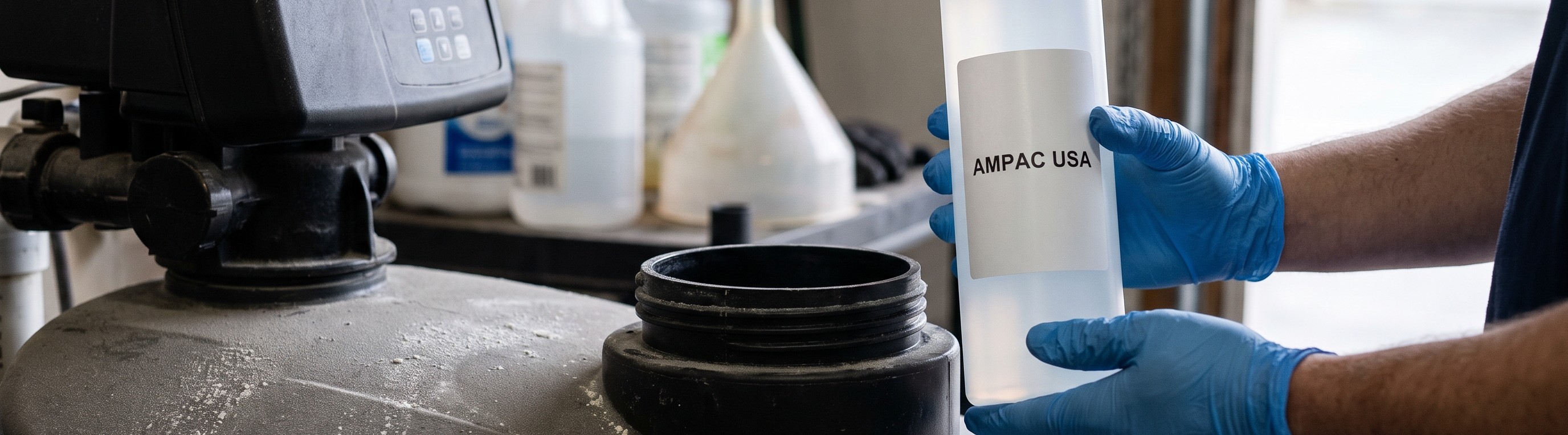
Water Softners Cleaners is built to order
These systems are engineered around your water conditions, flow rate and site, so we do not list generic units online. Request a quote and an engineer will call you to size a system for your application.
About water softners cleaners
Sizing a system? Send your flow rate and a feed-water analysis, and an AMPAC engineer will work out the configuration with you.
AMPAC USA water softeners and membrane cleaning chemicals address two critical aspects of water treatment system maintenance: preventing scale buildup caused by hard water, and restoring fouled RO membranes to near-original performance. Hard water above 7 grains per gallon (120 mg/L as CaCO3) is one of the most common causes of premature RO membrane fouling, scaling of heat exchangers, and reduced appliance efficiency in both residential and commercial systems.
Our water softener range includes ion exchange cartridges for point-of-use softening, in-line cartridge softeners for RO pre-treatment, and automatic regenerating whole-house softeners sized by daily water consumption and hardness level. Anti-scalant chemical dosing systems provide an alternative to ion exchange for commercial and industrial applications where sodium addition is undesirable.
Membrane cleaning chemicals are essential for restoring flux and rejection in fouled RO membranes. AMPAC USA stocks acid membrane cleaners (citric acid, sulfamic acid) for mineral scale removal including calcium carbonate and metal hydroxide deposits, and alkaline cleaners for biological fouling, biofilm, and organic deposits. Regular membrane cleaning extends membrane service life by 1–3 years. Contact us at (909) 548-4900 for membrane cleaning protocols and chemical selection.
Frequently Asked Questions
What types of water softener regenerant chemicals do you supply?
We supply sodium chloride (NaCl) pellets and crystals for standard cation exchange softeners, potassium chloride (KCl) pellets as a sodium-free alternative, and potassium permanganate (KMnO4) for regenerating greensand iron/manganese filters. We also stock resin cleaners to remove iron fouling and organic contamination from ion exchange resin beds.
How much sodium chloride does a water softener use per regeneration cycle?
Salt consumption depends on resin volume and regeneration efficiency. A standard 1-cubic-foot resin bed uses approximately 6-15 lbs of NaCl per regeneration cycle, depending on whether the system uses standard or high-efficiency regeneration programming. Counter-current regeneration systems can achieve the same hardness removal using 30-40% less salt than co-current systems.
When should I use potassium chloride instead of sodium chloride?
Potassium chloride is specified when softener discharge must meet low-sodium discharge limits, or when the customer prefers to avoid adding sodium to drinking water. KCl is approximately 2-3 times more expensive than NaCl and slightly less efficient per pound, but it functions identically in standard cation exchange softeners. No equipment modifications are needed to switch between NaCl and KCl in most systems.
What is potassium permanganate used for in water treatment?
Potassium permanganate is a strong oxidant used to regenerate greensand (glauconite or manganese dioxide-coated) filter media for iron and manganese removal. It reoxidizes the reduced manganese dioxide coating after the bed becomes exhausted. Typical dose for continuous-feed operation is 1-4 mg/L injected upstream of the filter. It is also used as a shock oxidant for high iron events in well water systems.
How do I know when ion exchange resin needs cleaning or replacement?
Signs that resin needs cleaning include a musty or sulfur odor in softened water, iron staining on fixtures even after softening, reduced hardness removal between regenerations, or increased pressure drop across the softener tank. Resin cleaner (iron-out or specialized resin sanitizer) can restore fouled resin. Resin that is mechanically broken, oxidized by chlorine, or severely fouled after cleaning should be replaced.
How should water softener salt be stored to prevent clumping?
Store salt in a dry, covered area away from moisture and temperature extremes. High humidity causes pellets to absorb moisture and bridge or clump inside the brine tank, which can block the salt from dissolving properly during regeneration. If clumping occurs inside the brine tank, manually break up the salt bridge before the next regeneration cycle. Pellet-grade salt resists clumping better than crystal salt in humid climates.