

Models
Need an output between two models, or a different feed water? Send us your numbers
About Solar Water Treatment & Solar Desalination Systems |...
Sizing a system? Send your flow rate and a feed-water analysis, and an AMPAC engineer will work out the configuration with you.
Diesel fuel for water treatment in remote locations costs 3 to 10 times the urban price once transport is factored in. For island communities, remote villages, and off-grid mining or agricultural operations, solar power eliminates that ongoing cost while providing a more reliable energy source than intermittent fuel deliveries.
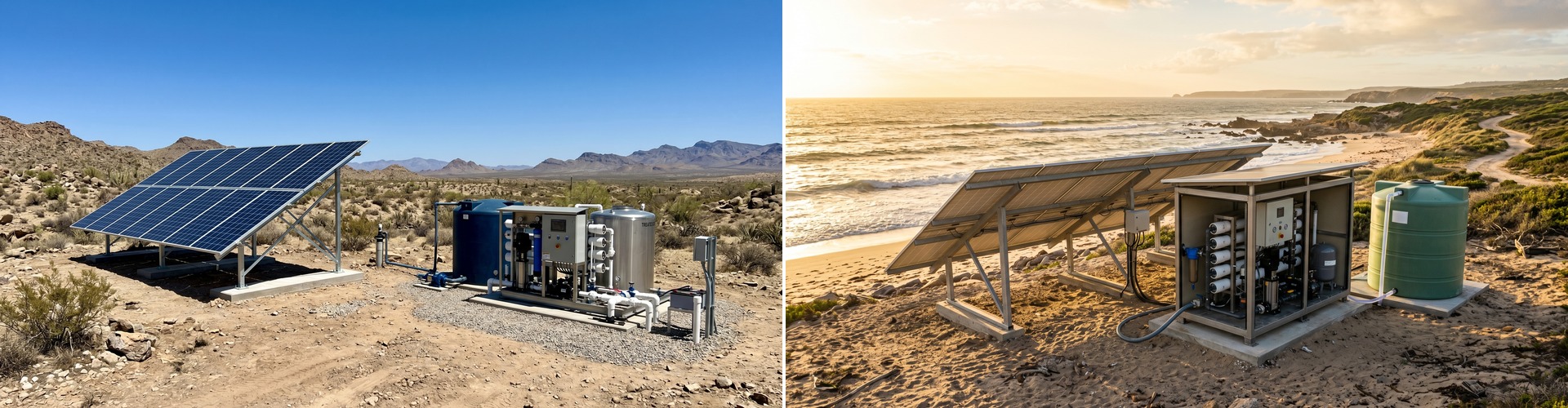
AMPAC USA's solar water treatment systems pair photovoltaic arrays with variable-frequency drive pumps that modulate RO operating pressure to match available solar power throughout the day. Systems produce treated water during daylight hours and store it in atmospheric tanks for 24-hour distribution. Battery backup options are available for sites requiring continuous production through the night.
Solar seawater desalination systems are deployed to island communities and coastal villages where brackish groundwater or seawater is the only available source. Freshwater production rates depend on solar irradiance and source water salinity - a typical 5-kilowatt array drives an AMPAC solar SWRO system producing 500 to 1,500 GPD from 35,000 ppm ocean water. Systems are containerized for shipping and require no specialized infrastructure beyond a concrete pad and a connection to the water distribution point.
The operational economics of solar water treatment improve as diesel prices increase and PV module costs decline. For a community currently purchasing diesel at a remote site premium, the payback period on a solar-powered water treatment system is typically three to seven years. After that, the cost of water production is essentially the cost of occasional membrane replacement and maintenance labor. AMPAC sizes systems conservatively to ensure adequate daily production even on overcast days and during seasonal low-irradiance periods.
Contact AMPAC USA at (909) 548-4900 to discuss solar-powered water treatment for your remote project site or community.
Frequently Asked Questions
How is an RO system powered by solar panels in a location with variable sunlight?
Solar-powered RO systems use a DC-powered high-pressure pump or an inverter-based AC pump matched to the photovoltaic array output. The system produces water when solar power is available and stores product in a tank, rather than trying to regulate pump speed to match real-time panel output. AMPAC USA solar RO systems use maximum power point tracking controllers that extract full available panel output across varying light conditions throughout the day.
What production output can a solar RO system realistically achieve per day?
A 1,000-watt solar array powering a brackish water RO system in a location with 5-6 peak sun hours produces approximately 800-1,200 gallons of purified water per day. Seawater RO systems require significantly more energy per gallon, so the same 1,000-watt array would yield 200-400 GPD from seawater feed. AMPAC USA provides site-specific production estimates based on GPS coordinates, monthly solar irradiance data, and feed water salinity.
Is battery backup necessary for a solar-powered water purification system?
Battery backup adds significant cost but is not always required if adequate product storage is provided. A community of 50 people needing 10 gallons per person per day can store 2-3 days of production in a 1,500-gallon tank, absorbing cloudy days without battery expense. Battery systems make sense when continuous pressure is required for distribution or when the community's water demand peaks at night.
How does a solar water treatment system serve a village without trained maintenance personnel?
AMPAC USA designs remote community systems with automatic membrane flushing, simple cartridge filter housings that any adult can service, and alarm outputs that can notify a remote operator by SMS when a fault occurs. Filter replacement is the most frequent maintenance task, typically every 1-3 months, and requires no tools beyond a filter housing wrench. We provide laminated pictographic maintenance guides and recommend training 2-3 community members during commissioning.
What feed water quality can a solar RO system handle in remote locations?
AMPAC USA solar RO systems are configured based on the specific water source at each project site. Brackish groundwater at 1,000-5,000 ppm TDS is the most energy-efficient source for solar RO. Surface water from rivers and ponds requires additional pre-treatment including multimedia filtration and disinfection before the RO stage, which increases system complexity and energy demand.