

Models
Need an output between two models, or a different feed water? Send us your numbers
About Electrodeionization RO-EDI
Sizing a system? Send your flow rate and a feed-water analysis, and an AMPAC engineer will work out the configuration with you.
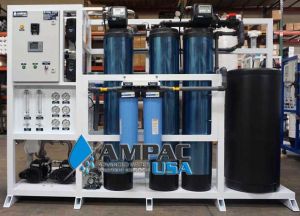
Ampac USA design and engineer customized RO and EDI for Efficient ultrapure water production, all on a single skid that is fully built and factory tested.
Ampac USA RO/EDI is customized to your specifications and is delivered, validated, and supported by the Ampac USA service team. We offer on-site service, remote online monitoring, and diagnostics, Ampac USA is always available, just a phone call away.
The purpose of electrodeionization (EDI) is to produce High Purity or Ultrapure water by removing charged ions from water that has been pre-treated by a reverse osmosis (RO) system.
EDI modules contain mixed-bed ion exchange resins which do not require a chemical regeneration step. Ions are continuously transported out of the permeate stream and into the concentrate by a DC current. Chemicals are not required for the EDI process or regeneration.
ElectroPure™ Electrodeionization EDI:
- Enables a simpler Skid Type system
- Produces ultrapure water (up to 18.2 megohm.cm)
- Eliminates regeneration chemicals and hazardous waste
- High recovery, up to 99%
- Single unit capacities ranging from 1/4 gpm to 44 gpm (60 l/hr to 10 m3/hr)
- Multiple unit arrays up to 6000 gpm (1400 m3/hr)
- Compact, durable, long-lifetime patented design.
For more Information Contact AMPAC USA EDI and RP/EDI Water! 909-548-4900
Frequently Asked Questions
What purity level does EDI produce and when is it required over standard RO?
EDI systems consistently produce 15 to 18 megohm-cm resistivity water, classified as ultrapure. Standard two-pass RO produces 1 to 10 megohm-cm, which is insufficient for semiconductor fabrication, pharmaceutical water for injection circuits, and high-pressure boiler makeup in power generation. EDI closes that gap without the chemical regeneration cycles required by conventional mixed-bed ion exchange.
How does EDI work without chemical regeneration?
EDI combines ion-exchange resin beads with ion-selective membranes in a stack energized by a low-voltage DC current. The electric current continuously regenerates the resin by driving ions out of the resin and through the membranes into a concentrate stream. This replaces the periodic acid and caustic regeneration required in traditional deionization systems, eliminating chemical handling and wastewater neutralization costs.
What feed water quality does EDI require to operate properly?
EDI performs best on RO permeate with TDS below 40 mg/L, hardness below 1 mg/L as CaCO3, carbon dioxide below 5 mg/L, and silica below 0.5 mg/L. Hardness and CO2 are the most common EDI killers: both consume resin capacity and degrade resistivity output. A well-designed two-pass RO system upstream of EDI is the standard configuration for reliable ultrapure production.
What industries use EDI systems and what are the typical flow rates?
Semiconductor fabs, pharmaceutical manufacturers, power plant water treatment, electronics cleaning operations, and analytical instrument manufacturers all rely on EDI. Flow rates range from 2 GPM for a small laboratory or biotech application to 500 GPM or more for a large semiconductor or power plant installation. EDI modules are designed to stack in parallel to reach any required flow rate.
What maintenance does an EDI system require compared to mixed-bed DI?
EDI has no scheduled chemical regeneration, which eliminates the labor, chemical costs, and wastewater treatment burden of conventional mixed-bed systems. Routine maintenance involves monitoring product resistivity and voltage/current readings, periodic sanitization of the EDI stack for pharmaceutical applications, and replacement of the stack every 5 to 10 years depending on feed water quality and operating hours.
Can an existing RO system be retrofitted with an EDI polishing stage?
Yes, in most cases. The key requirements are feed water quality from the RO system meeting EDI inlet specifications (hardness below 1 mg/L, TDS below 40 mg/L), adequate flow pressure (typically 40 to 80 PSI), and space for the EDI module and its small DC power supply. AMPAC USA can evaluate an existing RO system for EDI retrofit compatibility with a feed water analysis and system performance data.