
Models
-
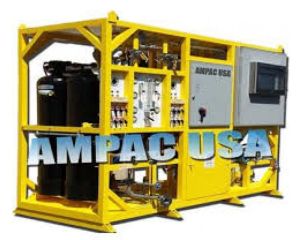
SW20K-C1D2
Off-Shore Sea Water Desalination Watermaker SW20K-Class1-Div2
The AMPAC USA Off-Shore Sea Water Desalination Watermaker SW20K-Class1-Div2 provides a critical solution for producing potable water in challenging marine environments.
View specifications -
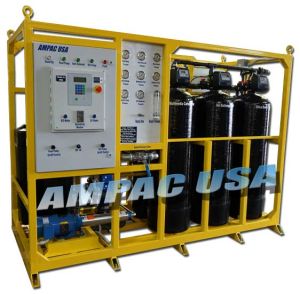
SWRO10K-C1D2
Off-Shore Sea Water Desalination Watermaker SW10K-C1D2
The AMPAC USA Off-Shore Sea Water Desalination Watermaker, model SW10K-C1D2, is a fully automated reverse osmosis system designed for critical marine and offshore environments.
View specifications
Need an output between two models, or a different feed water? Send us your numbers
About Fresh Watermaker| OffShore Seawater Desalination Watermakers
Sizing a system? Send your flow rate and a feed-water analysis, and an AMPAC engineer will work out the configuration with you.
Purified water is the basic need for life which can be required anywhere-on road, at home or even at offshore platform. Water can be anywhere, but there is no assurance that every drop of water available is purified. Also consumption of contaminated or polluted water can lead to many life threatening diseases. This calls for some water purification system that can be used for offshore purposes as well. Off-shore watermakers solve this problem and can be used anywhere.
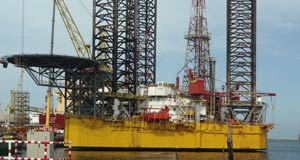 The AMPAC USA Offshore Watermakers is a horizontal one-piece frame configuration designed for oil & gas, wind farm and other offshore industrial operations, with internal high pressure booster pump for ease of use in compact locations. With their ready to use the equipment, AMPAC USA has proved to be a reliable partner for many offshore operations. The products that are manufactured for offshore use, combine all benefits of high-end technology of water purification systems for a highly efficient offshore water purification experience.
All the Oil and Gas RO products are engineered by experienced workers through highly competent workmanship. All components within the frame are readily accessible for easy maintenance. They can be used for simple sweater desalination processes or even for high demanding industrial seawater desalination purposes as well. Our products make use of membranes and pump to produce highly purified and ready to consume water from any seawater source.
The AMPAC USA Offshore Seawater Desalination Watermakers can be configured to explosion-proof Class 1 Div 1 & Class 1 Div 2 standards, adding protection from potentially catastrophic events. Offshore Seawater Desalination Watermakers by AMPAC USA are best for oil and gas applications.
To buy Oil and Gas RO Offshore Watermakers, Call 909-548-4900. Offshore Seawater Desalination Watermakers by AMPAC USA are best for oil and gas applications or fill our contact form to enable our executives to serve you better.
Frequently Asked Questions
What makes offshore oil platform watermakers different from standard commercial RO systems?
Offshore systems face four challenges that onshore units do not: continuous 24/7 runtime with no scheduled shutdowns, high-salinity seawater feed at varying temperatures, space constraints on deck and within hull compartments, and classified hazardous area zones requiring ATEX-rated electrical components. Every design decision, from pump selection to control panel location, accounts for these factors.
What salt rejection performance can we expect in offshore seawater conditions?
AMPAC USA offshore systems use high-rejection spiral-wound membranes rated at 99.6% NaCl rejection at standard test conditions. In real offshore seawater at 32,000 to 38,000 TDS, product water TDS is consistently below 400 mg/L. Operating pressure runs 800 to 1,000 PSI depending on feed temperature and salinity.
Are your offshore watermakers ATEX certified for use near flammable gas areas?
ATEX Zone 1 and Zone 2 configurations are available. Motors, control panels, and junction boxes are sourced from certified ATEX suppliers and assembled under IEC Ex documentation requirements. AMPAC USA provides the full ATEX technical file for offshore safety case submissions and facility hazardous area classification reviews.
What capacity range covers typical offshore platform requirements?
Platform crew sizes and operational water needs vary widely. Supply vessels typically need 500 to 2,000 GPD. Drilling rigs and production platforms with crews of 50 to 200 require 5,000 to 30,000 GPD. FPSOs with larger crews and process water demands go up to 100,000 GPD or more, often using multiple parallel skid trains for redundancy.
How is the system footprint minimized for space-constrained offshore decks?
Skid dimensions are optimized around vessel and platform structural bay spacing, typically 1.2 to 2.4 meter module widths. Vertical membrane vessel orientation reduces floor space versus horizontal arrays. All piping and electrical connections are top-entry where possible, allowing the skid base to sit flush against a bulkhead. CAD drawings are supplied for structural load review.
What maintenance intervals should offshore operators plan for?
Membrane cleaning cycles using CIP (clean-in-place) circuits are typically scheduled every 30 to 90 days depending on feed water biofouling load. Cartridge pre-filters change every 500 to 1,000 operating hours. High-pressure pump seals are rated for 8,000 hours. Annual membrane performance testing determines replacement timing, usually 3 to 5 years in offshore service.