

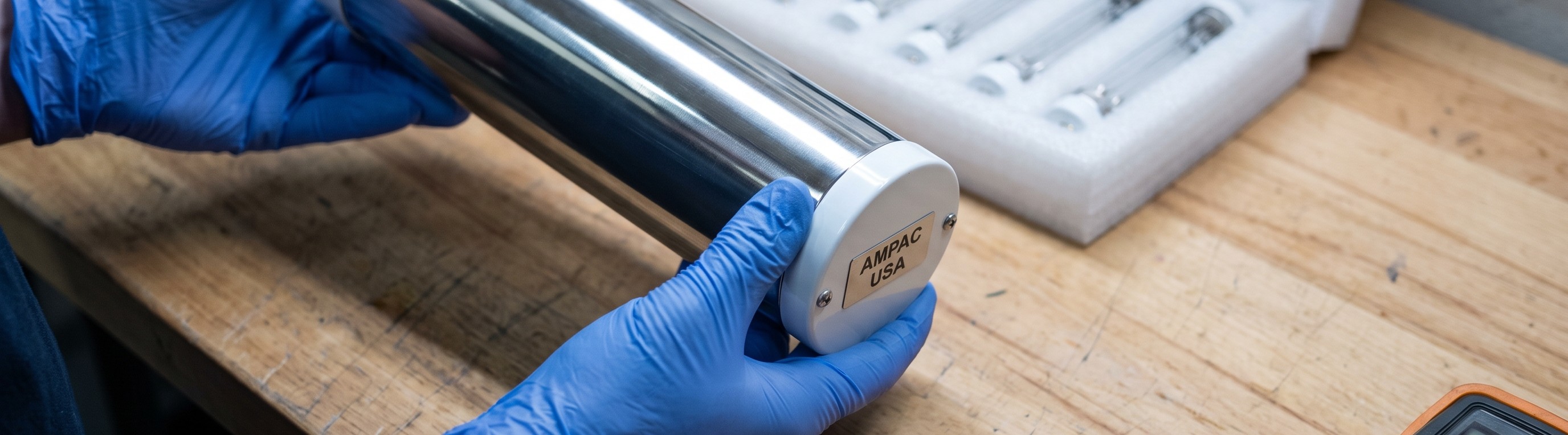
Industrial Ultra Violet Sterilizers is built to order
These systems are engineered around your water conditions, flow rate and site, so we do not list generic units online. Request a quote and an engineer will call you to size a system for your application.
About Industrial UV Sterilizers
Sizing a system? Send your flow rate and a feed-water analysis, and an AMPAC engineer will work out the configuration with you.
See our dedicated industrial UV sterilizers page for dose ratings, flow rates, and certification details.
Industrial UV Sterilization: Disinfection Guide
Reverse osmosis membranes reject most microorganisms, but not all of them slip past a fine pore size. Some bacteria and viruses are small enough, or resilient enough, to make it through. That's the gap UV sterilization closes. AMPAC USA engineers ultraviolet disinfection stages into commercial and industrial reverse osmosis systems, giving you a second, chemical-free barrier against bacteria, viruses, and cysts before water reaches your process or point of use.
How UV Sterilization Works
A UV sterilizer runs water past a germicidal lamp emitting light at roughly 254 nanometers (the UV-C band, the same range used in hospital sterilization rooms). That wavelength damages the DNA and RNA of microorganisms so they can't replicate. No chlorine. No chemical residual. No byproducts to manage downstream. NSF/ANSI 55 sets the bar for Class A disinfection at a minimum UV dose of 30,000 microwatt-seconds per square centimeter, and that's the standard AMPAC designs against for potable and process water applications.
UV Disinfection vs. Chemical Disinfection
| Parameter | UV Sterilization | Chlorine / Chemical |
|---|---|---|
| Chemical residual | None | Yes, requires dosing control |
| Taste and odor impact | None | Can affect taste |
| Effective against | Bacteria, viruses, cysts, protozoa | Bacteria, limited on cysts |
| Contact time | Seconds, inline | Minutes, requires holding tank |
| Operating cost driver | Lamp replacement (annual) | Ongoing chemical supply |
Where UV Sterilization Fits in Your System
Placement matters. AMPAC typically installs UV disinfection after the RO permeate stage or at the point of distribution, wherever water is most likely to pick up biological contamination before it's used. Common applications:
- Boiler feedwater: polishes RO permeate to control biological fouling before it reaches high-pressure boiler loops
- Food and beverage processing: adds a non-chemical microbial barrier ahead of product-contact water, supporting FDA CFR 21 water quality requirements
- Pharmaceutical and laboratory water: paired with multi-stage RO for microbiologically controlled purified water
- Point-of-use and distribution loops: guards against bacterial regrowth in storage tanks and long runs of pipe
Right now, our combined 6-stage reverse osmosis and UV sterilizer system (APRO6-UV) is a working example of this pairing in a packaged unit. For larger commercial and industrial builds, UV is specified and sized alongside the RO train itself, not bolted on as an afterthought.
How AMPAC Builds UV-Integrated Systems
Every industrial system starts with your feedwater chemistry. We size the RO membranes, the pre-treatment, and the UV dose together, so the UV stage is matched to the actual flow rate and water quality it needs to handle, not a generic off-the-shelf number. Systems are documented with a full O&M manual and startup support, same as the rest of AMPAC's industrial RO line.
Have a specific microbial concern, a spec sheet to match, or just want to know if UV makes sense for your application? Request a quote and send us your water analysis. Or call our engineering team direct at (909) 762-8020, and we'll tell you straight whether UV is the right call for your system.
See our full industrial UV sterilizers guide for sizing and NSF/ANSI 55 dose ratings.
Frequently Asked Questions
What UV wavelength is used for water disinfection and why?
Germicidal UV systems operate at 254 nm, which corresponds to the peak absorption wavelength of DNA and RNA in microorganisms. At this wavelength, UV radiation disrupts nucleic acid bonds, preventing bacterial and viral reproduction without adding chemicals to the water. Low-pressure mercury lamps deliver monochromatic 254 nm output with the highest germicidal efficiency per watt.
What flow rates do your industrial UV sterilizers cover?
Our industrial UV units range from 10 GPM for small commercial systems up to 500 GPM for large municipal or industrial treatment plants. Units are selected based on target UV dose (typically 40 mJ/cm2 minimum for NSF 55 Class A certification), water UV transmittance, and peak flow rate. Undersizing a UV system results in inadequate dose delivery and failed disinfection.
What is NSF 55 Class A certification and do I need it?
NSF/ANSI 55 Class A certifies that a UV system delivers a minimum 40 mJ/cm2 dose, sufficient to inactivate bacteria and viruses in drinking water applications. Class A is required for potable water treatment where UV is the primary disinfectant barrier. For pre-membrane biological control where additional treatment follows, Class B (16 mJ/cm2) may be acceptable depending on your regulatory framework.
Where should UV sterilizers be placed in a water treatment system?
UV is typically installed in two positions: pre-membrane to control biological growth on RO membranes, and post-RO for final disinfection before distribution. Post-RO UV is especially important because RO permeate has very low UV absorbance, maximizing germicidal efficiency. For chloramine removal before RO membranes, UV at 185 nm (medium-pressure lamps) is used rather than 254 nm germicidal units.
How often do UV lamps need to be replaced?
Low-pressure germicidal lamps lose approximately 30-40% of their initial UV output over 9,000-12,000 hours of operation. Most manufacturers recommend annual lamp replacement, regardless of whether the lamp is still illuminated. Running a degraded lamp results in insufficient dose delivery. Our systems include a UV intensity sensor with an alarm output when intensity drops below the minimum threshold.
Do stainless steel UV chambers require any special maintenance?
The quartz sleeve surrounding the UV lamp should be inspected and cleaned quarterly using a damp cloth or mild acid solution to remove mineral deposits, which absorb UV and reduce dose delivery. Full chamber cleaning is recommended annually. Stainless steel construction (304 or 316) resists corrosion and is easy to clean, but sleeve fouling in hard water areas is the most common cause of underperformance.