

Models
Need an output between two models, or a different feed water? Send us your numbers
About Type 1, 2, 3 Lab Water or laboratory
Sizing a system? Send your flow rate and a feed-water analysis, and an AMPAC engineer will work out the configuration with you.
AMPAC USA offers a complete line of Ultra pure water purification systems, our systems are high quality reverse osmosis systems, yet economical and effective. These RO/DI systems are designed for optimal performance and are the most advanced and effective technology in high purity drinking water systems. These RO/DI systems are standard and custom for the biotechnology and institutional markets. Ampac USA design and fabricate advanced standardized high purity water treatment systems that are easy to customize and quick turnaround time, including industries in the area of electronics components.
AMPAC USA, supplies standard point of use ultra pure water purification systems for medical applications. Ultra pure water treatment is one part of our company's mission to improve the quality of water supplies, we offer Type 1, 2 and 3 Water Purification and Water Treatment Systems for a wide range of industries, including electronics design. We offer a complete line of High Purity Reverse Osmosis Water Treatment Systems, Reverse Osmosis Water Purification Systems, Seawater Desalination, Watermakers, Water Filtration, Water Purification Equipment, including Oil Separation, Frac Water Treatment and Waste Water Treatment Systems with quality accessories that are custom-fabricated, designed and manufactured to suit a variety of industrial water treatment requirements. We are noted for our strong technical services instrumentation, bio-pharmaceutical filtration.
AMPAC USA, offer competitive prices and a focus on customer satisfaction in water treatment. We are here to assist with all of your specific customized applications. Our customers appreciate the care we take in bringing clean water to you. Contact AMPAC USA for more information on our toll-free at 877-611-8530.
Frequently Asked Questions
What are the three ASTM water grades and what is each used for in a laboratory?
Type 3 (ASTM D1193 Grade D, resistivity above 1 megohm-cm) handles glassware rinsing, autoclaving, and general washing where trace contamination is not critical. Type 2 (resistivity 1 to 10 megohm-cm, TOC below 50 ppb) covers buffer preparation, spectrophotometry, and general analytical chemistry. Type 1 (18.2 megohm-cm, TOC below 10 ppb) is used for trace analysis, cell culture, and HPLC work where background contamination invalidates results.
How does a single system produce all three water grades?
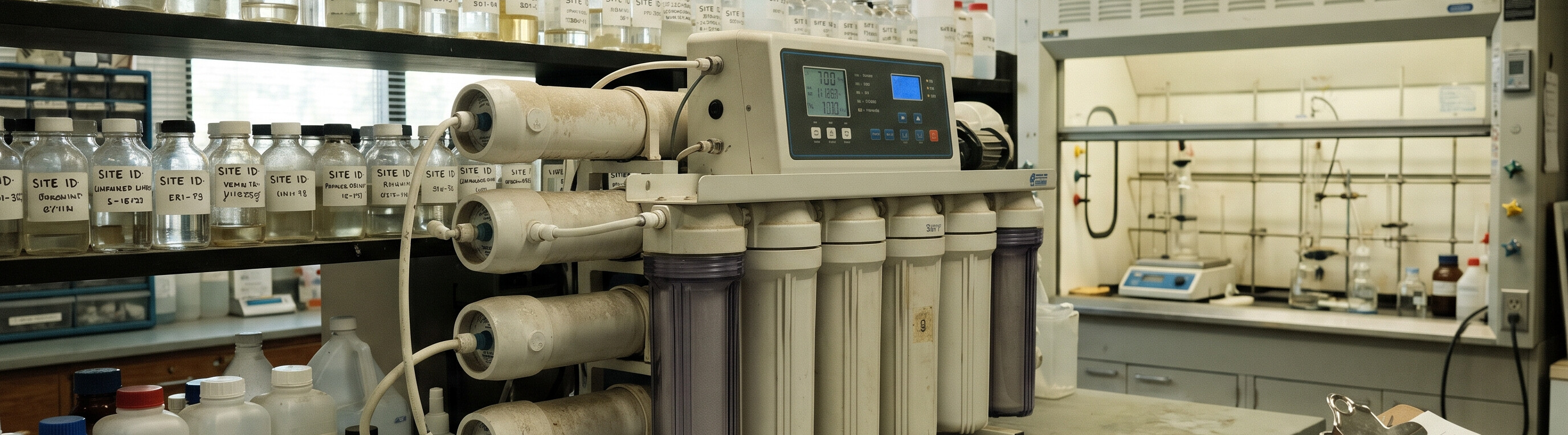
The core purification train, typically RO plus EDI or mixed-bed polishing, produces Type 1 water continuously. Type 2 water is drawn from a tap downstream of RO but upstream of the polishing stage. Type 3 water is produced directly by the RO unit itself before polishing. Modular polishing cartridges can be switched in and out to shift output quality. This architecture eliminates the cost of running separate systems for each grade.
What daily volume of each water grade does a typical mid-size research laboratory use?
A typical research lab with 10 to 20 bench scientists uses 50 to 150 liters of Type 3 per day for washing and autoclaving, 20 to 50 liters of Type 2 for buffers and reagents, and 5 to 20 liters of Type 1 for critical analytical applications. AMPAC USA systems are sized to these usage profiles, with storage tanks for Type 3 and Type 2, and point-of-use on-demand production for Type 1.
How are the three grades dispensed without cross-contamination?
Each grade has a dedicated dispensing tap or outlet. Type 1 dispenses on demand through a polishing cartridge immediately upstream of the tap, so only a minimal volume of water is in contact with the polishing resin at any time. Type 2 and Type 3 dispense from dedicated storage tanks with separate fill lines. Tanks are sealed and made of HDPE or polypropylene to minimize leaching.
What happens to system performance if feed water quality changes seasonally?
Municipal feed water TDS and temperature vary seasonally, affecting RO output quality and cartridge consumption rates. AMPAC USA multi-grade systems include inlet conductivity monitoring that alerts users to significant feed water changes. The RO stage handles most of the variation; polishing cartridge life may shorten in periods of high feed TDS or warm water when RO rejection efficiency dips slightly. Quarterly feed water testing is recommended.
What is the footprint and installation requirement for a combined Type 1/2/3 laboratory water system?
Combined systems for a 10 to 20 person lab typically consist of a wall-mounted RO and polishing unit occupying 24 by 12 by 48 inches, connected to one or two under-bench storage tanks of 20 to 50 liters each. Feed water connects to a standard 3/8-inch lab cold water line. Electrical connection is 120V standard outlet. Installation by a plumber familiar with laboratory water systems takes 4 to 6 hours.