

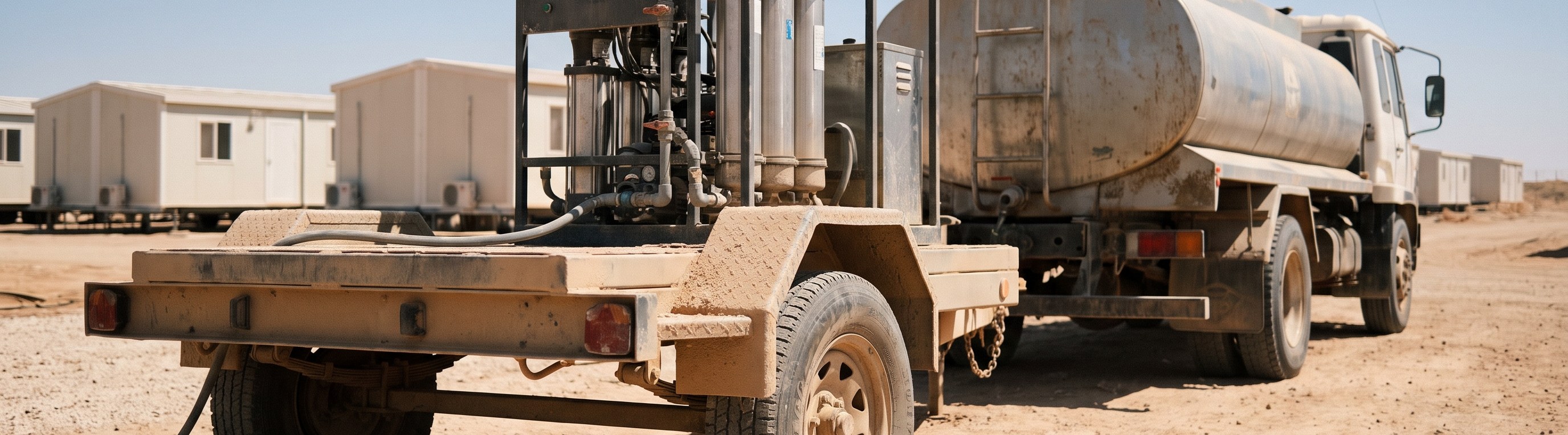
Models
-
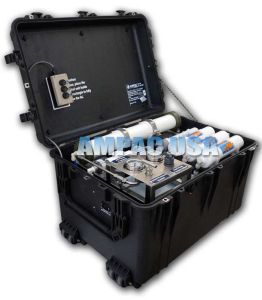
SW150
Portable Emergency Seawater Desalination Watermaker
150 GPD 560 LPD
View specifications -
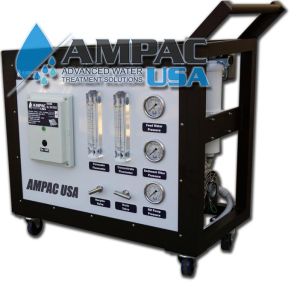
TR-300
Mobile Reverse Osmosis
300 GPD TR-300
View specifications -
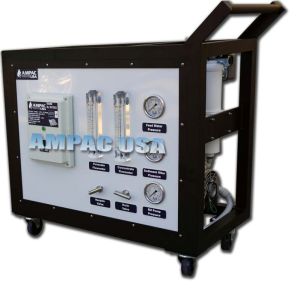
TR-500
Mobile Reverse Osmosis
500 GPD TR-500
View specifications -
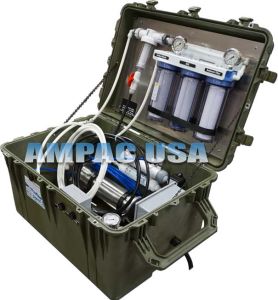
EP-500
Emergency Portable Brackish Water Reverse Osmosis
500 GPD EP-500
View specifications -
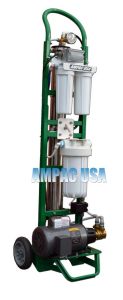
TR-1500
Mobile Reverse Osmosis
1,500 GPD TR-1500
View specifications -
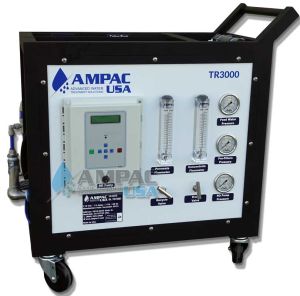
PCRO-3000
Portable Reverse Osmosis
3,000 GPD PCRO-3000
View specifications -
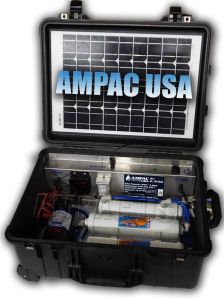
JB-1
Portable Water Filtration System
Solar Power Water Filter
View specifications
Need an output between two models, or a different feed water? Send us your numbers
About Portable Reverse Osmosis System
Sizing a system? Send your flow rate and a feed-water analysis, and an AMPAC engineer will work out the configuration with you.
Last updated: July 15, 2026
More than 2.2 billion people worldwide lack access to safely managed drinking water, and disasters, military deployments, and remote job sites all share the same root problem: no fixed water infrastructure (WHO/UNICEF Joint Monitoring Programme, 2023). Portable water filtration systems solve this by bringing full treatment capacity, not just filtration, directly to the point of need.
Emergency response guidelines set a minimum of 15 liters of water per person per day for drinking, cooking, and basic hygiene (Sphere Association, Minimum Standards in Water Supply, 2018). For a shelter housing 1,000 people, that works out to roughly 3,950 gallons per day – well within range of a single mid-capacity portable unit.
| Capacity (GPD) | Power Source Options | Typical Use Case |
|---|---|---|
| 50 - 500 GPD | Solar panel + battery, 12V DC | Off-grid homes, remote research camps, small farms |
| 500 - 5,000 GPD | Solar/battery hybrid, small diesel generator | Disaster relief shelters, refugee camps, small community water points |
| 5,000 - 15,000 GPD | Diesel generator, grid-tie, solar array | Military field operations, forward operating bases, large event sites |
| 15,000+ GPD | Grid power, generator bank, hybrid solar array | Municipal emergency backup, large-scale disaster response, temporary community systems |
Ranges reflect typical portable water treatment system categories across the industry; exact output depends on source water quality, membrane type, and pretreatment stage.
AMPAC USA designs and manufactures portable reverse osmosis systems, water purification units, and compact reverse osmosis filters for use in any environment. Whether you need a portable RO unit for camping, emergency preparedness, or off-grid living, our systems deliver safe, clean water from virtually any water source.
Our portable reverse osmosis water filtration systems are available in a wide range of flow rates and configurations, including:
- Portable reverse osmosis systems for salt water and brackish water desalination
- Portable reverse osmosis system camping and field-deployable units
- Emergency water filtration systems (portable) for disaster relief and military use
- Handheld reverse osmosis water filter and compact countertop RO system options
- Stand alone reverse osmosis water filter units for remote sites
Each portable water purifying machine is built to handle variable water pressure and diverse water sources - from rivers and lakes to sea water and brackish groundwater. Our systems include high-rejection RO membranes, pre-filtration stages, and ruggedized housings for field use.
AMPAC USA has been engineering advanced water treatment solutions for over 30 years. Our portable RO units and best portable reverse osmosis water filter systems are trusted by military, humanitarian, and commercial operators worldwide. Contact us for specifications, pricing, and custom configurations.
AMPAC USA portable reverse osmosis systems are engineered for field deployment, emergency response, camping, and off-grid applications. Each portable RO unit purifies water from diverse water sources including rivers, lakes, brackish wells, and tap water supplies by forcing water through a high-rejection RO membrane under water pressure. Our systems include a multi-stage reverse osmosis filter array - sediment pre-filter, carbon block, RO membrane, and post-filter stages.
Unlike a countertop RO system designed for home use, our field-portable units are ruggedized for transport and rapid deployment. Browse our complete line of portable reverse osmosis water filtration systems and portable RO unit configurations, or contact AMPAC USA to spec the right system for your application.
AMPAC USA offers the most comprehensive range of portable reverse osmosis systems for any application. Our portable ro unit and portable reverse osmosis filter system solutions are engineered for high-performance water treatment from virtually any water sources - rivers, lakes, brackish water, and even saltwater (portable reverse osmosis system for salt water). Each portable reverse osmosis water filter system includes a high-rejection membrane, pre-filters, and a countertop ro system or skid-mounted option for easy deployment. Our portable reverse osmosis machine and portable reverse osmosis unit designs maintain optimal water pressure for consistent output regardless of feed conditions. Whether you need a handheld reverse osmosis water filter, a compact portable reverse osmosis system camping unit, or a large stand alone reverse osmosis water filter for emergency use, AMPAC USA has the right portable reverse osmosis filter solution. A reliable reverse osmosis filter for portable use is essential for emergency preparedness - our emergency water filtration system portable units are trusted by first responders and relief organizations worldwide.
For larger trailer-mounted builds see mobile water treatment systems. For defence deployments see military seawater desalination.
Frequently Asked Questions
How to Choose a Portable Water Filtration System
Seven models, three power options, and a GPD range that spans 300 to 3,000. Picking the wrong one means you're either hauling a unit that can't keep up with your crew or paying for capacity you'll never use. Here's how to narrow it down.
Start with flow rate, not the model name
Work backward from headcount. A five-person field team drinking and cooking needs roughly 15-25 gallons a day; a 300 GPD unit covers that with room to spare. A disaster relief shelter housing 200 people needs 2,000+ GPD once you add hygiene and cooking water into the math. Don't size for average demand. Size for peak demand, because a portable filtration system that's undersized on day three of a deployment is a system that fails when it matters most.
One thing people miss: rated GPD assumes clean feed water. Run a 500 GPD unit on turbid river water and actual output drops, sometimes by half, because the system spends more cycles backwashing and less time producing permeate. If your source water is consistently muddy, size up.
RO vs. carbon vs. UV: what each one actually removes
These aren't competing technologies. They're layers, and most AMPAC portable units already stack two or three of them.
- Carbon block pre-filtration pulls chlorine, sediment, and organic compounds that would otherwise clog or foul a downstream membrane. It doesn't touch dissolved salts or most pathogens on its own.
- Reverse osmosis is the workhorse for anything with dissolved solids in it: brackish groundwater, seawater, agricultural runoff with fertilizer residue. It forces water through a semi-permeable membrane under pressure, rejecting salts, heavy metals, and most microorganisms in one pass.
- UV disinfection handles what a membrane pore size might let slip through: bacteria and viruses. It's a chemical-free finishing step, not a standalone treatment, since UV does nothing for turbidity or dissolved solids.
Bottom line: if the water source is fresh and relatively clear, carbon plus UV might be enough. Anything brackish, saline, or unpredictable calls for RO as the core stage. That's also the deciding factor between a countertop-style portable unit and one of our seawater desalination watermakers.
Power source: match it to where the system actually lives
This is where a lot of buyers get burned by spec sheets that assume grid power.
- Grid or generator-fed electric. Standard on most of our TR-series mobile RO units (TR-300, TR-500, TR-1500) and the PCRO-3000. Reliable, consistent pressure, no run-time limits as long as fuel or utility power holds.
- Solar with battery backup. The right call for genuinely off-grid sites: remote wells, agricultural operations without utility access, disaster zones where the grid is down. Our Solar Power Water Filter is built around this, and it pairs with our broader solar water treatment line if you need higher-capacity solar-driven output.
- Manual or hand-pump. The fallback tier for emergency kits and backpack-carried units where batteries and fuel aren't guaranteed. Lower output (think gallons per hour, not per day), but it works when nothing else does.
Solar sounds like the obvious answer until you actually run the numbers on cloudy-day output and battery bank size for your target GPD. Talk to us before you spec a solar system for a use case that really needs consistent high-volume production.
Match the system to the mission
Disaster relief and emergency response usually call for fast deployment and simple operation over raw capacity. Someone with minimal training needs to get the EP-500 or TR-500 running within an hour of arrival. Military and expeditionary use pushes toward our ROWPU-class systems and hardened configurations built for military and government procurement standards. Remote site and off-grid living work leans on solar or generator-backed units sized for sustained daily use, not just a single deployment. Agricultural operations treating brackish well water for irrigation or livestock typically need the higher end of the GPD range (the PCRO-3000 or above), run continuously rather than intermittently.
If what you actually need is a permanent, building-mounted system instead of something field-deployable, our residential and whole-house RO systems are the better fit. No point paying for ruggedized, transportable housing you'll never move.
AMPAC Portable System Comparison
| Model | Output (GPD) | Water Source | Power Source | Best For |
|---|---|---|---|---|
| TR-300 | 300 GPD | Fresh / lightly contaminated | Grid / generator electric | Small teams, drought relief |
| TR-500 | 500 GPD | Fresh / lightly contaminated | Grid / generator electric | Emergency response, mid-size crews |
| EP-500 | 500 GPD | Brackish | Grid / generator electric | Brackish wells, disaster relief |
| Solar Power Water Filter | ~1 GPM (solar-dependent) | Fresh / brackish | Solar + battery backup | Off-grid sites, remote living |
| Seawater Watermaker 150 GPD | 150 GPD / 560 LPD | Seawater | Grid / generator electric | Coastal and marine deployment |
| TR-1500 | 1,500 GPD | Fresh / lightly contaminated | Grid / generator electric | Larger shelters, wash-down use |
| PCRO-3000 | 3,000 GPD | Fresh / brackish | Grid / generator electric | High-volume emergency and agricultural use |
Need trailer-mounted output above 3,000 GPD, or a system that stays parked on-site for weeks at a time? Look at our mobile water treatment systems and mobile water provisioning systems instead. Same underlying RO technology, built for semi-permanent placement rather than carry-and-deploy.
What is a portable water purification system and how small is it?
Portable water purification systems are man-carry units designed for individual soldiers, small military teams, expedition groups, or field researchers. Units range from backpack-mounted systems weighing 15-35 lbs to hard-sided carry cases. They produce 50-500 GPD depending on model, sufficient for 5-50 people at basic hydration needs. Smaller gravity-fed units in soft-pack form weigh as little as 3-5 lbs.
What treatment technologies are used in portable systems?
Portable systems combine multiple barriers depending on size. Larger carry-case systems use hollow-fiber ultrafiltration or RO membranes plus UV disinfection. Smaller backpack units may use gravity hollow-fiber filtration with a chemical disinfection option. Military-grade units typically include RO for chemical and biological threat water treatment. All systems remove bacteria, protozoa, and most viruses to drinking water standards.
Can portable RO systems treat seawater or just fresh water?
Some of our portable systems include high-pressure hand or electric pumps capable of treating brackish water and seawater. However, seawater operation requires significantly more energy input, which limits battery-powered run time. Hand-pump seawater RO units are available for emergency survival use but produce lower daily volumes (2-10 gallons per hour of pumping) compared to brackish or freshwater operation.
What source water turbidity can portable systems handle?
Most portable systems include a sediment pre-filter (typically 5-25 micron) to extend membrane life. They perform best on source water below 10 NTU turbidity. Highly turbid river water or flood water above 50 NTU requires pre-settling or coagulation to protect membranes and filters. Several military-grade units include an in-line coagulant tablet dispenser for treating highly turbid surface water in the field.
How long do filters and membranes last in portable systems?
Hollow-fiber UF membranes in portable systems typically last 1-3 years under field conditions or process 100,000-200,000 gallons before replacement is needed. RO membranes in portable units last 1-2 years depending on source water quality and frequency of backwashing. Pre-filter cartridges may need replacement every few weeks in turbid water. All consumable parts are designed to be field-replaceable without tools.
Are portable water purification systems approved for military use?
Several of our portable systems meet or exceed NSF 58 standards for RO performance and NSF 55 Class A for UV disinfection. Military-specific configurations have been supplied through US Army, USMC, and allied nation procurement channels. We can provide units configured to specific military specifications including CARC exterior coating, 12/24V DC power compatibility, and desert/arctic temperature ratings. Contact us for GSA schedule pricing.
Can a portable water filtration system run completely off-grid, and for how long?
Yes, with the right power setup. Our solar-battery configurations are designed for indefinite off-grid operation as long as there's enough sun and battery capacity to match your daily GPD target. There's no fuel to run out of, which is the whole point. Generator-backed units run as long as fuel supply allows, typically sized for 8-12 hour daily duty cycles in field deployments. Hand-pump emergency units have no power dependency at all, but output drops to a few gallons per hour of active pumping. The honest answer on run time: it's not really about the filtration system, it's about your power source. Size the battery bank or fuel reserve to the mission length, not just the unit's rated capacity.
What's the difference between a portable system and a mobile trailer-mounted system?
Portable units are built to be carried, hand-trucked, or airlifted into a site and running within an hour. Think backpack cases up through skid-mounted units like the TR-500 or PCRO-3000. Mobile trailer-mounted systems are the next tier up: full RO trains built onto a trailer chassis for sites that need continuous operation over days or weeks and don't need to move again once parked. If you're setting up a temporary camp or disaster shelter that'll operate for more than a few days, a trailer-mounted system usually beats running a portable unit around the clock. It's built for that duty cycle; a portable unit isn't. For truly rapid single-deployment response, portable wins every time. Not sure which tier fits your timeline and site duration? That's exactly what our team sorts out on a spec call.
Can a portable reverse osmosis system be used for camping?
Yes. Portable reverse osmosis system camping models are built into rugged, weather-sealed cases, run on 12V/DC or hand-pump power, and treat lake, river, or other natural water sources down to safe drinking quality — ideal for backcountry trips where a fixed water source isn't available.
What is a handheld reverse osmosis water filter used for?
A handheld reverse osmosis water filter is a compact, single-person unit for emergency kits, bug-out bags, and field medical use. It trades output volume for portability, typically producing enough drinking water for one to two people per day from questionable source water.
Do you offer an emergency portable water filtration system?
Yes. AMPAC USA's emergency portable water filtration systems are designed for disaster response, military deployment, and off-grid emergencies, producing potable water from compromised municipal supplies, wells, or surface water within minutes of setup.
Can a portable reverse osmosis system treat salt water?
Standard portable reverse osmosis units are built for fresh or brackish water sources and are not rated for full-strength seawater. For a portable reverse osmosis system for salt water or marine use, see AMPAC USA's seawater desalination systems, which use higher-pressure membranes designed specifically for ocean-salinity feed water.
How does a portable RO unit compare to a countertop RO system?
A portable RO unit is built for mobility — battery or hand-pump operation, rugged housing, and use with untreated water sources — while a countertop reverse osmosis filter connects to a home faucet and municipal water pressure. Choose portable for field, camping, or emergency use; choose countertop for stationary home or office use.