
When a flood, hurricane, earthquake, or wildfire hits, most people worry about power and shelter first. But there’s one critical system that quietly decides whether life goes on smoothly or turns into chaos: water infrastructure.
And here’s the good news- with the right industrial reverse osmosis, seawater desalination, and commercial reverse osmosis solutions from AMPAC USA, you can protect your water supply when everything else feels uncertain.
What Happens to Water Infrastructure During Natural Disasters?
Natural disasters don’t just make things messy on the surface. They get into pipes, pumps, treatment plants, and distribution networks, the core of your water system.
How floods damage pipes, pumps, and reservoirs?
Floods are brutal on water infrastructure because they:
-
t
- Overwhelm intakes and reservoirs with mud, sewage, and chemicals.
- Break or shift pipelines due to soil erosion or pressure changes.
- Submerge pumps and electrical panels, leading to shutdowns or permanent damage.
t
t
Even if water is still “running,” it may be contaminated and completely unsafe to drink or use for production.
Read more: About Water Treatment Chemicals
How earthquakes, storms, and fires disrupt treatment plants?
-
t
- Earthquakes can crack tanks, break lines, and misalign equipment, making basic treatment impossible.
- Hurricanes and severe storms can knock out power, destroy control panels, and contaminate surface water sources.
- Wildfires lead to ash-filled watersheds and toxic runoff that traditional systems struggle to handle.
t
t
In all these situations, a fast, robust emergency water purification solution becomes the difference between operational continuity and total shutdown.
Why Reliable Water Matters More Than Ever in Emergencies
Health, hygiene, and business continuity risks
In a disaster, unsafe water isn’t “just an inconvenience.” It can:
-
t
- Spread disease through drinking, cooking, and washing.
- Shut down hospitals, factories, hotels, and food facilities.
- Paralyze entire communities that depend on a single treatment plant or municipal source.
t
t
The hidden cost of water downtime
-
t
- A plant that can’t run its process water? Lost production.
- A hotel that can’t provide safe water? Lost guests.
- A municipality without safe drinking water? Public outrage and long-term reputational damage.
t
t
This is why organizations turn to AMPAC USA emergency RO systems – to keep water quality stable even when everything around them is unstable.
Read more about: Does an RO System Remove Lead?
Natural Disasters and Water Infrastructure: Emergency Reverse Osmosis Solutions
When your usual supply is compromised, Emergency Reverse Osmosis Solutions by AMPAC USA can step in as a rapid-response shield for your water infrastructure.
These systems:
-
t
- Take in contaminated feedwater (surface, well, or even brackish sources).
- Remove salts, pathogens, heavy metals, and many chemical pollutants.
- Produce clean, safe water that meets strict quality standards.
t
t
Instead of waiting for the grid or municipal system to recover, you take control of your own water security.
Disaster Proof Water Infrastructure with Emergency Water Treatment Systems
So, how do you make your water infrastructure more “disaster-proof”? You don’t rely on a single point of failure.
Mobile, modular, and fast-deploy RO systems
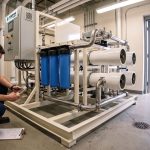
AMPAC USA emergency RO units can be:
-
t
- Mobile – mounted on trailers, skids, or containers.
- Modular – scaled up or down depending on the size of your facility or community.
- Quick to deploy – connect feedwater, power, and storage, and you’re on your way.
t
t
Integrating backup power and storage for resilience
Pairing these systems with:
-
t
- Backup generators or solar power, and
- Clean-water storage tanks,
t
creates a complete emergency water treatment ecosystem that can operate independently of damaged city systems.
Read more about Does Reverse Osmosis Remove Coliform Bacteria?
How Do AMPAC USA RO Systems Protect Different Water Sources?
Different disasters affect different water sources – and AMPAC USA systems are designed to handle that variety.
From brackish to seawater: flexible treatment capabilities
Whether your feedwater is:
-
t
- Brackish well water contaminated after flooding,
- River or lake water polluted by runoff, or
- Ocean water when everything inland is compromised,
t
t
AMPAC USA solutions can integrate industrial reverse osmosis or seawater desalination technology to turn it into reliable, high-quality water.
Why redundancy in treatment saves you during crises
By adding a dedicated RO system as a secondary or emergency line, you gain:
-
t
- A backup treatment barrier when the primary line is down.
- Flexibility to switch water sources without compromising quality.
- Confidence that even in a worst-case scenario, you’re not starting from zero.
t
t
How Industrial Reverse Osmosis Keeps Critical Operations Running
Industrial facilities don’t just need “some water.” They need consistent quality and reliable volume.
Protecting factories, hospitals, and utilities
Industrial reverse osmosis systems from AMPAC USA help:
-
t
- Hospitals keep sterilization, dialysis, and hygiene systems functioning.
- Factories protect boilers, cooling towers, and process lines from contaminated water.
- Utilities maintain backup purified water to support essential services.
t
t
During a disaster, this can be the difference between total shutdown and partial or even full operation.
Read more about How a Water Treatment Plant RO System Works
Why Seawater Desalination Becomes a Lifeline After Coastal Disasters
If you’re near the coast, you’re exposed to hurricanes, tsunamis, and storm surges, but you also have a massive resource right next to you the ocean.
Turning oceans into safe, drinkable water
AMPAC USA seawater desalination systems can:
-
t
- Take in seawater when inland sources are destroyed or contaminated.
- Use high-rejection RO membranes to strip out salts and impurities.
- Provide drinking-quality water for communities, resorts, or industrial users.
t
t
In other words, when everything else fails, the ocean becomes your emergency reservoir.
How Commercial Reverse Osmosis Supports Businesses in Crisis
Commercial facilities – hotels, universities, malls, campuses, office parks, all rely on clean water to serve people safely. Keeping hotels, campuses, and communities supplied
Commercial reverse osmosis systems by AMPAC USA help you:
-
t
- Maintain safe drinking water for guests, staff, and residents.
- Keep kitchens, laundries, and restrooms operating.
- Avoid sudden closures or regulatory penalties due to unsafe water.
t
t
For any customer-facing operation, “We still have safe water” becomes a competitive advantage during a region-wide crisis.
Protecting Water Infrastructure from Natural Disasters with Advanced RO Water Treatment
This is where strategy kicks in.
Layered protection: pretreatment, RO, and polishing
AMPAC USA solutions can be built as a multi-barrier system:
-
t
- Pretreatment: filters, softeners, or sediment removal to handle heavy loads.
- RO core: industrial reverse osmosis or seawater desalination to strip out dissolved contaminants.
- Post-treatment (polishing): UV, activated carbon, or remineralization to fine-tune taste and safety.
t
t
This layered approach gives your water infrastructure more than one line of defense when nature throws everything at you.
Emergency Water Purification: Safeguarding Water Infrastructure During Natural Disasters
When disaster hits, you don’t have weeks to think. You need a simple playbook.
Rapid deployment playbook: assess, connect, purify
-
t
- Assess your available water sources (wells, rivers, tanks, seawater).
- Connect your AMPAC USA emergency RO system using the correct pretreatment and pumps.
- Purify and store clean water in dedicated tanks or distribution lines.
t
t
Because these systems are designed for real-world emergency use, they focus on reliability, durability, and ease of operation not just lab specs.
How to Choose the Right AMPAC USA System for Your Emergency Plan
Picking the right system isn’t guesswork; it’s about asking smart questions ahead of time.
Key questions to ask before disaster strikes
-
t
- How many people or processes do I need to supply during an emergency?
- What is my most reliable emergency feedwater source (groundwater, surface water, seawater)?
- How long do I need to sustain operations without municipal supply?
- What power options will I have (grid, generator, solar, hybrid)?
t
t
t
With those answers, you and AMPAC USA can determine whether an industrial reverse osmosis, seawater desalination, or commercial reverse osmosis configuration or a mix of them, best protects your infrastructure.
Read more: Emergency Portable Watermakers
Why Planning with AMPAC USA Today Saves You Tomorrow
Planning for natural disasters isn’t pessimistic it’s smart risk management.
By integrating AMPAC USA systems into your water strategy you:
-
t
- Reduce downtime and financial losses.
- Protect people’s health and trust.
- Comply more easily with regulations, even under stress.
- Turn your water system from a vulnerability into a strategic asset.
t
t
t
Conclusion: Turning Natural Disasters into Manageable Water Challenges
Natural disasters will keep happening. Floods, storms, quakes, and fires are outside your control.
But your water resilience? That’s absolutely within your control.
By combining industrial reverse osmosis, seawater desalination, and commercial reverse osmosis solutions from AMPAC USA, you create a safety net for your water infrastructure, one that keeps people safe, operations running, and your reputation intact when others are scrambling.
When the next disaster hits, you don’t want to be asking, “Where will we get safe water?”
You want to be saying, “We’re ready. Turn on the AMPAC system.”
FAQs about AMPAC USA RO Systems and Disaster Readiness
-
t
- Can AMPAC USA RO systems run if the power grid is down?
Ans: Yes. Many emergency-ready systems can be paired with generators or alternative power sources. When you plan ahead, you can size your RO units and backup power together so the system keeps running even during prolonged outages. - Are industrial reverse osmosis systems only for large factories?
Ans: Not at all. While industrial systems are ideal for large plants and utilities, they can also be configured for mid-sized facilities that need higher volumes or stricter water quality than standard commercial systems can provide. - How fast can an emergency RO system be deployed after a disaster?
Ans: If the system is pre-installed or staged as part of your preparedness plan, it can be activated very quickly, sometimes within hours. Mobile or containerized systems can also be moved to affected sites and connected rapidly to local sources. - Is seawater desalination practical for small coastal communities or resorts?
Ans: Yes. Modern seawater desalination RO units can be sized for small communities, island resorts, or coastal facilities. They’re especially valuable where freshwater sources are limited or easily contaminated by storm surges and flooding. - What’s the difference between commercial reverse osmosis and industrial reverse osmosis in emergencies?
Ans: Commercial reverse osmosis systems are typically used for hotels, restaurants, offices, schools, and small campuses, focusing on drinking and service water. Industrial reverse osmosis systems are built for higher flow rates, tougher conditions, and process-critical applications in manufacturing, utilities, and large infrastructure both can play a vital role in a complete disaster-preparedness strategy.
t
t
t
t
References:
- EPA guidance on resilience of water and wastewater utilities through disaster response
nnhttps://www.eird.org/isdr-biblio/PDF/Natural%20disaster%20mitigation%20in%20drinking.pdfnnhttps://www.eird.org/isdr-biblio/PDF/Natural%20disaster%20mitigation%20in%20drinking.pdfnnhttps://pmc.ncbi.nlm.nih.gov/articles/PMC12020068/nnhttps://www.sciencedirect.com/science/article/pii/S2590061720300600nnhttps://pmc.ncbi.nlm.nih.gov/articles/PMC12020068/
Related Articles
Frequently Asked Questions
How do natural disasters specifically contaminate water supplies?
Natural disasters introduce a range of contaminants into water sources. Floods overwhelm intakes with mud, sewage, and chemicals, while wildfires lead to ash-filled watersheds and toxic runoff. Earthquakes and severe storms can damage infrastructure, allowing untreated water to mix with potable supplies, necessitating advanced purification like AMPAC USA’s industrial RO systems.
What specific damage do floods inflict on water infrastructure?
Floods severely impact water infrastructure by overwhelming intakes and reservoirs with mud, sewage, and chemicals. They can also break or shift pipelines due to soil erosion and pressure changes, and submerge pumps and electrical panels, causing shutdowns or permanent damage. AMPAC USA’s robust systems are designed to provide continuity even when primary infrastructure is compromised.
Why is emergency water purification essential for operational continuity during a crisis?
Emergency water purification is critical to prevent disease spread, maintain hygiene, and ensure business continuity for hospitals, factories, and hotels. Without safe process or potable water, operations cease, leading to significant financial losses and reputational damage. AMPAC USA’s emergency RO systems provide stable water quality, preventing total shutdowns and supporting community resilience.
Can existing municipal water treatment plants effectively handle disaster-induced contamination?
Often, existing municipal water treatment plants struggle with the extreme and varied contamination caused by disasters. For instance, traditional systems are not equipped to handle the high levels of ash, heavy metals, or chemical runoff from wildfires, or the sheer volume of sediment and pathogens from floods. Specialized solutions like AMPAC USA’s advanced industrial and commercial RO systems are engineered to manage these complex challenges.
What types of AMPAC USA RO systems protect water supplies during emergencies?
AMPAC USA offers a range of robust reverse osmosis solutions specifically designed for emergency water protection. These include industrial RO systems for large-scale operations, commercial RO systems for businesses, and seawater desalination units for coastal areas. Our engineers leverage 30+ years of field experience to deploy systems that ensure stable, purified water even when conventional infrastructure fails.
Conclusion
Contact our team at info@ampac1.com or (909) 548-4900 to discuss your water treatment needs.
AMPAC USA engineers custom water purification systems for commercial, industrial, and emergency applications — from 500 GPD to multi-million GPD. Trusted by municipalities, military, and industry worldwide.