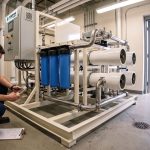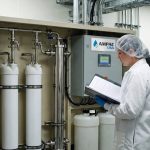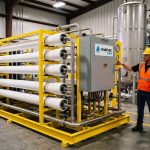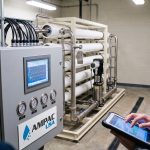

Modern water treatment facilities rely heavily on water treatment plant RO systems to deliver safe, clean, and reliable water for industrial, municipal, and commercial use. A water treatment plant RO system combines advanced filtration technologies with robust design to ensure that impurities, salts, and contaminants are effectively removed. In this guide, we provide a complete breakdown of how a water treatment plant RO system functions, highlighting its components, processes, and applications.
Introduction to Water Treatment RO Systems
A water treatment plant RO system is an advanced filtration technology that uses a semi-permeable membrane to separate contaminants from water at a molecular level, removing dissolved salts, bacteria, viruses, organic matter, and chemical impurities. The U.S. EPA recognizes reverse osmosis as one of the best available technologies (BAT) for removing a wide range of drinking water contaminants.
Core Principle of Reverse Osmosis
The working principle is based on osmosis — applying external pressure to force water through the membrane while leaving behind salts, heavy metals, and other contaminants, producing high-quality purified water on one side and concentrated brine on the other.
Key Components of a Water Treatment Plant RO System
1. Raw Water Intake System
Collection of raw water from rivers, lakes, wells, or seawater. Large pumps and intake screens remove large debris before the water moves into pre-treatment.
2. Pre-Treatment Unit
Pre-treatment protects RO membranes from fouling, scaling, and damage. It typically includes multimedia filters, activated carbon filters, cartridge filters, and chemical dosing systems for anti-scalant and coagulant injection.
3. High-Pressure Pump
The high-pressure pump applies sufficient pressure (up to 80 bar for seawater desalination) to overcome osmotic pressure, enabling water to pass through the semi-permeable membranes.
4. RO Membrane Modules
Membranes allow only water molecules to pass while rejecting dissolved salts, heavy metals, bacteria, and other impurities. They are typically configured in spiral-wound modules for maximum efficiency.
5. Post-Treatment Unit
After the RO process, water may undergo pH adjustment, mineral re-addition for taste and health, and UV disinfection or chlorination for microbial control.
Types of RO Systems in Water Treatment Plants
Brackish Water RO Systems
Designed for water sources with moderate salinity levels, commonly used in municipalities, agriculture, and industries. Learn about Seawater and Brackish Water Composition to understand the chemistry behind these systems.
Seawater Desalination RO Systems
Engineered to withstand high osmotic pressures and used in coastal areas to convert seawater into potable water.
Industrial RO Systems
Customized for pharmaceuticals, food and beverage, textiles, and power generation. See our guide on Industrial Reverse Osmosis Treatment for details.
Municipal RO Systems
Large-scale plants supplying drinking water to cities and towns, ensuring compliance with international water safety standards.
Step-by-Step Process of a Water Treatment Plant RO System
- Collection – Raw water is collected and transferred to the pre-treatment unit.
- Pre-Treatment – Removal of turbidity, suspended solids, organic matter, and chlorine.
- Pressurization – A high-pressure pump forces pre-treated water into the RO membrane module.
- Separation – Water molecules pass through the membrane; dissolved salts and impurities remain behind.
- Concentration – Brine or reject water is discharged or further treated for recovery.
- Post-Treatment – Purified water undergoes pH correction, remineralization, and disinfection.
- Storage & Distribution – Treated water is delivered for municipal supply, food processing, pharmaceuticals, and power generation.
Advantages and Challenges of Water Treatment Plant RO Systems
Advantages
- High Removal Efficiency: Eliminates up to 99% of dissolved salts and contaminants.
- Versatility: Suitable for seawater, brackish water, and groundwater sources.
- Scalability: Easily expandable to meet growing water demands.
- Energy Efficiency: Modern RO systems integrate energy recovery devices that reduce power consumption.
Challenges
- Membrane fouling due to organic matter and biofilm growth.
- Scaling from calcium, magnesium, and silica deposits.
- High energy consumption in seawater desalination plants.
- Wastewater disposal issues from concentrated brine.
Related: Water Treatment Chemicals — understanding anti-scalants and coagulants used in RO pre-treatment.
Future of Water Treatment Plant RO Systems
Emerging trends include advanced membrane materials for higher efficiency, hybrid treatment systems combining RO with nanofiltration or ion exchange, Zero Liquid Discharge (ZLD) systems to eliminate wastewater discharge, and AI-driven monitoring for predictive maintenance and energy optimization.
Also see: Industrial RO System Components for a deep dive into the engineering behind large-scale RO systems.
Conclusion
A water treatment plant RO system is an indispensable solution for meeting the global demand for clean and safe water. By integrating advanced filtration, robust design, and innovative technologies, these systems provide consistent water quality for municipal, industrial, and agricultural applications. With continued advancements, water treatment plant RO systems will remain at the forefront of sustainable water treatment, ensuring reliable water supply for future generations.
Frequently Asked Questions
What contaminants do water treatment plant RO systems remove?
A water treatment plant RO system effectively removes dissolved salts, bacteria, viruses, organic matter, and chemical impurities from water. It achieves this by forcing water through a semi-permeable membrane, leaving contaminants behind. The U.S. EPA recognizes reverse osmosis as a Best Available Technology (BAT) for removing a wide range of drinking water contaminants.
Why is pre-treatment essential for RO systems in water treatment plants?
Pre-treatment is crucial for protecting RO membranes from fouling, scaling, and damage, which can significantly reduce system efficiency and lifespan. It typically involves multimedia filters, activated carbon filters, cartridge filters, and chemical dosing for anti-scalant and coagulant injection. AMPAC USA engineers design robust pre-treatment units tailored to specific raw water characteristics.
What pressure is required for a water treatment plant RO system to operate effectively?
The high-pressure pump in a water treatment plant RO system applies sufficient pressure to overcome osmotic pressure, forcing water through the semi-permeable membranes. This pressure can range significantly, with seawater desalination systems requiring up to 80 bar (1160 psi) due to higher salinity. Proper pressure ensures optimal permeate flow and contaminant rejection.
What are the main stages of a water treatment plant RO system?
A water treatment plant RO system typically involves several key stages: raw water intake, comprehensive pre-treatment, high-pressure pumping, the reverse osmosis membrane modules, and post-treatment. Each stage is critical, from removing large debris and protecting membranes to purifying water and ensuring final quality for specific applications.
Where are water treatment plant RO systems commonly used?
Water treatment plant RO systems are widely used across various sectors requiring high-purity water. AMPAC USA has deployed these systems for industrial processes, municipal drinking water, luxury resorts, offshore oil rigs, military bases, and food & beverage plants in over 150 countries. They are essential for delivering safe, clean, and reliable water from diverse sources.
AMPAC USA engineers custom water purification systems for commercial, industrial, and emergency applications — from 500 GPD to multi-million GPD. Trusted by municipalities, military, and industry worldwide.