
Quick Answer
On April 2, 2026, the U.S. EPA published Draft Contaminant Candidate List 6 (CCL 6), adding microplastics and pharmaceuticals as priority contaminant groups for the first time in the program’s history. This is not yet a regulatory mandate – but it opens a formal 60-day comment period (closes June 2, 2026) and sets the stage for enforceable drinking water standards. A 60-day public comment period runs through June 2026; finalization expected by November 2026. Reverse osmosis systems with membranes rated below 0.001 micron are currently the most effective household technology for microplastic removal.
- The EPA added microplastics to the Contaminant Candidate List 6 (CCL 6) in 2024, a critical step toward federal regulation.
- Reverse osmosis systems remove up to 99% of microplastics from drinking water.
- Nanoplastics smaller than 1 micron remain a detection challenge.
- Bottled water is not safer – it often contains higher microplastic concentrations than filtered tap water.
- RO membranes are among the treatment options for microplastics, and AMPAC USA can help you choose a system for your water. For background on how RO works, see the US EPA overview of drinking water treatment technologies.
The U.S. Environmental Protection Agency made history on April 2, 2026, when it published the Draft Sixth Contaminant Candidate List (CCL 6) in the Federal Register. For the first time, the agency formally classified microplastics as a contaminant group requiring focused research and potential future regulation under the Safe Drinking Water Act (SDWA).
This move signals a major shift in how the federal government views the invisible plastic particles now found in virtually every water source – from mountain springs to municipal taps. Combined with newly enforced PFAS limits also taking effect in 2026, American drinking water is entering a new regulatory era.
Here is what you need to know about EPA CCL 6, why microplastics matter, and what water treatment systems are proven to remove them.
What Is the EPA Contaminant Candidate List (CCL)?
The Contaminant Candidate List is a roster of unregulated chemicals and microbes that EPA scientists believe may pose a risk to public health via drinking water. Substances on the CCL are not yet regulated – but their inclusion triggers focused research, data collection, and a formal scientific review that can lead to enforceable Maximum Contaminant Levels (MCLs) years down the road.
The CCL is updated every five years under SDWA requirements. Previous lists included chemicals such as perchlorate, chromium-6, and PFAS – all of which later received regulatory attention. The CCL pipeline has proven to be a reliable early-warning system for emerging threats.
- CCL 1 (1998): 60 chemicals, 10 microbes – led to regulation of several disinfection byproducts
- CCL 2 (2005): 51 chemicals – flagged perchlorate, prompting health advisory guidance
- CCL 3 (2009): 116 chemicals – included pharmaceuticals for the first time as individual compounds
- CCL 4 (2016): 97 chemicals – added cyanotoxins and strontium
- CCL 5 (2022): Included PFAS as a group, paving the way for the 2024 PFAS MCL rule
- CCL 6 (Draft, April 2026): Adds microplastics and pharmaceuticals as groups – a significant methodological shift
What the EPA Announced on April 2, 2026
The Draft CCL 6 published by EPA marks two historic firsts:
- Microplastics listed as a contaminant group – rather than individual plastic compounds, the EPA is treating microplastics collectively. This acknowledges the analytical challenge: thousands of plastic polymer types exist, and standardized detection methods are still being developed.
- Pharmaceuticals listed as a contaminant group – building on CCL 3 and 5 work, the agency is expanding its pharmaceutical monitoring scope to include hormones, antibiotics, and other drug residues that pass through conventional wastewater treatment.
The announcement opened a 60-day public comment period ending June 2, 2026. EPA is expected to finalize CCL 6 by November 17, 2026, following consultation with its independent Science Advisory Board (SAB).
Importantly, the U.S. Department of Health and Human Services (HHS) simultaneously announced a $144 million investment in a new microplastics research program – measuring plastics in human tissue, evaluating health impacts, and exploring removal technologies. This coordinated federal action signals that microplastics regulation, while still years away, is now on an accelerated track.
“EPA is taking bold action to ensure drinking water is safe from microplastics, pharmaceuticals, and potential hidden contaminants.”
U.S. Environmental Protection Agency, April 2, 2026
Why Microplastics in Drinking Water Are a Serious Concern
Microplastics – generally defined as plastic particles smaller than 5 millimeters – have been detected in virtually every water source tested globally, including deep ocean samples, Arctic ice cores, and remote mountain springs. Research published in peer-reviewed journals has detected them in human blood, lung tissue, breast milk, and even fetal placental tissue.
Sources of Microplastics in Water
- Plastic degradation: Bottles, packaging, and synthetic textiles break down into micro and nano-scale fragments over time through UV exposure and mechanical wear
- Wastewater effluent: Conventional municipal wastewater treatment removes approximately 70-80% of microplastics, but the remainder enters surface water
- Stormwater runoff: Road runoff carries tire rubber particles, synthetic fibers from clothing, and fragmented single-use plastics into waterways
- Agricultural sources: Plastic mulch film, irrigation pipes, and biosolid application introduce plastics directly into soil and groundwater
Known and Suspected Health Effects
The scientific consensus on microplastic health effects is still developing, but the weight of evidence is growing. Key concerns include:
| Health Concern | Mechanism | Status of Evidence |
|---|---|---|
| Inflammation | Physical irritation from particles in tissues | Animal studies strong; human studies ongoing |
| Endocrine disruption | Leaching of plasticizers (phthalates, BPA) from plastic particles | Well-documented for specific compounds |
| Oxidative stress | Free radical generation from nano-plastic fragments | Laboratory evidence; human data limited |
| Gut microbiome disruption | Accumulation in intestinal tissue | Emerging – 2024-2025 studies |
| Cardiovascular risk | 2024 NEJM study linked plaque microplastics to heart attack/stroke risk | Significant – human cohort data |
A landmark 2024 study published in the New England Journal of Medicine found microplastics and nanoplastics in arterial plaque samples and linked their presence to a 4.5-fold increased risk of heart attack, stroke, or death over a three-year follow-up period – the first major human clinical evidence connecting microplastics to cardiovascular outcomes.
Microplastics and PFAS: A Dual Regulatory Challenge in 2026
The CCL 6 microplastics announcement comes alongside the implementation of the EPA’s first-ever enforceable PFAS limits, which took effect in 2024 and require public water systems to comply by 2027:
- PFOA and PFOS: Maximum Contaminant Level (MCL) set at 4 parts per trillion (ppt)
- PFHxS, PFNA, HFPO-DA: MCL at 10 ppt each
- EU Drinking Water Directive: Requires PFAS monitoring beginning in 2026 across all EU member states
The global PFAS treatment market is projected at $2.1 billion in 2026, growing to $3.4 billion by 2033 as regulations tighten worldwide. Microplastics regulation is expected to follow a similar trajectory – starting with candidate listing, progressing to monitoring requirements, and ultimately leading to MCLs.
For water treatment facility operators and building owners, the lesson from PFAS is clear: begin evaluating microplastic removal capacity now, before binding regulations force rushed compliance.
Can Water Treatment Systems Remove Microplastics?
The good news: reverse osmosis systems and ultrafiltration membranes can effectively remove microplastics from drinking water. The key factor is membrane pore size relative to particle size.
Reverse Osmosis (RO) – Most Effective Method
Reverse osmosis membranes have pore sizes of approximately 0.0001 microns (1 angstrom) – far smaller than even the smallest microplastic particles. RO membranes remove:
- Microplastics (5mm down to 1 micron) – 99%+ removal
- Nanoplastics (below 1 micron) – high removal efficiency
- PFAS compounds – simultaneous removal at >95% efficiency
- Heavy metals, dissolved solids, bacteria, and viruses
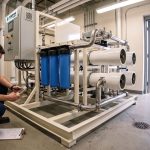
Commercial and industrial reverse osmosis systems from AMPAC USA are engineered for applications from small-scale point-of-use to large-scale municipal treatment. Our systems process water at commercial capacity, and we can discuss the performance data that exists for your application.
Ultrafiltration (UF) and Nanofiltration (NF)
Ultrafiltration membranes (pore size 0.01-0.1 microns) remove microplastics >0.1 microns effectively, but allow smaller nano-scale particles to pass. Nanofiltration (0.001 microns) bridges the gap between UF and RO. Both technologies are used in municipal pre-treatment and industrial water reuse applications.
Conventional Treatment Limitations
Standard coagulation-flocculation-sedimentation – the backbone of most municipal water treatment – removes approximately 70-80% of microplastics by mass but is ineffective against smaller particles and nanoplastics. Activated carbon alone does not physically retain microplastics, though it can adsorb some plastic-associated chemical pollutants.
The CCL 6 Comment Period: What Stakeholders Should Do
EPA’s 60-day public comment period (ending June 2, 2026) is an opportunity for water utilities, industries, municipalities, and citizens to submit scientific data and technical comments to shape how microplastics are ultimately defined and regulated.
Key issues that remain unresolved and are open for public input:
- Case definition: What particle size range and polymer types will be regulated? Will nanoplastics be included?
- Analytical methods: No validated standardized method for microplastic quantification in drinking water exists yet – EPA must develop one before MCLs can be enforced
- Lab capacity: Certified laboratories capable of reliable microplastic analysis at ppb or ppt levels are limited nationally
- Treatment feasibility: Costs and technical requirements for large water systems to achieve very low microplastic concentrations need to be assessed
What Water Treatment Facilities Should Do Right Now
Even without binding MCLs for microplastics, proactive water quality managers should take these steps now:
- Conduct baseline microplastic monitoring. Document current levels in source and finished water using available analytical methods. This data will be valuable for future regulatory compliance demonstrations.
- Evaluate membrane treatment upgrades. Facilities currently using conventional treatment should assess the cost-benefit of adding UF or RO polishing stages. These investments address PFAS compliance simultaneously.
- Review PFAS compliance status. The April 2027 PFAS compliance deadline is approaching. Membrane-based treatment planned for PFAS removal will also provide microplastic co-removal benefit.
- Submit public comments to EPA. Water system operators have until June 2, 2026 to provide technical input on CCL 6. Practical operational feedback from the field is valuable to the rulemaking process.
- Train operations staff. Keep staff informed on emerging regulatory developments. Early awareness enables planning for equipment procurement and budget allocation cycles.
AMPAC USA Water Treatment Solutions for Microplastic Removal
AMPAC USA, Manufactured in North America at our Woods Cross, Utah facility, designs and builds commercial reverse osmosis systems and industrial RO systems engineered for today’s most challenging water quality requirements – including PFAS, microplastics, nitrates, heavy metals, and dissolved solids.
Our membrane systems are designed to exceed current and anticipated regulatory standards, protecting municipalities, manufacturers, schools, hospitals, and commercial facilities from emerging contaminants before they become mandates.
Whether you need a 250 GPD commercial RO unit for a restaurant or a multi-million-gallon industrial system for a manufacturing facility, AMPAC USA engineers a solution matched to your flow rate, source water chemistry, and regulatory requirements.
Contact AMPAC USA today at (909) 762-8020 or visit our website to speak with a water treatment engineer about your microplastic removal and PFAS compliance needs.
📚 References & Further Reading
- U.S. EPA – Contaminant Candidate List 6
- WHO Report: Microplastics in Drinking Water (2019)
- NSF/ANSI 58 – Reverse Osmosis Drinking Water Treatment Systems
- AMPAC USA – Residential Reverse Osmosis Systems
Frequently Asked Questions About Microplastics in Drinking Water (2026)
When will microplastics become regulated in U.S. drinking water?
The U.S. EPA published Draft Contaminant Candidate List 6 (CCL 6) on April 2, 2026, adding microplastics as a priority contaminant. This initiates a 60-day public comment period, closing June 2, 2026, with finalization expected by November 2026. While not yet a regulatory mandate, this is a critical step towards enforceable drinking water standards under the Safe Drinking Water Act.
How effective are reverse osmosis systems at removing microplastics?
Reverse osmosis (RO) systems are highly effective, removing up to 99% of microplastics from drinking water. Systems with membranes rated below 0.001 micron are currently the most effective household technology for this purpose. AMPAC USA reverse osmosis systems use RO membranes, which are among the treatment options for microplastics.
What is the EPA Contaminant Candidate List (CCL)?
The EPA Contaminant Candidate List (CCL) is a roster of unregulated chemicals and microbes that EPA scientists believe may pose a risk to public health via drinking water. Inclusion on the CCL triggers focused research, data collection, and a formal scientific review that can lead to enforceable Maximum Contaminant Levels (MCLs) years down the road. The CCL is updated every five years under SDWA requirements.
Is bottled water a safer alternative for avoiding microplastics?
No, bottled water is generally not safer and often contains higher microplastic concentrations than filtered tap water. Microplastics are pervasive in various water sources, including those used for bottling. For effective removal, AMPAC USA recommends reverse osmosis systems over relying on bottled water.
What are nanoplastics and why are they difficult to remove?
Nanoplastics are plastic particles smaller than 1 micron, making them significantly smaller than microplastics. Their minuscule size presents a detection challenge and makes them harder to filter out with conventional methods. While reverse osmosis systems are highly effective against microplastics, nanoplastics require even finer filtration capabilities and remain an ongoing challenge for complete removal.