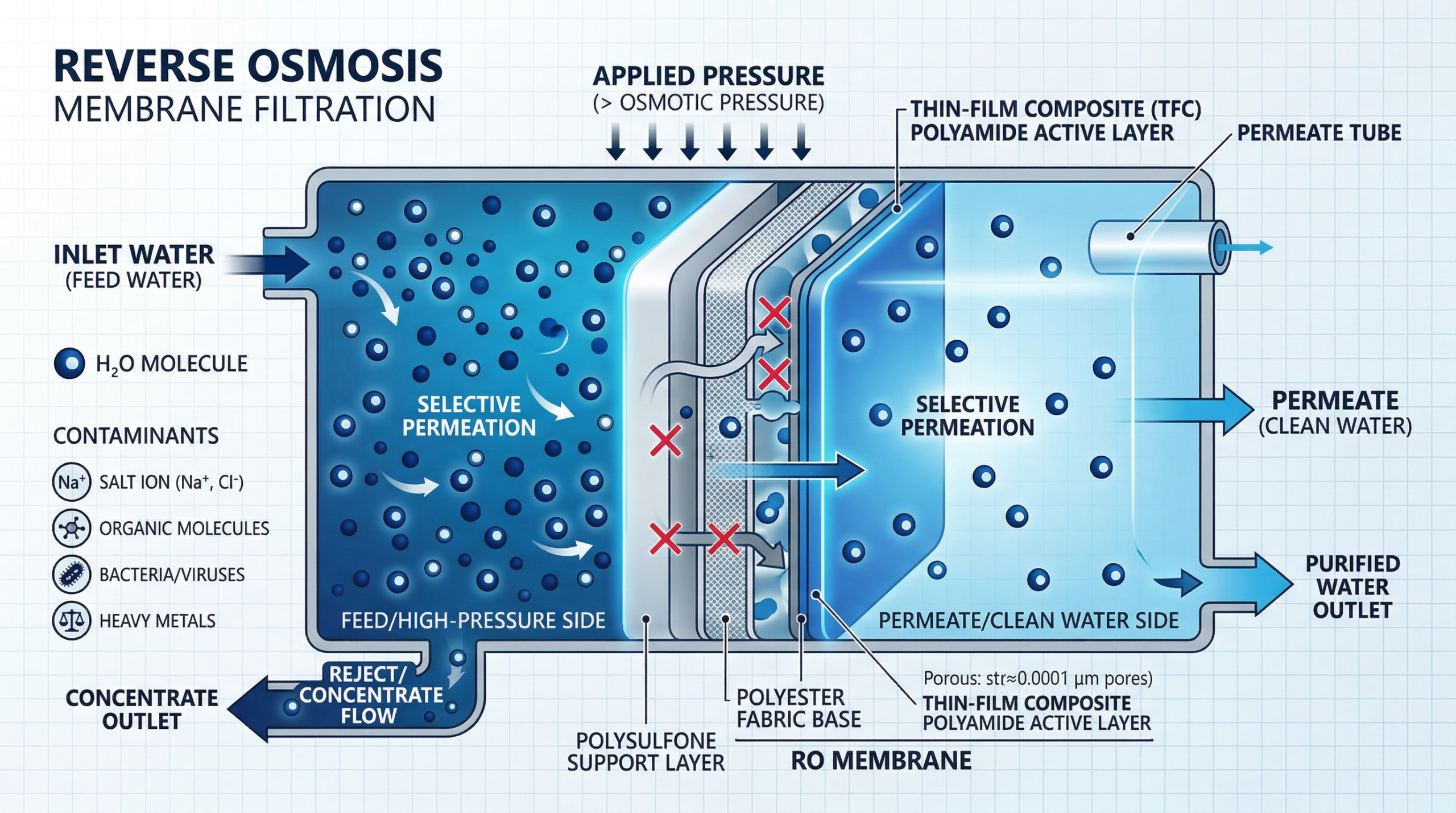

Reverse osmosis is a pressure-driven membrane filtration process that removes dissolved salts, organic molecules, bacteria, and pyrogens from water. Originally developed in the 1950s by researchers at UCLA, RO technology has become the gold standard for water purification across residential, commercial, industrial, and municipal applications worldwide. According to the International Desalination Association, reverse osmosis now accounts for more than 65% of all desalination capacity globally, producing over 65 million cubic meters of purified water daily.
How Does Reverse Osmosis Work? The Science Explained
Natural osmosis occurs when water moves from a region of lower solute concentration to higher solute concentration through a semipermeable membrane. Reverse osmosis applies external pressure — typically 40-1,000 PSI depending on the application — to force water molecules through the membrane in the opposite direction, leaving contaminants behind.
The RO membrane acts as an extremely fine molecular filter. A thin-film composite (TFC) polyamide membrane has pore sizes of approximately 0.0001 microns (0.1 nanometers). For perspective, a human hair is about 75 microns wide — roughly 750,000 times larger than an RO membrane pore. This incredibly tight filtration is what allows RO to remove contaminants that other filtration methods cannot.
The Four Stages of a Reverse Osmosis System
Stage 1 — Sediment Pre-Filter (5 microns): Removes sand, silt, rust, and particulate matter that could damage the RO membrane. This extends membrane life significantly.
Stage 2 — Carbon Pre-Filter: Activated carbon adsorbs chlorine, chloramines, volatile organic compounds (VOCs), and other chemicals that degrade polyamide RO membranes. The EPA notes that chlorine concentrations above 0.1 ppm can permanently damage TFC membranes.
Stage 3 — RO Membrane: The core of the system. Water is pressurized against the semipermeable membrane. Pure water (permeate) passes through while dissolved solids, heavy metals, bacteria, and other contaminants are flushed to drain (concentrate/reject stream).
Stage 4 — Post-Carbon Polish: A final activated carbon filter removes any residual taste or odor, ensuring the highest quality output water.
What Does Reverse Osmosis Remove? Contaminant Removal Rates
RO is among the most comprehensive water treatment technologies available. According to testing data from the NSF International and the Water Quality Association, a properly maintained reverse osmosis system removes the following contaminants:
| Contaminant | RO Removal Rate | Health Risk |
|---|---|---|
| Lead | 95–99% | Neurological damage, developmental delays in children |
| Arsenic | 92–99% | Cancer, cardiovascular disease |
| PFAS / PFOA / PFOS | 90–99% | Cancer, thyroid disease, immune suppression |
| Fluoride | 90–95% | Dental and skeletal fluorosis at high levels |
| Chlorine / Chloramines | 95–98% | Taste, odor, potential bladder cancer |
| Nitrates | 80–90% | Methemoglobinemia (blue baby syndrome) |
| Bacteria (E. coli, Salmonella) | 99.99% | Gastrointestinal illness, potentially fatal |
| Viruses | 99.98% | Various illnesses depending on virus |
| Total Dissolved Solids (TDS) | 90–99% | Taste, scaling, equipment damage |
| Microplastics | >99.9% | Endocrine disruption, inflammation |
| Chromium-6 | 95–98% | Cancer (EPA classifies as likely carcinogen) |
| Sodium | 90–95% | Hypertension, cardiovascular risk |
Types of Reverse Osmosis Systems: Residential vs. Commercial vs. Industrial
Reverse osmosis systems are manufactured at every scale, from compact under-sink units producing 50 gallons per day to massive industrial plants processing millions of gallons daily. Choosing the right system depends on your water source, required output volume, and intended application.
Residential RO Systems (50–400 GPD)
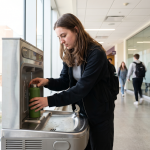
Home RO systems are typically point-of-use units installed under the kitchen sink with a dedicated faucet. They operate at household water pressure (40-80 PSI) and produce 50 to 400 gallons per day. Most residential systems use 3 to 7 stages of filtration. A standard 4-stage residential RO system costs between $150 and $600, with replacement filters running $50–$150 annually. AMPAC USA residential RO systems are designed for maximum efficiency with minimal wastewater.
Commercial RO Systems (200–20,000 GPD)
Commercial systems serve restaurants, hotels, hospitals, laboratories, and small manufacturing facilities. They require higher flow rates and often include features like automatic membrane flushing, TDS monitoring, and low-pressure safety shutoffs. Commercial RO systems range from $2,000 to $80,000 depending on capacity and feed water conditions. AMPAC USA commercial RO systems are available from 200 GPD to 20,000 GPD with custom configurations.
Industrial RO Systems (10,000–1,000,000+ GPD)
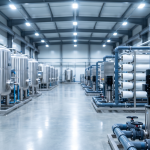
Industrial-scale systems serve power plants, semiconductor fabrication facilities, pharmaceutical manufacturing, and municipal water treatment. These systems incorporate advanced features including energy recovery devices, multi-stage arrays, PLC automation, and continuous monitoring. AMPAC USA industrial RO systems are engineered for 24/7 operation with recovery rates up to 85% and automated CIP cleaning cycles.
Seawater Desalination Systems (SWRO)
Seawater RO systems operate at much higher pressures (800-1,200 PSI) to overcome the osmotic pressure of seawater (approximately 350-400 PSI at 35,000 ppm TDS). These specialized systems use seawater-rated membranes and energy recovery devices that can recapture 50-60% of the input energy. AMPAC USA seawater desalination systems produce fresh water from ocean sources for coastal communities, marine vessels, and island installations.
| System Type | Capacity (GPD) | Operating Pressure | Price Range | Best For |
|---|---|---|---|---|
| Residential | 50–400 | 40–80 PSI | $150–$600 | Home drinking water |
| Commercial | 200–20,000 | 100–250 PSI | $2,000–$80,000 | Restaurants, hotels, labs |
| Industrial | 10,000–1,000,000+ | 150–600 PSI | $25,000–$500,000+ | Manufacturing, pharma, power |
| Seawater (SWRO) | 500–1,000,000+ | 800–1,200 PSI | $10,000–$1,000,000+ | Coastal, marine, islands |
Advantages and Disadvantages of Reverse Osmosis
Advantages of RO Water Purification
- Most comprehensive contaminant removal — removes 90-99.99% of dissolved solids, chemicals, bacteria, and viruses in a single process
- No chemical additives required — purely physical separation process, unlike chlorination or ozonation
- Scalable — available from 50 GPD residential to millions of GPD municipal
- Proven technology — over 70 years of continuous development and refinement
- Low energy consumption — modern RO uses 3-6 kWh per 1,000 gallons, compared to 40-60 kWh for distillation
- Consistent output quality — membrane performance is predictable and measurable via TDS monitoring
- Compact footprint — produces more water per square foot than most alternative technologies
Limitations to Consider
- Wastewater production — residential systems typically produce 2-4 gallons of concentrate per gallon of permeate (commercial systems achieve 75-85% recovery)
- Removes beneficial minerals — some users prefer to add a remineralization stage for drinking water
- Membrane replacement — RO membranes last 2-7 years depending on application and maintenance
- Pre-treatment required — feed water must be pre-filtered to protect the membrane from fouling
- Not effective against dissolved gases — CO2 and some VOCs may pass through (addressed by post-treatment)
How to Choose the Right Reverse Osmosis System
Selecting the optimal RO system requires evaluating several key factors:
- Water source and quality: Test your feed water for TDS, hardness, pH, chlorine, iron, and specific contaminants. Higher TDS requires higher operating pressure and may need pretreatment.
- Required output volume: Calculate your daily water demand in gallons per day (GPD). For commercial use, factor in peak demand periods.
- Permeate quality requirements: Different applications need different purity levels. Drinking water needs TDS below 500 ppm, while pharmaceutical production may require below 1 ppm.
- Available space: Measure your installation area. Under-sink systems need about 15×15 inches, while commercial systems may need a dedicated equipment room.
- Budget: Consider total cost of ownership including purchase price, installation, energy, membrane replacement, and maintenance over 5-10 years.
Reverse Osmosis vs. Other Water Purification Methods
| Method | TDS Removal | Bacteria | Viruses | Chemicals | Energy Use |
|---|---|---|---|---|---|
| Reverse Osmosis | 90-99% | 99.99% | 99.98% | 95-99% | 3-6 kWh/1000 gal |
| Carbon Filtration | 5-20% | Minimal | No | 50-80% | Gravity/low |
| UV Disinfection | 0% | 99.99% | 99.99% | 0% | 0.5 kWh/1000 gal |
| Distillation | 99.9% | 99.99% | 99.99% | 95-99% | 40-60 kWh/1000 gal |
| Ultrafiltration | 10-30% | 99.99% | 99.9% | 20-40% | 1-3 kWh/1000 gal |
As the comparison shows, reverse osmosis provides the best overall balance of contaminant removal, energy efficiency, and versatility. While distillation matches RO in removal rates, it consumes 7-10 times more energy per gallon processed.
Maintaining Your Reverse Osmosis System
Proper maintenance is essential for consistent water quality and maximum membrane life. The Water Quality Association recommends the following maintenance schedule:
- Every 6-12 months: Replace sediment and carbon pre-filters
- Every 12 months: Replace post-carbon polish filter
- Every 2-5 years: Replace RO membrane (residential); 3-7 years for commercial/industrial
- Monthly: Check TDS readings of permeate water (should be 90-99% lower than feed water)
- Annually: Sanitize the system and storage tank
A TDS meter is the most important monitoring tool for RO systems. If permeate TDS rises above 10% of feed water TDS, the membrane likely needs cleaning or replacement.
The Future of Reverse Osmosis Technology
RO technology continues to advance rapidly. Key developments include:
- Graphene oxide membranes: Research at MIT and the University of Manchester shows graphene-based membranes could be 100-1,000 times more permeable than current TFC membranes while maintaining rejection rates
- Energy recovery devices: Modern isobaric pressure exchangers now recover up to 60% of input energy in seawater desalination, reducing the energy cost to as low as 2.5 kWh per cubic meter
- Smart monitoring: IoT-enabled RO systems with real-time membrane performance tracking, predictive maintenance, and remote management capabilities
- Zero liquid discharge (ZLD): Advanced systems that maximize water recovery to 95%+ while minimizing environmental impact of brine discharge
- Solar-powered desalination: Renewable energy integration is making RO viable for off-grid and remote communities worldwide
📚 References & Further Reading
- NSF/ANSI 58 — RO System Certification Standard
- EPA: Drinking Water Treatment Methods
- WQA: Reverse Osmosis Technology Review
- AMPAC USA — What is Reverse Osmosis?
Frequently Asked Questions About Reverse Osmosis
Is reverse osmosis water safe to drink?
Yes, reverse osmosis water is safe and healthy to drink. RO removes harmful contaminants including lead, arsenic, PFAS, bacteria, and viruses. While RO also removes some minerals, the World Health Organization notes that most essential minerals are obtained from food rather than water. Many RO systems include a remineralization stage that adds back beneficial calcium and magnesium.
How much water does reverse osmosis waste?
Residential RO systems typically have a recovery rate of 20-35%, meaning 2-4 gallons of water go to drain for every gallon of purified water produced. However, modern commercial and industrial systems achieve 75-85% recovery. The concentrate water from RO is not truly “wasted” — many users redirect it for irrigation, toilet flushing, or other non-potable uses.
Does reverse osmosis remove PFAS (forever chemicals)?
Yes, reverse osmosis is one of the most effective methods for removing PFAS compounds from water. Studies show RO removes 90-99% of PFOA, PFOS, and other per- and polyfluoroalkyl substances. The EPA’s April 2024 PFAS regulation set maximum contaminant levels at 4 parts per trillion for PFOA and PFOS, and RO consistently achieves these standards.
How long does a reverse osmosis membrane last?
RO membrane lifespan depends on the application, feed water quality, and maintenance. Residential membranes typically last 2-5 years, commercial membranes 3-5 years, and industrial membranes 5-7 years. Signs that a membrane needs replacement include decreased water production, increased TDS in permeate, or higher-than-normal operating pressure.
Can reverse osmosis remove bacteria and viruses?
Yes. RO membranes remove 99.99% of bacteria (including E. coli, Salmonella, Campylobacter) and 99.98% of viruses (including Hepatitis A, Norovirus, Rotavirus). The 0.0001-micron pore size of RO membranes is far smaller than the smallest bacteria (0.2 microns) and viruses (0.02 microns), making RO an effective barrier against waterborne pathogens.
What is the difference between RO and water softening?
Water softeners use ion exchange to replace calcium and magnesium (hardness minerals) with sodium, reducing scale buildup. Reverse osmosis physically removes dissolved solids through membrane filtration. RO removes hardness minerals plus thousands of other contaminants that softeners cannot, including lead, PFAS, arsenic, and microorganisms. For comprehensive water treatment, many installations use a softener as pretreatment before an RO system.
Does reverse osmosis remove chlorine?
RO systems remove 95-98% of free chlorine, but the primary chlorine removal occurs in the carbon pre-filter stage, which adsorbs chlorine before it reaches the membrane. This is by design — chlorine degrades polyamide TFC membranes, so it must be removed in the pretreatment stage. The result is that the final permeate is essentially chlorine-free.
Get the Right RO System for Your Needs
Whether you need a home drinking water system or a high-capacity industrial installation, AMPAC USA has been engineering reverse osmosis solutions for over 30 years. Our systems are NSF-certified, made in the USA, and backed by expert technical support.
- Residential RO Systems — Under-sink and whole-house solutions
- Commercial RO Systems — 200 to 20,000 GPD
- Industrial RO Systems — 10,000 GPD and above
- Seawater Desalination — SWRO watermakers for marine and coastal use
Contact AMPAC USA for a free water quality consultation and system recommendation. Call (909) 762-8020 or request a quote online.
Related Articles
- Brackish Water Reverse Osmosis Systems: Enhancing Water Purification
- Reverse Osmosis Water Purification Systems
- Reverse Osmosis Water Purification
- Water Softener vs Reverse Osmosis: Which Do You Need? | AMPAC USA
Conclusion
This post highlighted how emergency and military-grade water purification systems provide safe drinking water rapidly in the most challenging field conditions. For organizations requiring deployable water treatment capability, AMPAC USA engineers portable and trailer-mounted systems built to perform wherever they are needed. Contact our team at info@ampac1.com or (909) 548-4900 to discuss your emergency water treatment requirements.