


A lot of water sits in an awkward middle — too mineralized to use as-is, not nearly salty enough to warrant a seawater desalination plant. That’s brackish water. Inland wells across the American Southwest. River water downstream from irrigated farmland. Groundwater in coastal areas where saltwater has been creeping in for years. Process water from mining dewatering. All of it in a TDS range that breaks the economics of both standard filtration and seawater RO. Run a tap-water RO system on it and the pump can’t build enough pressure; you get poor rejection and fast membrane degradation. Run a seawater system on it and you’re burning 3–4 times the energy you need. Brackish water RO is what actually fits.
What Is Brackish Water?
Brackish water is typically defined as water with a total dissolved solids (TDS) concentration between 1,000 and 15,000 ppm (parts per million). For reference, freshwater is generally below 500 ppm, the EPA secondary standard for drinking water is 500 ppm, and seawater runs 30,000–45,000 ppm. Brackish water occupies the large zone in between.
| Tap / Municipal Water | <500 ppm | 60–150 psi |
| Light Brackish | 500–2,500 ppm | 150–250 psi |
| Moderate Brackish | 2,500–8,000 ppm | 250–450 psi |
| High Brackish | 8,000–15,000 ppm | 450–600 psi |
| Seawater | 30,000–45,000 ppm | 800–1,200 psi |
The distinction matters because using the wrong system type costs money every day. A seawater RO unit running on 3,000 ppm brackish water is using 3–4 times the energy it needs. A standard tap water RO system can’t generate enough pressure to push water through a membrane against high osmotic pressure — you get low flow, poor rejection, and premature membrane failure.
How Brackish Water Reverse Osmosis Works
The physics of BWRO are identical to any other RO system: a high-pressure pump forces water through a semi-permeable membrane with pores small enough to block dissolved ions, bacteria, viruses, and most organic molecules. Water molecules pass through. Dissolved minerals don’t. The output is two streams — purified permeate (the product) and concentrated brine (the reject).
What differentiates a brackish water RO system from a standard system is the membrane selection, pump capacity, and pressure rating. BWRO membranes are specifically engineered with a salt rejection optimized for the brackish range and a pressure rating that keeps energy consumption reasonable when working against 150–600 psi operating pressure. The most common BWRO membrane element is the 8-inch diameter, 40-inch long spiral-wound element — 8040 format — which fits standard pressure vessels used across the industry.
System Components
- Feed pump — Pressurizes the feed water to operating pressure. Industrial BWRO systems use multistage centrifugal pumps rated for continuous duty. Pump sizing is critical — undersizing causes inadequate flow; oversizing wastes energy and can damage membranes.
- Pretreatment system — Protects the membrane from fouling and scaling. Typically includes multimedia filtration (suspended solids removal), cartridge filtration (5 micron), and antiscalant chemical dosing. Well water may also need iron removal ahead of the RO.
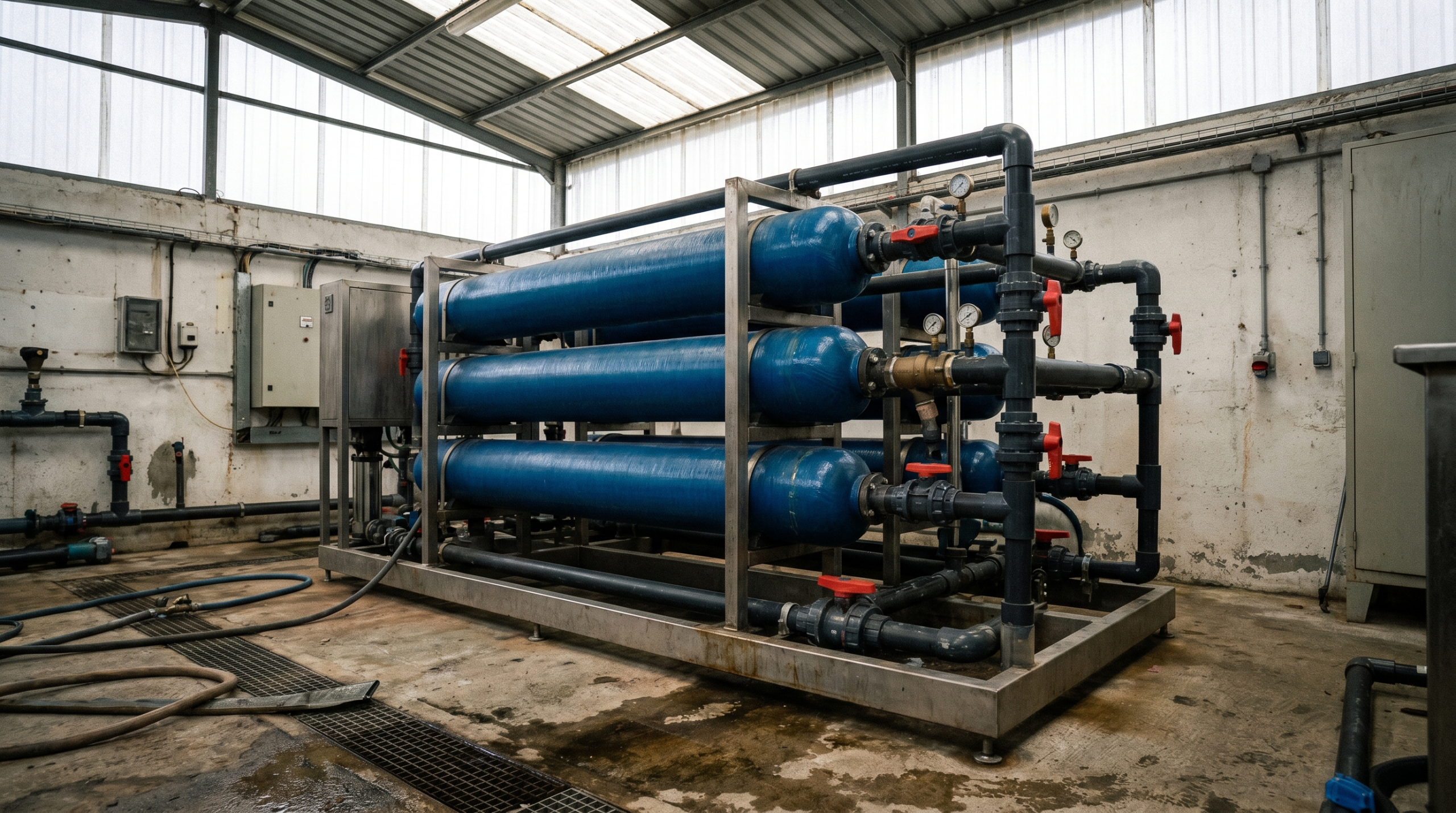
- Membrane elements and pressure vessels — The core of the system. Industrial BWRO systems arrange multiple membrane elements in series within pressure vessels, and multiple vessels in parallel to achieve target flow rates. A 100,000 GPD system might use 50–100 membrane elements across 8–12 pressure vessels.
- Instrumentation and controls — PLC or microprocessor-based control systems monitor pressure, flow, conductivity, and system status. Automatic shutdown on high-pressure events prevents membrane damage. Remote monitoring is standard on modern industrial units.
- Brine management — The concentrate stream (typically 20–25% of feed volume) requires disposal. Options include drain, evaporation ponds, injection wells, or — in zero-liquid-discharge applications — further concentration via evaporators.
Who Uses Brackish Water RO Systems?
Municipal and Community Water Supply
Inland communities in the American Southwest, Texas, Middle East, and North Africa often have no freshwater source available. Groundwater from desert aquifers commonly runs 2,000–8,000 ppm TDS — drinkable in small quantities but unsuitable for industrial use or human health over the long term. BWRO plants from 50,000 to 5,000,000 GPD serve communities where brackish groundwater is the only available source. The U.S. has hundreds of municipal BWRO installations, with concentrations in Arizona, Texas, Florida, and California.
Agricultural and Irrigation Water Reuse
Drainage water from irrigated farmland accumulates salts over time. In California’s San Joaquin Valley, some agricultural drainage runs 2,000–10,000 ppm TDS. BWRO systems treat this water for reuse in irrigation or discharge to meet state standards. Food processing facilities also use BWRO to treat process water and reduce freshwater withdrawal permits.
Mining and Industrial Process Water
Mines generate large volumes of high-TDS water from dewatering operations, tailings ponds, and acid mine drainage. TDS levels of 3,000–12,000 ppm are common. BWRO systems treat this water for reuse in mineral processing (reducing freshwater consumption) or for discharge compliance. The heavy industrial duty cycle in mining applications requires systems built for 24/7 operation in harsh conditions.
Power Generation
Power plants — coal, natural gas, nuclear — need large volumes of high-purity water for cooling tower makeup, boiler feed water, and steam generation. Many plants draw from rivers or wells with brackish-range TDS. BWRO followed by deionization polishing is the standard water treatment train at most modern power generation facilities.
Oil and Gas Produced Water Treatment
Produced water — the water that comes up with oil and gas extraction — is often highly brackish (5,000–50,000 ppm TDS). BWRO systems treat lower-salinity produced water for reuse in hydraulic fracturing or agricultural application. Higher-salinity streams require more aggressive treatment (thermal or high-recovery RO) before BWRO polishing.
Coastal and Island Communities
Coastal aquifers are frequently impacted by saltwater intrusion as freshwater is withdrawn faster than it recharges. Wells that ran 300 ppm TDS fifteen years ago may now test at 3,000–8,000 ppm as the saltwater wedge advances. BWRO systems treat this intrusion-impacted water at lower energy cost than full seawater desalination.
BWRO System Sizing: Key Parameters
Sizing a brackish water RO system correctly requires knowing the feed water chemistry and the target permeate quality. The most critical inputs:
| Feed TDS (ppm) | |||
| Feed water temperature | |||
| SDI (Silt Density Index) | |||
| Hardness (Ca, Mg) | |||
| Iron and manganese | |||
| Target recovery rate | 75–85% is typical; above 85% risks scale and membrane stress | ||
| Required permeate flow (GPD) |
BWRO System Cost: What to Expect
Brackish water RO system pricing is primarily driven by flow rate, feed water TDS, and pretreatment requirements. As a general guide for turnkey systems:
| 10,000 GPD | 1,000–5,000 | $15,000–$30,000 | 3–6 kWh |
| 25,000 GPD | 1,000–5,000 | $25,000–$55,000 | 3–6 kWh |
| 50,000 GPD | 2,000–8,000 | $45,000–$100,000 | 4–8 kWh |
| 100,000 GPD | 2,000–10,000 | $80,000–$180,000 | 4–9 kWh |
| 500,000 GPD | 3,000–12,000 | $300,000–$750,000 | 5–10 kWh |
BWRO vs. Seawater RO: Choosing the Right System
The most expensive procurement mistake in water treatment is specifying a seawater system for a brackish source. Running a SWRO plant on 5,000 ppm feed water uses 3–4 times the electricity of a correctly sized BWRO system — every hour, every day, for the life of the plant. That’s not a rounding error; it’s a six-figure annual operating cost difference on a mid-sized installation.
The reverse is also true. Push a BWRO system past its design TDS ceiling and salt rejection drops, membranes degrade faster, and you’re replacing a system years ahead of schedule. Get a water analysis done first, size to your actual source, and build in a buffer for seasonal swings and long-term salinity drift — especially in coastal zones where intrusion tends to worsen over time.
Frequently Asked Questions: Brackish Water RO
What is brackish water?
Water with total dissolved solids between 1,000 and 15,000 ppm, sitting between freshwater (generally below 500 ppm) and seawater (30,000-45,000 ppm).
How does a brackish water RO system differ from standard tap-water RO or seawater RO?
Brackish water RO operates at 200-600 psi, higher than standard tap-water RO (60-150 psi) but far lower than seawater systems (800-1,200 psi). Running a tap-water system on brackish feed causes poor rejection and fast membrane degradation, while running a seawater system wastes 3-4 times the energy actually needed.
What recovery rate and TDS reduction can a brackish water RO system achieve?
Typically 75-85 percent water recovery with 95-99 percent TDS reduction, making it the standard solution for wells, rivers, agricultural runoff, and industrial process water with elevated mineral content.
AMPAC USA Brackish Water RO Systems
AMPAC USA builds turnkey brackish water RO systems from 5,000 to 2,000,000+ GPD. Systems are designed around your feed water analysis — actual chemistry from your well, river, or process source — not a catalog TDS assumption. Our engineering team runs membrane simulation models and sizes pretreatment to match what you’re actually dealing with, whether that’s high iron, high silica, seasonal TDS variation, or a source that’s been getting saltier every year.
We’ve put systems in desert well water projects, coastal intrusion zones, agricultural drainage reuse applications, and active mining operations. The environments are different; the approach is the same — get the sizing right, build it to run continuously, and don’t cut corners on pretreatment.
If your source water tests above 1,000 ppm TDS, send us your water analysis and we’ll give you a system recommendation. Or browse our industrial RO line for standard configurations.