
Quick answer: Water filling stations, self-service kiosks that dispense purified, filtered water into a refillable bottle, are spreading across college campuses, offices, and neighborhoods because bottled water is expensive, wasteful, and increasingly distrusted. A gallon of bottled water can cost hundreds of times more than filtered tap water, roughly 50 billion plastic bottles get thrown away in the U.S. every year, and modern reverse osmosis systems now make it easy to deliver consistent, great-tasting water on demand without the plastic.
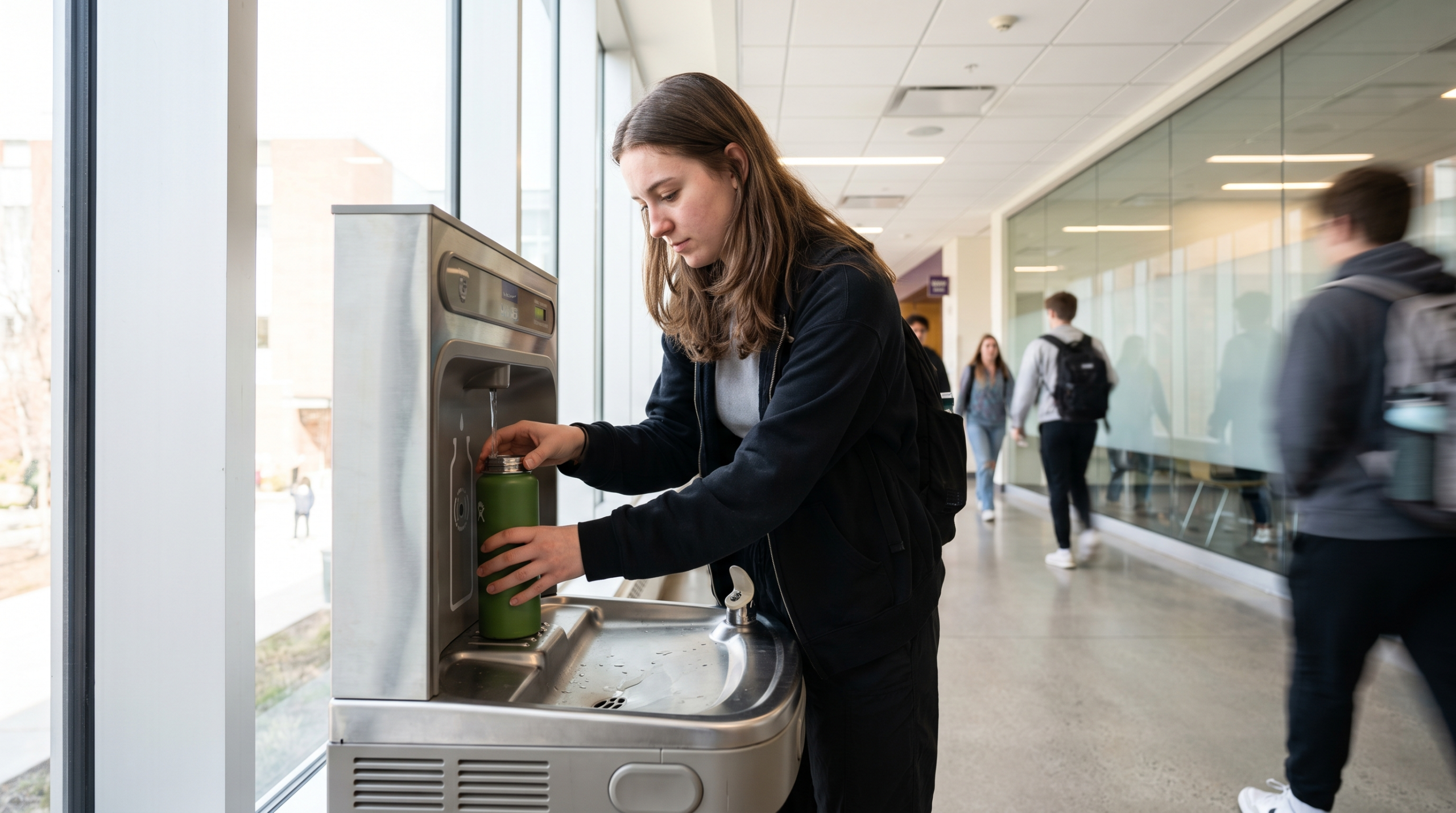
Walk across almost any university campus built or renovated in the last decade and you’ll notice something missing: the old bubbler-style drinking fountain has quietly been replaced, or joined, by a taller unit with a digital counter ticking up the number of bottles it has kept out of the trash. That’s not a coincidence. It’s the result of three pressures converging at once: cost, waste, and a growing skepticism about what’s actually in the bottle.
How Common Are Filling Stations on Campuses Now?
They’ve gone from a niche sustainability perk to a near-standard feature. More than 60% of U.S. schools now include bottle filling stations as part of campus wellness and sustainability programs, and the shift happened fast once one or two stations proved themselves.
The University of Michigan is a good example of how quickly usage can snowball. When the school installed its first two refill stations in Mason Hall back in 2010, those two units alone logged more than 270,000 uses in a single year. That kind of number is hard to ignore, and it’s why Michigan and dozens of other universities kept expanding the program rather than treating it as a pilot. Stony Brook University now runs more than 100 filling stations across its campuses, each with its own electronic counter, and the school’s “Fill It Forward” incentive app has logged tens of thousands of registered refills since 2018. Jefferson Lab’s stations have saved more than 84,000 plastic bottles. Penn State’s New Kensington campus passed 200,000. These aren’t marketing numbers from a vendor; they’re facility counters, and they keep climbing.
The market backs up what’s happening on the ground. The global water bottle filling station market is projected to grow from roughly $435 million in 2025 to $597 million by 2030, and the broader bottle-filling-station category (including office and public installations) is expected to nearly double by 2030 as touchless, IoT-connected units become standard rather than a novelty.
How Much Plastic and Money Does Bottled Water Actually Waste?
A lot of both. Roughly 50 billion plastic water bottles are thrown away in the U.S. every year, and globally only about 23% of plastic bottles get recycled, meaning the majority end up in landfills, incinerators, or the environment, where a single bottle can take around 450 years to break down.
The cost gap is just as stark, and it’s the argument that tends to land hardest with students and facility managers alike. Municipal tap water runs about $0.004 per gallon. Bottled water, by contrast, averages around $1.22 per gallon at the low end, and name-brand single bottles like Aquafina, Dasani, and Smartwater can run $7 to $10 or more per gallon once you do the math on a 16.9-ounce bottle. Home and building-level filtration, by comparison, costs only a few cents per gallon to produce. Switching from bottled to filtered water saves the average person around $354 a year, and a family of four can save well over $1,400. For a campus of 20,000 students, or an office building with a few hundred employees, that math scales into real budget line items, not just a feel-good number.
Why Are People Losing Trust in Bottled Water Specifically?
Because independent testing keeps finding things in bottled water that people assumed they were paying to avoid, most notably microplastics. Awareness has jumped fast: about 70% of U.S. adults now say they’re aware that bottled water can contain microplastics, up sharply from just a year earlier.
The underlying research is part of why. Studies have found bottled water can contain roughly 94 microplastic particles per liter on average, meaning someone who drinks only bottled water for hydration could be ingesting on the order of 190 microplastic particles a day just from the container itself, before accounting for anything already in the source water. Bottled water isn’t necessarily held to a higher purity standard than tap water either; in the U.S., it’s regulated by the FDA as a food product, while municipal tap water falls under the EPA’s Safe Drinking Water Act, and the two frameworks don’t test for exactly the same things on the same schedule. That regulatory gap, combined with the plastic-leaching question, is a big part of why “just buy bottled water” has stopped being the automatic safe choice it once was.
What Makes Modern Filling Stations Different From Old Drinking Fountains?
The difference isn’t the faucet, it’s what’s behind the wall. Older drinking fountains ran straight off the municipal line with no filtration beyond whatever the city already provided. Today’s filling stations are built around multi-stage purification, typically sediment pre-filtration, carbon filtration for taste and chlorine removal, and increasingly a reverse osmosis (RO) stage that strips out dissolved solids, heavy metals, and many of the contaminants tap water testing sometimes flags.
That RO stage is the real upgrade. A properly sized commercial RO system can push a filling station’s water quality well past what either municipal tap water or a typical bottled water brand delivers, and it does it consistently, station after station, refill after refill, without generating a single bottle. Many systems now also include a remineralization stage after the RO membrane, adding back trace minerals like calcium and magnesium so the water doesn’t taste flat, which was a common complaint with early-generation RO output. This is the layer of engineering that turned filling stations from a bare-bones utility fixture into something that can genuinely replace a case of bottled water in taste and reliability, not just in cost.
For facilities managers or property owners evaluating a filling-station rollout, this is also where the equipment choice actually matters. A commercial reverse osmosis system sized correctly for expected foot traffic is what keeps a bank of filling stations performing consistently under real campus or office demand, rather than degrading in output or taste as usage climbs. The same underlying reverse osmosis technology scales down for a single building or a residential setup too, which is worth knowing if the conversation started with “filling stations” but ends with “what about our own water at home.”
Do Filling Stations Actually Reduce Plastic Use, or Is That Overstated?
They do, and the effect compounds the longer a station stays in service. Each station tracks bottles saved with an electronic counter, and the totals aren’t small: 84,000-plus at a single national lab facility, over 200,000 at one satellite college campus, and Michigan’s original two-unit pilot alone crossed a quarter million uses in its first year.
The mechanism is straightforward. A student or employee who buys a $2 bottle of water twice a day is generating two disposable containers daily, roughly 500 to 700 a year, per person. Give that same person a refillable bottle and a filling station on their walk to class or their office floor, and that number drops close to zero. Multiply that by a campus population in the tens of thousands, and the annual bottle reduction runs into the millions, which is exactly why university sustainability offices track and publicize these counters so aggressively. It’s one of the few sustainability metrics that updates in real time and is genuinely hard to argue with.
Is This Trend Reaching Beyond Colleges, Into Communities and Workplaces?
Yes, and it’s moving in the same direction the campus data points to. Filling stations are showing up in office lobbies, gyms, airports, hospitals, and municipal buildings, driven by the same combination of cost savings, sustainability targets, and public expectation that a building should offer clean water without a vending machine markup attached.
The market numbers reflect that spread. The bottle-filling-station category broadly (beyond just campuses) grew from about $1.36 billion in 2024 to $1.46 billion in 2025, and is projected to reach roughly $2.10 billion by 2030, a 7.5% compound annual growth rate. That’s not a niche category anymore; it’s infrastructure planners and building owners treating filling stations the way they’d treat any other standard utility fixture, something you install once during a renovation or new build rather than something you retrofit years later when the plastic-waste conversation finally reaches your building.
Frequently Asked Questions
Are water filling stations more sanitary than water fountains?
Generally yes. Most modern filling stations use touchless or hands-free bottle sensors, and because they dispense straight into a bottle rather than requiring mouth contact with a spout, they reduce the surface contact points that raised hygiene concerns with older-style fountains.
Do filling stations need reverse osmosis, or is basic carbon filtration enough?
It depends on the source water and the goals of the installation. Carbon filtration alone handles chlorine taste and odor, but it doesn’t remove dissolved solids or many contaminants the way RO does. Facilities aiming for bottled-water-level purity and taste consistency generally pair carbon pre-filtration with an RO stage.
How much does it cost to install a water filling station?
Costs vary by unit type, plumbing access, and whether an existing fountain is being retrofitted or a new line needs to be run, but the ongoing operating cost is consistently a few cents per gallon, which is why most installations pay for themselves within one to two years compared to the bottled water they displace.
Does filtered water from a filling station taste different from bottled water?
It can taste better. Straight RO water without remineralization can taste flat, but stations that add a post-RO remineralization stage typically produce water that tastes comparable to, or better than, popular bottled brands, since it’s free of the plastic taste some bottled water picks up in storage.
Is bottled water actually held to lower purity standards than tap water?
Not lower exactly, but different. Bottled water is regulated by the FDA as a food product, while tap water falls under the EPA’s Safe Drinking Water Act. The testing frequency and specific contaminant panels aren’t identical between the two frameworks, which is part of why bottled water isn’t automatically the safer or purer choice many consumers assume it is.
Sources: Beverage Marketing Corporation data via gitnux.org and wifitalents.com bottled water industry reports; Aquasana; The Global Statistics (plastic pollution); GlobeNewswire (Bottle Filling Stations Market Forecast Report 2025-2030); StatsMarketResearch (Water Bottle Filling Stations Market 2025-2032); University of Michigan (record.umich.edu); Stony Brook University Sustainability (stonybrook.edu); Jefferson Lab (jlab.org); Penn State New Kensington (newkensington.psu.edu); H2O Distributors bottled water cost calculator; HomeWater and American Home Water & Air cost-comparison data; U.S. FDA and EPA regulatory frameworks for bottled and tap water.
AMPAC USA engineers custom water purification systems for commercial, industrial, and emergency applications — from 500 GPD to multi-million GPD. Trusted by municipalities, military, and industry worldwide.