
The word “ultrapure” gets applied loosely in water treatment marketing. Vendors slap it on everything from carbon-filtered tap water to genuinely reagent-grade laboratory systems. That imprecision costs buyers money — either from over-specifying a system that’s far more complex than their application requires, or from under-specifying and then dealing with product quality failures, equipment corrosion, or failed regulatory audits. This guide cuts through that noise and explains exactly what ultrapure water is, how EDI systems produce it, and who actually needs it versus who’s been sold on it.
What Is Ultrapure Water, Exactly?
Ultrapure water is water that has been stripped of essentially everything except H₂O molecules. The standard measure is electrical resistivity: pure water at 25°C has a theoretical maximum resistivity of 18.2 MΩ·cm (megaohm-centimeters). Dissolved ions — sodium, chloride, calcium, silica, trace metals — all conduct electricity, so higher ion concentration means lower resistivity. Water at 18.2 MΩ·cm has virtually no ions remaining.
| Water Quality Grade | Resistivity | Conductivity | Typical TDS (ppb) | Typical Use |
|---|---|---|---|---|
| Tap Water | <0.001 MΩ·cm | >1,000 µS/cm | >100,000 ppb | Drinking, general cleaning |
| RO Permeate | 0.05–0.5 MΩ·cm | 2–20 µS/cm | 1,000–10,000 ppb | Boiler makeup, cooling towers, rinsing |
| ASTM Type 3 (Lab Grade) | ≥1 MΩ·cm | ≤1 µS/cm | <200 ppb | General lab use, buffer prep |
| ASTM Type 2 (High Purity) | ≥10 MΩ·cm | ≤0.1 µS/cm | <50 ppb | HPLC, cell culture, reagent prep |
| ASTM Type 1 / Ultrapure | 18.2 MΩ·cm | 0.055 µS/cm | <5 ppb | Semiconductor rinse, WFI, analytical |
The jump from RO permeate to ultrapure water isn’t a matter of adding one more filter. It requires a fundamentally different treatment stage — and that’s where electrodeionization comes in.
What Is Electrodeionization (EDI)?
Electrodeionization is a continuous ion removal process that combines ion exchange resin, ion exchange membranes, and an applied electrical current to remove dissolved ions from water — without requiring chemical regeneration. It was developed in the 1950s, commercialized in the 1980s, and is now the dominant technology for producing ultrapure water at industrial scale.
How EDI Works
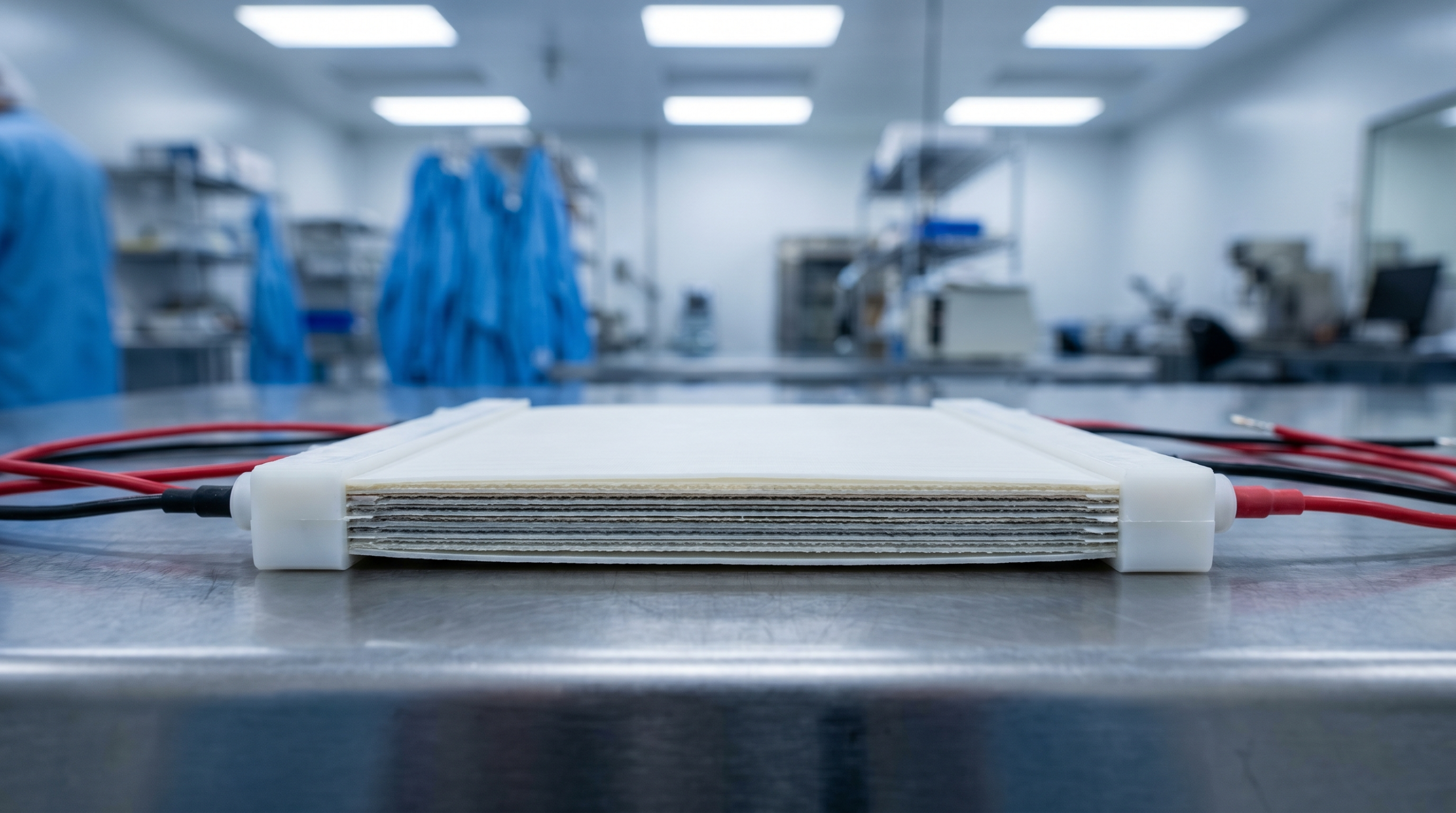
An EDI module is a stack of alternating diluting and concentrating compartments separated by cation and anion exchange membranes. The diluting compartments are packed with mixed-bed ion exchange resin. Feed water (RO permeate) flows through the diluting compartments. DC electrical current applied across the stack does two things simultaneously:
- Ion removal — Dissolved cations (Na⁺, Ca²⁺, Mg²⁺) migrate toward the cathode through cation exchange membranes. Anions (Cl⁻, SO₄²⁻, SiO₃²⁻) migrate toward the anode through anion exchange membranes. Both exit into the concentrating compartments and are flushed to drain as concentrate.
- Resin regeneration — The electrical current electrolyzes water molecules at the resin-membrane interface, producing H⁺ and OH⁻ ions that continuously regenerate the ion exchange resin. This is why EDI doesn’t need periodic acid/caustic regeneration cycles like conventional mixed-bed deionizers.
The result: continuous, chemical-free production of ultrapure water at 16–18.2 MΩ·cm resistivity. No downtime for regeneration. No chemical storage. No neutralization of regenerant waste streams.
EDI vs. Mixed-Bed Deionization: Key Differences
| Factor | Mixed-Bed DI | Electrodeionization (EDI) |
|---|---|---|
| Output quality | Up to 18.2 MΩ·cm | 16–18.2 MΩ·cm (continuous) |
| Chemical regeneration | Required (HCl + NaOH) | Not required |
| Downtime for regen | 4–8 hours per cycle | None (continuous operation) |
| Output consistency | Degrades toward end of resin life | Consistent throughout module life |
| Operating cost | Higher (chemical, labor, disposal) | Lower (electricity only) |
| Capital cost | Lower upfront | Higher upfront |
| Regulatory complexity | Hazardous chemical handling required | No chemical storage/disposal |
| Silica removal | Good (to ppb levels) | Good (to ppb levels) |
| CO₂ removal | Good | Good (electrical driving force) |
For facilities requiring continuous 24/7 production of ultrapure water, EDI is almost always the right choice over mixed-bed DI. The operational savings from eliminating chemical regeneration typically pay back the higher capital cost within 18–36 months.
The Full Ultrapure Water Treatment Train
No single technology produces ultrapure water alone. UPW production is always a multi-stage treatment train where each stage removes specific contaminant classes and protects the next stage from fouling. The standard configuration:
Each stage explained:
Pretreatment: Multimedia filtration + activated carbon + 5µm cartridge filter
→ Removes suspended solids, chlorine, organics that would foul/damage RO membrane
Primary RO: 95–99% TDS reduction
→ Produces 0.05–0.5 MΩ·cm permeate as EDI feed
Optional: Degassing membrane / CO₂ stripping
→ Removes dissolved CO₂ that loads EDI and degrades resistivity
EDI Module: Polishes RO permeate to 16–18.2 MΩ·cm
→ Continuous, chemical-free ion removal
UV Sterilization (185nm + 254nm):
→ Destroys bacteria and breaks down trace organics (TOC reduction)
Ultrafiltration (0.01–0.02µm):
→ Final barrier against particles, colloids, and bacteria/endotoxins
Point of Use: Polishing mixed-bed resin loop in semiconductor applications
Industries That Actually Require Ultrapure Water
Semiconductor Manufacturing
Semiconductor fabrication is the most demanding ultrapure water application on earth. Advanced logic chips (3nm, 2nm node processes) require rinse water at 18.2 MΩ·cm resistivity with total silica below 1 ppt (part per trillion), TOC below 1 ppb, and particle counts below 10 particles per milliliter at 0.05µm. A single fab may use 2–5 million gallons of ultrapure water per day. Ionic contamination at sub-ppb levels can destroy yields on a production run worth millions of dollars.
Pharmaceutical — Water for Injection (WFI)
USP Purified Water and Water for Injection (WFI) are defined pharmacopeial standards with specific conductivity, TOC, and microbial requirements. WFI is used in parenteral (injectable) drug manufacturing and must meet conductivity below 1.3 µS/cm at 25°C and TOC below 500 ppb. Membrane-based WFI systems (RO + EDI + UF) have largely replaced distillation for new installations since the European Pharmacopoeia recognized membrane purification as an acceptable WFI production method in 2017.
Power Generation (High-Pressure Steam)
Steam turbines operating above 1,500 psi require boiler feed water purity approaching ultrapure specifications — conductivity below 0.1 µS/cm and silica below 0.005 ppm. A single silica deposit on a turbine blade at these pressures can cause catastrophic blade failure. Power plant water treatment trains typically run RO followed by EDI to achieve this standard without the chemical handling that mixed-bed DI requires at this scale.
Analytical Laboratories and Research
HPLC, ICP-MS, trace metal analysis, molecular biology, and cell culture work require ASTM Type 1 or Type 2 water. Laboratory UPW systems are typically small (1–50 gallons per hour) but must meet the same resistivity and TOC specifications as industrial systems. The difference is scale — lab systems use small EDI modules or polishing columns rather than large industrial EDI stacks.
LED and Display Manufacturing
LCD and OLED display panel manufacturing requires UPW for glass substrate cleaning at specifications approaching semiconductor-grade — typically 15–18 MΩ·cm resistivity with particle and organic specifications similar to semiconductor applications, though somewhat less stringent at current display panel node sizes.
Who Doesn’t Need Ultrapure Water (But Often Gets Sold It)
Honestly? Most commercial and light industrial applications. Here’s a reality check on common over-specified situations:
- Food and beverage processing — RO permeate or RO + UV is appropriate. USP Purified Water specifications are not required for food production water (though some clean-in-place applications benefit from RO quality).
- Boiler feed water below 600 psi — Standard RO meets the water quality requirements. EDI is not needed and adds unnecessary cost.
- Car wash operations — RO permeate (50–100 ppm TDS) is the target. Ultrapure systems are overkill and economically irrational.
- General laboratory rinsing and preparation — ASTM Type 3 water (≥1 MΩ·cm) from a standard RO + DI polisher handles most routine lab water needs. Type 1 UPW is needed only for specific analytical applications.
- Aquarium and aquaculture — RO permeate. The mineral additions required for healthy aquatic systems would instantly degrade UPW anyway.
EDI System Sizing and Cost
EDI module sizing starts with the permeate flow from your upstream RO — that’s your EDI feed. One thing worth flagging before you get into quotes: EDI is a polishing technology, not a primary treatment step. Feed it anything other than RO permeate and you’ll foul or damage the modules quickly. The feed requirements that matter most:
- Feed conductivity: ideally below 40 µS/cm (some modules accept up to 100 µS/cm)
- Free chlorine: must be absent (<0.02 ppm) — chlorine oxidizes EDI membranes
- Feed temperature: 5–35°C (most modules rated for 15–25°C optimal)
- CO₂: below 10 ppm recommended; high CO₂ reduces resistivity output
- Iron, manganese, silica: must be within module specifications
| RO + EDI System Capacity | Typical Application | System Cost Range | Output Resistivity |
|---|---|---|---|
| 1,000–5,000 GPD | Small laboratory, clinic | $20,000–$50,000 | 15–18.2 MΩ·cm |
| 10,000–50,000 GPD | Pharmaceutical, research facility | $60,000–$180,000 | 16–18.2 MΩ·cm |
| 50,000–200,000 GPD | Power generation, mid-size pharma | $150,000–$500,000 | 16–18.2 MΩ·cm |
| 200,000+ GPD | Semiconductor fab, large power plant | $500,000–$5,000,000+ | 17–18.2 MΩ·cm |
Frequently Asked Questions: Ultrapure Water and EDI Systems
Can I get 18.2 MΩ·cm from RO alone?
No. Even the best RO membrane produces permeate at 0.1-0.5 MΩ·cm, orders of magnitude below the ultrapure standard. RO removes 95-99 percent of ions, but the remaining 1-5 percent is enough to keep conductivity well above the ultrapure threshold. EDI or mixed-bed DI is always required as a polishing step.
How long do EDI modules last?
EDI modules typically last 5-10 years with proper feed water preconditioning (chlorine-free RO permeate feed). Performance degrades gradually over time, and most facilities plan module replacement when output drops below their specification threshold.
Does ultrapure water corrode pipes and equipment?
Yes. Ultrapure water is aggressive toward metal piping because it has essentially no buffering capacity and will leach ions from metal surfaces. UPW distribution systems use PVDF or ultrapure-grade polypropylene piping with constant circulation loops to prevent stagnation.
What’s the difference between ‘high purity’ and ‘ultrapure’ water?
‘High purity’ is a marketing term with no standard definition. ‘Ultrapure’ has a technical definition: 18.2 MΩ·cm resistivity, the theoretical maximum purity of liquid water. When evaluating any system, ask for specific output specifications rather than relying on the label.
AMPAC USA Ultrapure Water and EDI Systems
AMPAC USA builds RO + EDI systems for pharmaceutical manufacturing, power generation, laboratory operations, and specialty industrial processes. Systems come with complete pretreatment, distribution loop design support, and commissioning. Performance is validated against your actual quality specifications — not a generic catalog number.
Before specifying anything, define what you actually need in measurable terms: resistivity, TOC, specific ion limits, endotoxin requirements. That exercise alone sometimes reveals that a well-designed RO + polishing DI handles the application at half the cost of a full UPW train.
Talk to our engineering team about your water quality requirements. We’ll give you a straight answer on whether a full EDI system is warranted, or whether something simpler fits the job. If a different configuration makes more sense for your application, we’ll say so.
Related Articles
- Effective Reverse Osmosis Water Filter for Microplastics in Industrial Applications
- Boiler Feed Water Treatment: Why Industrial Facilities Need Reverse Osmosis
- Industrial Water Purification: RO vs Distillation vs UV vs UF [2026 Comparison]
- Industrial Reverse Osmosis Systems & Water Treatment Systems
See our industrial reverse osmosis systems for facilities requiring ultrapure or EDI-polished water.