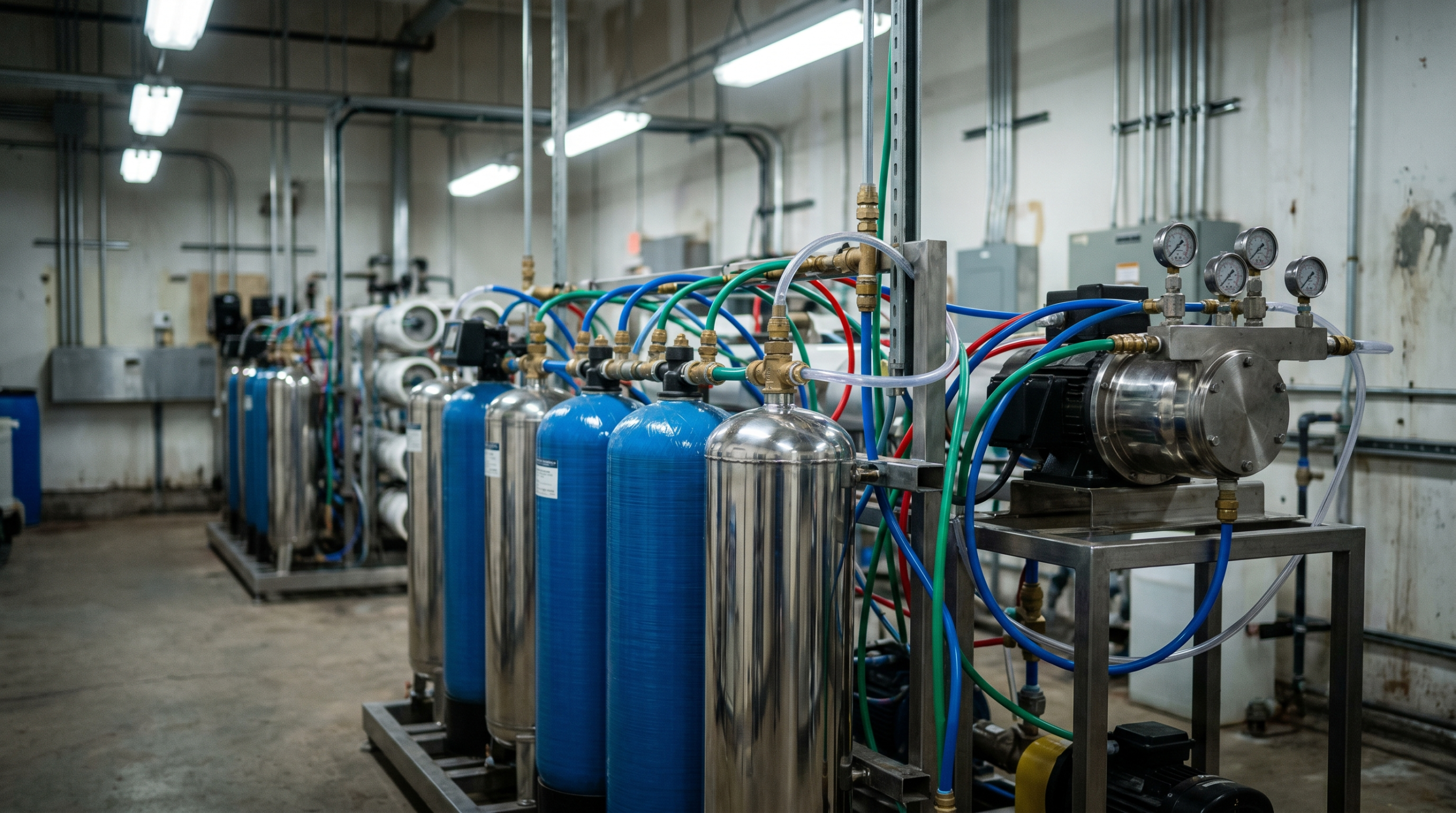

Reverse osmosis sounds complicated. The underlying principle isn’t. Water is pushed through a membrane so fine it passes water molecules and blocks nearly everything dissolved in them — salts, metals, nitrates, PFAS, bacteria. That’s it. What makes commercial and industrial RO systems complex is the engineering around that membrane: the pressure required to overcome osmotic pressure, the pre-treatment to protect the membrane, the recovery management to control waste, and the system controls that keep everything running reliably. This page explains how it all works.
The Osmosis Problem (and How RO Solves It)
Osmosis is the natural movement of water through a semi-permeable membrane from a region of lower dissolved solids concentration to a region of higher concentration. Left alone, water moves in the wrong direction for purification — toward the contaminated side.
Reverse osmosis applies pressure greater than the osmotic pressure of the feed water, forcing water to move against its natural direction — through the membrane and away from the dissolved contaminants. The pressure required depends on the TDS of the feed water:
| Feed Water Type | Typical TDS (ppm) | Osmotic Pressure (PSI) | Required Operating Pressure |
|---|---|---|---|
| Low-TDS municipal water | 100–300 ppm | 5–15 PSI | 50–100 PSI |
| Moderate-TDS municipal or well water | 300–1,000 ppm | 15–50 PSI | 100–200 PSI |
| High-TDS brackish groundwater | 1,000–5,000 ppm | 50–250 PSI | 200–400 PSI |
| Seawater | 30,000–45,000 ppm | 350–500 PSI | 800–1,200 PSI |
Operating pressure must exceed osmotic pressure to produce flow. The margin above osmotic pressure — called net driving pressure (NDP) — determines production rate. Lower NDP means lower flow; higher NDP means higher flow up to the membrane’s rated maximum pressure.
What the RO Membrane Actually Does
A commercial RO membrane is a thin-film composite (TFC) element consisting of three layers:
- Polyester support web (~120 µm thick) — structural layer, provides mechanical support
- Microporous polysulfone interlayer (~40 µm thick) — transition layer between support and active skin
- Ultrathin polyamide active layer (~0.2 µm thick) — the functional rejection layer where separation occurs
The polyamide active layer is what separates water from contaminants. Water molecules (H₂O, 0.275 nm diameter) pass through at a molecular level via a solution-diffusion mechanism — they dissolve into the membrane material, diffuse through it, and emerge on the permeate side. Contaminants are rejected by a combination of size exclusion (molecules larger than the membrane pore size cannot pass) and charge repulsion (the polyamide surface carries a slight negative charge that repels dissolved anions).
This is why RO removes both uncharged molecules (like urea — too large) and ionic contaminants (like nitrate — charged repulsion plus size) with very different mechanisms, but high efficiency for both.
The Four Streams in an RO System
| Stream | Also Called | Description |
|---|---|---|
| Feed water | Inlet water | Source water entering the system after pre-treatment |
| Permeate | Product water, RO water | Purified water that has passed through the membrane — the output you use |
| Concentrate | Reject, brine | Feed water that did not pass the membrane; contains all rejected contaminants at elevated concentration |
| Bypass | Blend stream | Optional: untreated feed water blended with permeate to achieve a target TDS (used in beverage and some process applications) |
Every RO system produces both permeate and concentrate. Concentrate must be disposed of — typically to drain, sewer, or in some industrial applications, evaporation. The ratio of permeate to feed water is the recovery rate, a critical system design parameter covered in detail in RO Recovery Rate Explained.
How a Commercial RO System Is Arranged
A commercial RO system is not just a membrane in a housing. The full system typically includes:
- Pre-treatment train — protects the membrane from fouling and damage. Minimum for municipal water: sediment pre-filter + carbon block. Well water typically requires additional pre-treatment for iron, hardness, and bacteria. See Commercial RO Buyer’s Guide for pre-treatment requirements by feed water type.
- High-pressure pump — raises feed water pressure to the operating level required to overcome osmotic pressure and produce flow. In commercial systems, this is typically a multi-stage centrifugal pump or a positive displacement pump rated for continuous-duty operation.
- Pressure vessel(s) — fiberglass or stainless steel housings, each containing one or more spiral-wound membrane elements in series. Commercial systems may have multiple pressure vessels arranged in arrays.
- Membrane elements — typically 4-inch (residential/light commercial) or 8-inch (commercial/industrial) spiral-wound TFC elements. Each element is a flat membrane sheet wound around a central permeate collection tube, with feed spacers between membrane layers to maintain flow channels.
- Instrumentation — feed pressure, permeate pressure, concentrate pressure gauges; TDS monitors on feed and permeate; flow meters; optional: conductivity sensor with automatic divert to drain for out-of-spec water.
- Control system — auto-shutoff on low feed pressure (pump protection), high-pressure shutoff, optional programmable auto-flush to clear concentrate from membrane surface during standby periods.
- Post-treatment (application-dependent) — UV disinfection, remineralization, pH adjustment, storage tank, booster pump, or polishing stages (EDI, mixed-bed DI) for high-purity applications.
What RO Removes (and Doesn’t Remove)
| Contaminant | Typical RO Rejection | Mechanism |
|---|---|---|
| Total dissolved solids (TDS) | 90–99% | Size exclusion + charge repulsion |
| Calcium, magnesium (hardness) | 95–99% | Size + charge |
| Nitrates (NO₃⁻) | 85–95% | Charge repulsion (monovalent anion, lowest rejection of common ions) |
| Arsenic (As(V)) | 92–96% | Size + charge (As(III) lower: 40–70% — oxidize to As(V) before RO) |
| Lead | 95–99% | Size + charge |
| PFAS (PFOA, PFOS) | 90–99% | Size exclusion (large molecules) |
| Fluoride | 90–96% | Size + charge |
| Chromium-6 (Cr(VI)) | 92–97% | Charge repulsion |
| Bacteria | 99.9% | Size exclusion (cells far too large for membrane pores) |
| Viruses | 99–99.9% | Size exclusion |
| Chlorine | Low (<50%) | Carbon pre-filter removes chlorine before membrane — not an RO function |
| Dissolved gases (CO₂, H₂S, radon) | Low | Small uncharged molecules pass through membrane; degassing equipment required |
Why Operating Conditions Change RO Performance
RO system output and rejection are not fixed values — they change with operating conditions:
- Temperature: Membrane permeability increases with temperature. A system producing 2,000 GPD at 77°F produces roughly 1,400 GPD at 55°F well water and 2,600 GPD at 95°F. Size for your coldest water temperature. See our RO Calculators for temperature derating.
- Feed TDS: Higher TDS increases osmotic pressure, reducing net driving pressure and output at the same operating pressure. Very high-TDS feed may require higher operating pressure or a larger pump.
- Recovery rate: As recovery increases (more permeate extracted from each unit of feed water), the concentrate TDS rises, increasing osmotic pressure and reducing output. Systems designed for higher recovery require more careful scaling management.
- Membrane fouling: As membranes accumulate scale, biofilm, or colloidal deposits over time, flow declines and the system must increase pressure to maintain output. Performance trending (normalized permeate flow, normalized salt rejection) detects fouling early, before it causes irreversible damage.
AMPAC USA RO Systems
AMPAC USA manufactures commercial and industrial reverse osmosis systems from 500 GPD to 500,000 GPD+, built in Woods Cross, UT. Standard commercial systems use FILMTEC™ BW30 series membranes in fiberglass pressure vessels on powder-coated aluminum or stainless steel frames, with Cat Pumps or Grundfos high-pressure pumps and factory pressure-test and performance-verification before shipping.
Ready to specify an RO system? Contact AMPAC USA with your daily water requirement, feed water source, and any water test data — we’ll provide a complete system specification and quote within one business day.
Related: RO Membrane Types | RO Recovery Rate Explained | RO Rejection Rate: What It Means and How to Measure It | RO System Calculators
Related Articles
- Water Softener vs Reverse Osmosis: Which Do You Need? | AMPAC USA
- The Pros and Cons of Reverse Osmosis Filtration Process-Ampac USA
- Ampac USA-A Comprehensive Guide on Reverse Osmosis
- Ampac USA- Pre-Treatment Solutions in Reverse Osmosis
Frequently Asked Questions
How does reverse osmosis actually work?
Pressure greater than the feed water’s natural osmotic pressure is applied, forcing water molecules through a semi-permeable membrane while blocking dissolved salts, metals, nitrates, PFAS, and bacteria. The required pressure increases with feed water TDS, from 50-100 PSI for low-TDS municipal water up to 800-1,200 PSI for seawater.
What are the four streams in an RO system?
Feed water (source water entering the system), permeate (purified product water), concentrate (rejected water carrying contaminants at elevated concentration), and an optional bypass or blend stream used in some beverage applications to hit a target TDS.
What does reverse osmosis not remove effectively?
Dissolved gases like CO2, H2S, and radon pass through the membrane largely unaffected since they are small and uncharged, and chlorine removal is handled by the carbon pre-filter rather than the membrane itself.
How does temperature affect RO system output?
Membrane permeability increases with temperature. A system producing 2,000 GPD at 77 degrees Fahrenheit may only produce about 1,400 GPD at 55 degrees, so systems should be sized for the coldest expected feed water temperature, not an average.