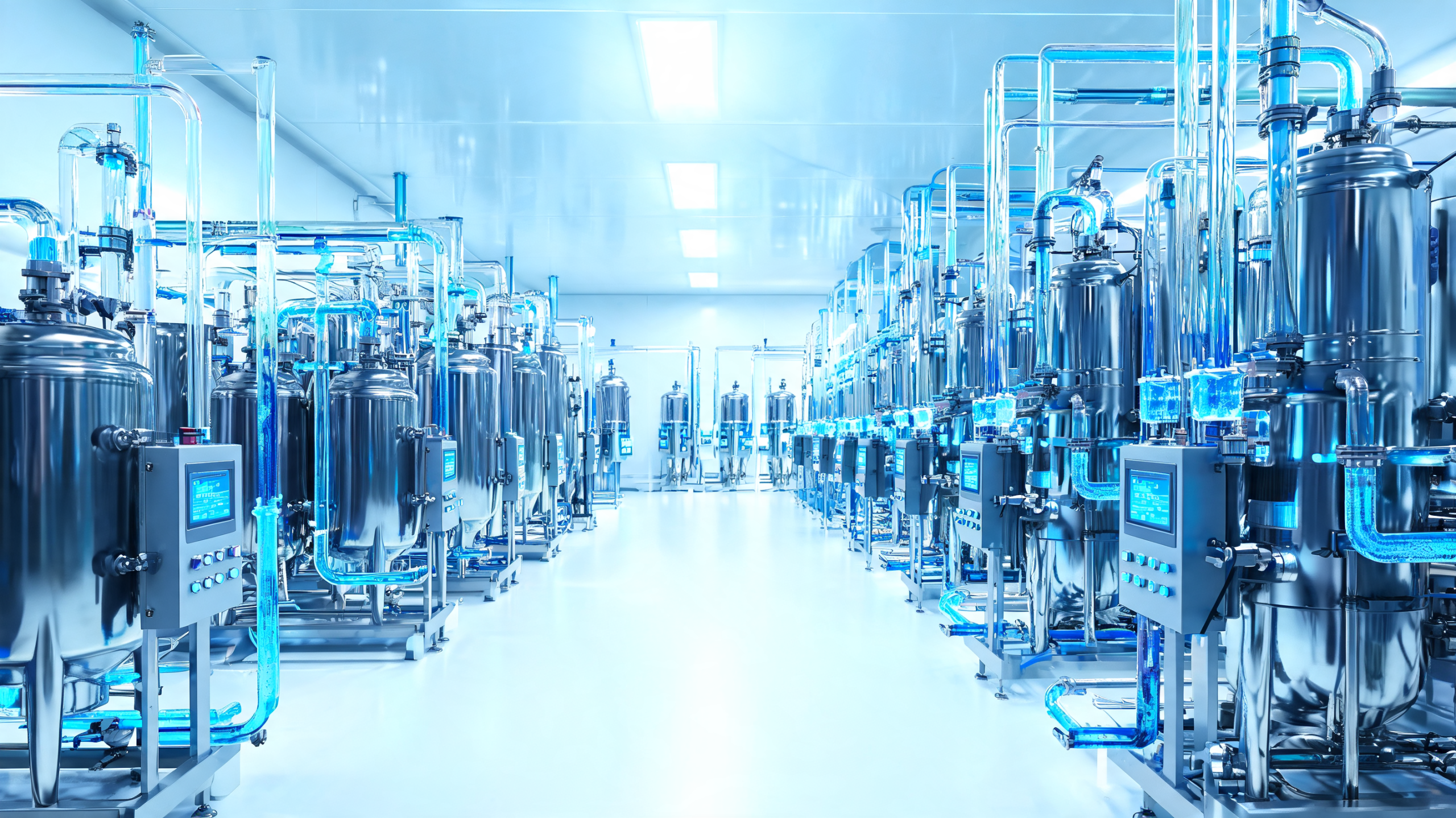

Pharmaceutical makers don’t get to round up on water quality. USP Purified Water has to hit strict conductivity limits every single time – because total dissolved solids directly affect conductivity readings, microbial control, and what ends up in the final product. Here’s what the TDS requirements actually look like, and how well-designed reverse osmosis systems keep everything in spec.
USP Purified Water conductivity and TDS limits
USP Chapter <645 doesn’t name a hard TDS number. It tests conductivity instead, which tracks closely enough with dissolved solids to serve as the effective limit. Stage 1 sets the bar at conductivity under 1.3 µS/cm at 25°C with temperature compensation off. That typically lines up with TDS below 0.7 to 1.0 ppm – though the exact match depends on what ions are in the feed water.
Fail Stage 1 and the test moves to Stages 2 and 3, each with tighter temperature controls. Clear any stage and the water’s compliant. Push past all three and you’re looking at rejected batches, regulatory findings, or a production shutdown. None of those are cheap.
How TDS and conductivity work together on the floor
Why does USP test conductivity instead of TDS directly? Because conductivity measurements are fast, continuous, and easy to validate under real production conditions – far more practical than pulling grab samples for TDS analysis every hour. Operators commonly multiply conductivity by 0.5 to 0.7 to estimate TDS. A 1.0 µS/cm reading means roughly 0.5 to 0.7 ppm TDS. Smart systems target well below the USP limit, not right at it, so there’s buffer when feedwater shifts with the seasons or membranes start to age.
How reverse osmosis cuts TDS down
A single RO pass strips out 95 to 99 percent of dissolved ions, organics, and particles at the pressures and recoveries used in pharma. Multi-stage setups push TDS further into the sub-ppm range that USP demands. Add electrodeionization or mixed-bed polishing downstream and the train routinely delivers 0.1 to 0.5 µS/cm conductivity. Consistently. Not just when the feed water cooperates.
Performance depends on feed quality, membrane choice, and recovery settings. High-rejection thin-film composite membranes rated at 99.7% NaCl rejection are standard in pharmaceutical designs for a reason.
Typical RO numbers in pharma service
- Recovery sits between 50 and 75 percent per stage, based on feed TDS.
- Operating pressure runs 150 to 250 psi on brackish sources.
- Permeate conductivity lands under 1 µS/cm before any polishing step.
- TOC drops 90 to 95 percent right along with TDS.
Building a pharmaceutical-grade RO system
A compliant setup starts with pretreatment that shields the membranes and keeps permeate quality steady. Multi-media filters, activated carbon, and antiscalant dosing come first. After that, you need sanitary piping in 316L stainless steel with orbitally welded joints – because dead legs are where bacteria hide, and regulators know exactly where to look.
Key design features
- Hot-water or chemical sanitization capability built in from the start.
- Continuous recirculation loops after the RO vessels.
- Online conductivity and TOC sensors with defined alarm setpoints.
- Data logging that satisfies 21 CFR Part 11 requirements.
- Redundant pumps and membranes so a single failure doesn’t shut down production.
Validation, monitoring, and day-to-day care
Installation qualification confirms every component matches the design spec. Operational qualification proves the system hits conductivity, TOC, and microbial targets even under worst-case conditions. Performance qualification runs it through a set period with daily samples. (The regulators want all three documented. Skip one and the inspection doesn’t go well.)
On an ongoing basis: daily conductivity checks, weekly TOC tests, monthly microbial counts. Clean the membranes when normalized permeate flow falls 10 to 15 percent or differential pressure climbs above baseline. Approved sanitizers followed by thorough rinses bring rejection back above 99 percent.
Practical steps for picking and running the system
- Run a full feed-water analysis for TDS, hardness, silica, and organics before sizing anything.
- Size the array for 60 to 70 percent recovery while keeping the concentrate ratio safe from scaling.
- Choose membranes that carry documented pharmaceutical-grade certifications. Not just “food grade.”
- Place continuous conductivity sensors right after each RO stage and after final polishing.
- Write a change-control procedure for membrane swaps or new cleaning chemicals.
- Train operators on alert and action limits tied directly to USP <645 stages – not generic numbers someone wrote on a whiteboard.
Bottom line
USP Purified Water compliance isn’t a documentation exercise. It’s a live system problem. The conductivity limits are tight, the validation requirements are specific, and the cost of getting it wrong – in rejected product, regulatory action, or both – is real. A well-designed RO system with solid pretreatment, proper sanitization capability, and continuous monitoring gets you there. But only if the validation was done right and the operators know what the numbers actually mean.
See our industrial reverse osmosis systems engineered for pharmaceutical-grade water production.
Frequently Asked Questions
What conductivity limit must USP Purified Water meet?
USP Chapter 645 sets Stage 1 at conductivity under 1.3 uS/cm at 25C with temperature compensation off, which typically corresponds to TDS below 0.7 to 1.0 ppm depending on the ions present in the feed water.
Can a single-pass RO system meet USP Purified Water requirements alone?
A single RO pass strips out 95-99 percent of dissolved ions, but multi-stage RO plus electrodeionization or mixed-bed polishing downstream is what reliably delivers the 0.1-0.5 uS/cm conductivity USP requires, consistently rather than only when feed water conditions are favorable.
What construction is required for pharmaceutical-grade RO piping?
316L stainless steel with orbitally welded joints, since dead legs in piping are where bacteria can hide and regulators specifically inspect for them.
How often should a pharmaceutical RO system be monitored and cleaned?
Daily conductivity checks, weekly TOC tests, and monthly microbial counts. Membranes should be cleaned when normalized permeate flow falls 10-15 percent or differential pressure climbs above baseline.