
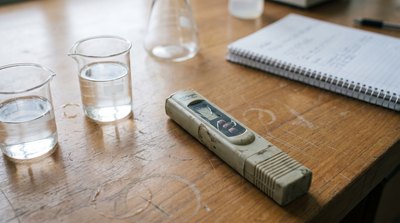
Most RO operators check a TDS pen once a week, see a number under 50, and call it good. That’s not wrong – but it’s incomplete. TDS tells you the membrane is rejecting salts. It doesn’t tell you which salts, whether the reading is trending in the wrong direction, or whether your pretreatment is quietly degrading the membrane one week at a time. The four parameters below together give you an actual picture of system health.
The Four Core RO Water Quality Parameters
1. TDS – Total Dissolved Solids
TDS is the aggregate weight of all dissolved minerals, salts, and organics in your water, measured in parts per million (ppm) or milligrams per liter (mg/L). For RO permeate (the product water), TDS is the primary go/no-go metric.
| Application | Target Permeate TDS | Reject if Above |
|---|---|---|
| Restaurant / food service drinking water | <50 ppm | 150 ppm |
| Water store / vending | <30 ppm | 50 ppm |
| Boiler feedwater (low pressure, <300 psi) | <100 ppm | 150 ppm |
| Boiler feedwater (high pressure, >600 psi) | <1 ppm | 5 ppm (needs EDI) |
| Pharmaceutical (USP purified water) | <0.5 ppm (500 µg/L) | Per USP <645> |
| Laboratory (Type II water) | <1 ppm | 5 ppm |
| Semiconductor / Type I UPW | <0.005 ppm (5 ppb) | Resistivity <18 MΩ·cm |
What a rising TDS tells you: If your permeate TDS increases by 10-15% from the system’s baseline, that’s an early warning. Gradual TDS rise over weeks usually means membrane fouling or scaling. A sudden jump – 30%+ overnight – suggests a mechanical failure: broken O-ring, telescoped membrane element, or a bypass leak.
2. Conductivity
Conductivity measures how well water carries an electrical charge – which is directly proportional to its dissolved ion content. It’s essentially TDS measured electronically, in microsiemens per centimeter (µS/cm). Most inline RO monitors measure conductivity rather than TDS and convert using a factor (typically 0.5-0.7 depending on ion composition).
Salt rejection formula: Rejection (%) = (1 - Permeate Conductivity / Feed Conductivity) × 100
A new membrane should reject 97-99% of ions. If rejection drops to 90% or below on a system that was previously performing at 98%, the membrane is either fouled, scaled, or damaged.
3. pH
RO membranes don’t remove dissolved CO2 – only ions. Carbon dioxide passes through freely, then dissolves into the permeate as carbonic acid, dropping pH to 5.5-6.5 even when the feed water is neutral. This is normal. It confuses a lot of operators who test permeate pH, see 5.8, and assume something is wrong.
| pH Range (Permeate) | Likely Cause | Action |
|---|---|---|
| 5.5-6.5 | Normal – CO2 passthrough | None required for most uses |
| <5.5 | High CO2 in feed, acidic source water, or acid injection issue | Check feed pH; test for acid dosing fault |
| >7.5 | Caustic contamination, NaOH carryover from CIP, or membrane degradation | Investigate pretreatment chemistry immediately |
pH becomes critical in two contexts: boiler feedwater (where low pH accelerates corrosion) and pharmaceutical water (where USP standards define conductivity limits at measured pH). For drinking water applications, if end users are concerned about acidity, a calcite or alkaline post-filter resolves it without affecting membrane performance.
4. Hardness
Hardness (calcium and magnesium ions) is what the RO membrane was primarily designed to reject. Permeate hardness should be near zero – typically <1 grain per gallon (GPG) or <17 ppm as CaCO3. If hardness is measurable in the permeate, one of three things is happening:
- The membrane is damaged or at end of life
- There’s a bypass leak (O-ring, glue line, or interconnector failure)
- Feed water hardness is so high (400+ ppm) that even 98% rejection leaves detectable hardness in the permeate – in which case softener pretreatment or a second-pass RO is needed
Calculating and Monitoring Salt Rejection
Salt rejection is the single most useful diagnostic number for an RO membrane. Most operators don’t track it – they should.
SR (%) = (1 – Cp / Cf) × 100
Where:
Cp = Permeate conductivity (or TDS)
Cf = Feed conductivity (or TDS)
Example: Feed = 800 µS/cm, Permeate = 16 µS/cm → SR = (1 – 16/800) × 100 = 98%
Log this number monthly. A 2% drop in rejection over 6 months is normal membrane aging. A 5% drop in one month means something changed – check antiscalant dosing, SDI, chlorine exposure, and pH before assuming the membrane is done.
What Bad Numbers Usually Mean in Practice
| Symptom | Most Likely Cause | Check First |
|---|---|---|
| TDS creeping up 10-20% over months | Membrane fouling (biological or mineral) | SDI, antiscalant dosing, CIP schedule |
| TDS jumps 50%+ overnight | O-ring failure, membrane bypass, or damaged element | Pressure vessel integrity, element seals |
| High TDS + low pressure differential | Membrane compaction or aging | Operating hours, last replacement date |
| High TDS + high pressure differential | Scaling (calcium carbonate, silica, barium sulfate) | Langelier Saturation Index, antiscalant log |
| Low TDS but low flow rate | Biofouling on feed spacer (pressure drop without rejection loss early on) | Normalized permeate flow, microbial testing |
| Permeate pH below 5.5 | High CO2 in feed or acid dosing fault | Feed water source, acid injection rate |
Feed Water Quality: What the RO Sees Before the Membrane
Permeate quality is determined upstream. No amount of membrane technology compensates for poorly conditioned feed water. The three feed water parameters that most directly affect RO performance:
SDI – Silt Density Index
SDI measures particulate fouling potential. RO membranes require SDI <5; most membrane manufacturers recommend SDI <3 for rated performance and warranty coverage. SDI above 5 clogs feed spacers, increases differential pressure, and forces more frequent cleaning. This is a pretreatment problem – usually resolved with multimedia filtration, ultrafiltration, or better coagulation upstream.
Free Chlorine
Polyamide thin-film composite membranes (the type in virtually every commercial and industrial RO) are intolerant of oxidants. Free chlorine above 0.1 ppm will degrade membrane performance – initially through reduced rejection, ultimately through physical breakdown of the polyamide layer. Municipal water users must dechlorinate with sodium metabisulfite or activated carbon before the feed pump. This is non-negotiable. Chlorine damage is irreversible and voids membrane warranties.
Langelier Saturation Index (LSI)
LSI predicts whether calcium carbonate will precipitate out of solution and scale the membrane. LSI above +0.5 at the concentrate side means scaling risk. The fix is antiscalant dosing, acid injection to drop pH (which shifts the carbonate equilibrium), or softening to reduce hardness. For brackish water systems with high TDS feed, running the Stiff & Davis Stability Index (SDSI) gives a more accurate picture than LSI.
Recommended Monitoring Schedule
| Parameter | Frequency | Method | Alert Threshold |
|---|---|---|---|
| Permeate TDS | Daily (or continuous) | Inline sensor or TDS pen | >15% above baseline |
| Salt rejection | Weekly | Feed + permeate conductivity | <95% (was >97%) |
| Differential pressure | Weekly | Pressure gauges, feed vs. concentrate | >15% above clean baseline |
| SDI | Monthly (or after any source water change) | SDI test kit, 0.45µm membrane | >3 (act at >5) |
| Free chlorine | Daily (municipal feed) | DPD test or ORP sensor | Any detectable level (>0.05 ppm) |
| Feed pH | Daily | Inline pH sensor | <5.5 or >8.5 to membrane |
| Permeate hardness | Monthly | Titration or test strips | Any detectable hardness (>1 GPG) |
FAQ
What TDS should RO water be for drinking?
The WHO guideline for palatable drinking water is below 600 ppm TDS, but most people prefer water under 150 ppm. RO systems typically produce 10-50 ppm permeate from municipal supply. For water stores and vending, many operators target below 30 ppm for customer satisfaction and competitive differentiation.
Why is my RO water pH acidic?
RO membranes pass dissolved CO2 freely. CO2 dissolves in the permeate to form carbonic acid, which drops pH to 5.5-6.5. This is completely normal and harmless for most applications. If pH needs to be raised for drinking water or boiler makeup, a calcite post-filter or alkaline cartridge brings it back to 7-8 without affecting membrane performance.
How do I know if my RO membrane needs replacement?
Three signals: (1) Salt rejection has dropped more than 3-4% from the membrane’s original performance at similar operating conditions. (2) Normalized permeate flow has decreased more than 15% from baseline, indicating fouling that cleaning cannot reverse. (3) The system has exceeded the manufacturer’s rated operating hours (typically 3-5 years for commercial membranes, 2-3 years in high-SDI or high-temperature applications). CIP cleaning can restore performance when fouling is the issue – but if rejection is low and cleaning doesn’t recover it, the membrane is done.
What is a good conductivity reading for RO water?
For commercial drinking water applications, permeate conductivity below 80 µS/cm is the typical target (roughly <50 ppm TDS). For boiler feedwater, below 30 µS/cm for low-pressure boilers, and below 1 µS/cm for high-pressure steam generation. Laboratory and pharmaceutical applications use conductivity as the primary compliance parameter – USP purified water requires conductivity below 1.3 µS/cm at 25°C.
Need an RO system built to hit your water quality targets?
AMPAC USA engineers RO systems to your feed water analysis and permeate requirements. Whether you’re targeting 50 ppm for a water store, <1 ppm for a high-pressure boiler, or USP-grade for pharmaceutical production – we size and configure the pretreatment, membrane array, and monitoring to get there.
Request a free system evaluation →
Related: Boiler Feed Water Treatment Guide | Brackish Water RO Systems | Ultrapure Water and EDI
Frequently Asked Questions
What TDS should RO water be for drinking?
The WHO guideline for palatable drinking water is below 600 ppm TDS, but most people prefer water under 150 ppm. RO systems typically produce 10-50 ppm permeate from municipal supply. For water stores and vending, many operators target below 30 ppm for customer satisfaction and competitive differentiation.
Why is my RO water pH acidic?
RO membranes pass dissolved CO2 freely. CO2 dissolves in the permeate to form carbonic acid, which drops pH to 5.5-6.5. This is completely normal and harmless for most applications. If pH needs to be raised for drinking water or boiler makeup, a calcite post-filter or alkaline cartridge brings it back to 7-8 without affecting membrane performance.
How do I know if my RO membrane needs replacement?
Three signals: salt rejection has dropped more than 3-4 percent from the membrane original performance, normalized permeate flow has decreased more than 15 percent from baseline, or the system has exceeded the manufacturer rated operating hours (typically 3-5 years for commercial membranes).
What is a good conductivity reading for RO water?
For commercial drinking water applications, permeate conductivity below 80 uS/cm is the typical target (roughly under 50 ppm TDS). For boiler feedwater, below 30 uS/cm for low-pressure boilers, and below 1 uS/cm for high-pressure steam generation. USP purified water requires conductivity below 1.3 uS/cm at 25C.