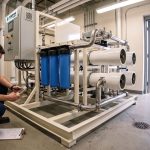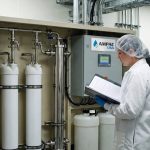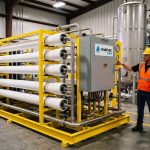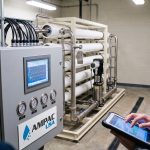

Industrial reverse osmosis treatment is essential for producing pure water at scale in manufacturing, power generation, pharmaceuticals, food and beverage, and electronics. Access to pure, safe, and reliable water is a cornerstone of industrial success, and industrial reverse osmosis (RO) treatment has emerged as the critical solution — ensuring consistent water quality, protecting expensive equipment, reducing operational costs, and complying with strict regulatory standards.
What Is Industrial Reverse Osmosis Treatment?
Reverse Osmosis (RO) is a process that uses a semi-permeable membrane to remove dissolved salts, impurities, and contaminants from water. In an industrial setting, industrial reverse osmosis treatment is scaled up with high-capacity pumps, membranes, and pre-treatment equipment to handle massive volumes of water. According to EPA guidance on membrane filtration, industrial RO achieves up to 99% rejection of dissolved solids, making it the gold standard for process water purification.
Why Industrial Reverse Osmosis Treatment Is Vital
Protection of Equipment and Infrastructure
Hard water and dissolved minerals lead to scaling, corrosion, and fouling in boilers, heat exchangers, and pipelines. Industrial RO treatment prevents mineral buildup, ensuring smooth operation and reducing costly repairs.
Compliance With Industry Standards
Industries like pharmaceuticals and electronics must meet stringent purity standards, such as USP, ISO, and ASTM guidelines. RO-treated water provides consistent compliance, helping businesses avoid penalties and reputational risks.
Optimizing Production Quality
In food and beverage production, water quality directly impacts taste, safety, and shelf life. In pharmaceuticals, ultrapure water is essential for drug formulation. Industrial RO treatment guarantees stable and high-quality output across production lines.
Cost Efficiency and Sustainability
By reducing reliance on chemical treatments and lowering energy consumption in downstream systems, RO minimizes operational expenses and supports sustainability goals by enabling water reuse and reducing wastewater discharge.
How Industrial Reverse Osmosis Systems Work
- Pre-Treatment Stage — Water passes through sand filters, activated carbon filters, and water softeners to remove suspended solids, chlorine, and hardness that could damage RO membranes.
- High-Pressure Pumping — A high-pressure pump forces water through the RO membranes, overcoming osmotic pressure.
- Membrane Filtration — Semi-permeable membranes remove dissolved salts, organics, and microorganisms, producing permeate (pure water) and concentrate (rejected brine).
- Post-Treatment — UV disinfection, pH adjustment, and remineralization ensure water meets specific industrial requirements.
- Storage and Distribution — Purified water is stored in sanitized tanks and distributed through pipelines with safeguards against recontamination.
Key Applications of Industrial Reverse Osmosis
Power Plants
Power plants use RO-treated water in boilers and cooling towers, preventing scale and corrosion while improving efficiency. See also: How a Water Treatment Plant RO System Works.
Food and Beverage Industry
Breweries, dairies, and bottling plants rely on RO to ensure taste consistency and safety in products.
Pharmaceutical and Biotechnology
RO water is vital for drug manufacturing, laboratory use, and sterile environments, ensuring compliance with global pharmacopeia standards.
Electronics and Semiconductor Manufacturing
Ultra-pure water is essential for microchip production and precision cleaning. RO ensures zero ionic contamination. Learn more in our guide to Ultra-Pure Water Industries.
Benefits of Industrial Reverse Osmosis Treatment
-
Unmatched Purity — RO achieves up to 99% rejection of dissolved salts and impurities.
-
Operational Reliability — Stable water quality minimizes process interruptions.
-
Reduced Chemical Usage — RO reduces reliance on harsh chemicals for water conditioning.
-
Water Reuse and Conservation — Industries can recycle wastewater through RO.
-
Scalability — Industrial RO systems can be customized for small-scale plants or large manufacturing facilities.
Challenges and Solutions in Industrial RO Systems
- Membrane Fouling: Caused by suspended solids and biological growth. Solution: Effective pre-treatment, anti-scalants, and regular cleaning cycles.
- High Energy Consumption: Pressure pumps consume significant energy. Solution: Energy recovery devices and advanced membrane technologies.
- Wastewater Disposal: RO produces concentrated brine. Solution: Zero-liquid discharge systems and recycling technologies.
Technological Innovations in Industrial RO
- Energy Recovery Devices (ERDs) to reduce power consumption.
- Nanocomposite Membranes for higher rejection rates and durability.
- Automation and IoT Integration for real-time monitoring and predictive maintenance.
- Hybrid Systems combining RO with ultrafiltration, EDI (electrodeionization), and nanofiltration.
Related reading: Industrial RO System Components Explained and Conductivity of RO Water.
Conclusion
Industrial reverse osmosis treatment is the backbone of modern water purification strategies worldwide. Its ability to deliver pure, reliable, and sustainable water supply ensures operational efficiency, compliance, and cost savings. From pharmaceuticals and electronics to power plants and food processing, industrial RO treatment safeguards both production and profitability. As industries continue to evolve, the reliance on industrial reverse osmosis will only increase.
Frequently Asked Questions
What percentage of dissolved solids can industrial reverse osmosis systems remove?
Industrial reverse osmosis (RO) systems are highly effective, achieving up to 99% rejection of dissolved solids and impurities. This makes RO the gold standard for process water purification, ensuring consistent water quality for critical industrial applications.
Which key industries critically depend on industrial reverse osmosis for their pure water supply?
Key industries such as manufacturing, power generation, pharmaceuticals, food and beverage, and electronics critically depend on industrial RO. These sectors require consistent, high-purity water for everything from drug formulation and product quality to protecting expensive equipment and ensuring regulatory compliance.
How does industrial reverse osmosis protect critical industrial equipment and infrastructure?
Industrial RO treatment prevents the damaging effects of hard water and dissolved minerals, such as scaling, corrosion, and fouling in boilers, heat exchangers, and pipelines. By eliminating these mineral buildups, it ensures smooth operation, extends equipment lifespan, and significantly reduces costly maintenance and repairs.
What essential pre-treatment steps are involved in an industrial reverse osmosis system?
Essential pre-treatment for industrial RO systems includes sand filters to remove suspended solids, activated carbon filters for chlorine removal, and water softeners to eliminate hardness. These steps are crucial for protecting the delicate RO membranes from damage and ensuring optimal system performance and longevity.
What are the primary cost efficiency and sustainability benefits of implementing industrial RO?
Industrial RO significantly reduces operational expenses by minimizing reliance on chemical treatments and lowering energy consumption in downstream systems. Furthermore, it supports sustainability goals by enabling water reuse and substantially reducing wastewater discharge, leading to a more environmentally responsible and cost-effective operation.
AMPAC USA engineers custom water purification systems for commercial, industrial, and emergency applications — from 500 GPD to multi-million GPD. Trusted by municipalities, military, and industry worldwide.