
Quick answer: Brackish water is water that is saltier than freshwater but not as salty as seawater, typically 1,000 to 10,000 ppm of total dissolved solids (TDS). It forms where fresh and salt water mix, such as estuaries and coastal aquifers, and it is treated with brackish water reverse osmosis (BWRO).
Brackish water sits in a salinity range between freshwater and seawater – typically 1,000 to 10,000 parts per million (ppm) of total dissolved solids (TDS). It’s too salty to drink untreated and too fresh to be considered seawater, which puts it in a treatment category of its own. Brackish water reverse osmosis systems are the standard solution for industries and municipalities that draw from these sources.
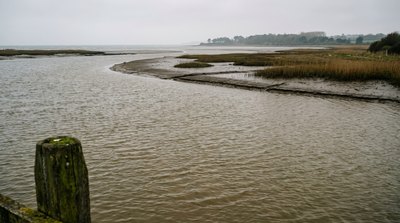
You encounter brackish water most often in estuaries where rivers meet the ocean, in coastal aquifers that have seen saltwater intrusion, in agricultural drainage systems, and in produced water from oil and gas operations. For industrial facilities and municipalities drawing from these sources, the salinity level requires a purpose-built treatment approach.
How Brackish Water Differs from Seawater
Seawater runs at roughly 35,000 ppm TDS. Brackish water is anywhere from 3% to 29% as saline. That difference matters enormously for treatment design: a seawater reverse osmosis (SWRO) system operates at 800-1,200 psi of feed pressure, while a brackish water RO (BWRO) system typically runs at 150-400 psi. Lower pressure means lower energy consumption – often 0.5-1.5 kWh per 1,000 gallons for brackish RO versus 3-6 kWh for seawater RO. The U.S. Environmental Protection Agency classifies brackish groundwater as a key alternative water source in water-stressed regions.
Freshwater vs. Brackish Water vs. Seawater: Where the Lines Actually Fall
Freshwater runs under 1,000 ppm TDS, brackish water sits at 1,000-10,000 ppm, and seawater averages around 35,000 ppm (USGS, 2025). That’s not just a number on a lab report. It’s the line that decides whether your source needs simple filtration or a full desalination train.
Most people assume “salty water” is one category. It isn’t. The USGS actually splits saline water into three bands: slightly saline (1,000-3,000 ppm), moderately saline (3,000-10,000 ppm), and highly saline, which is anything above 10,000 ppm and includes seawater. Brackish water spans the first two bands – which is exactly why one “brackish water system” spec sheet rarely fits every site.
| Parameter | Freshwater | Brackish Water | Seawater |
|---|---|---|---|
| TDS Range | Under 1,000 ppm | 1,000-10,000 ppm | 30,000-45,000 ppm |
| Typical Sources | Rivers, lakes, unconfined aquifers | Coastal aquifers, estuaries, farm drainage, oilfield produced water | Open ocean, tidal basins |
| Safe to Drink Untreated? | Usually, with basic disinfection | No – exceeds EPA’s secondary taste/odor standard | No |
| Standard Treatment | Filtration + disinfection | Reverse osmosis, ion exchange, or electrodialysis | Seawater RO or thermal distillation |
Here’s the part that surprises people who are new to this: brackish water shows up in more places than seawater ever will. Coastal aquifers that have seen saltwater intrusion, inland aquifers sitting over ancient marine deposits, irrigation return flow, oilfield produced water – all of it lands somewhere in that 1,000-10,000 ppm band. If your facility is more than a few miles from the coast and still pulling salty groundwater, brackish is almost always the answer, not seawater.
Effective Treatment Methods for Brackish Water
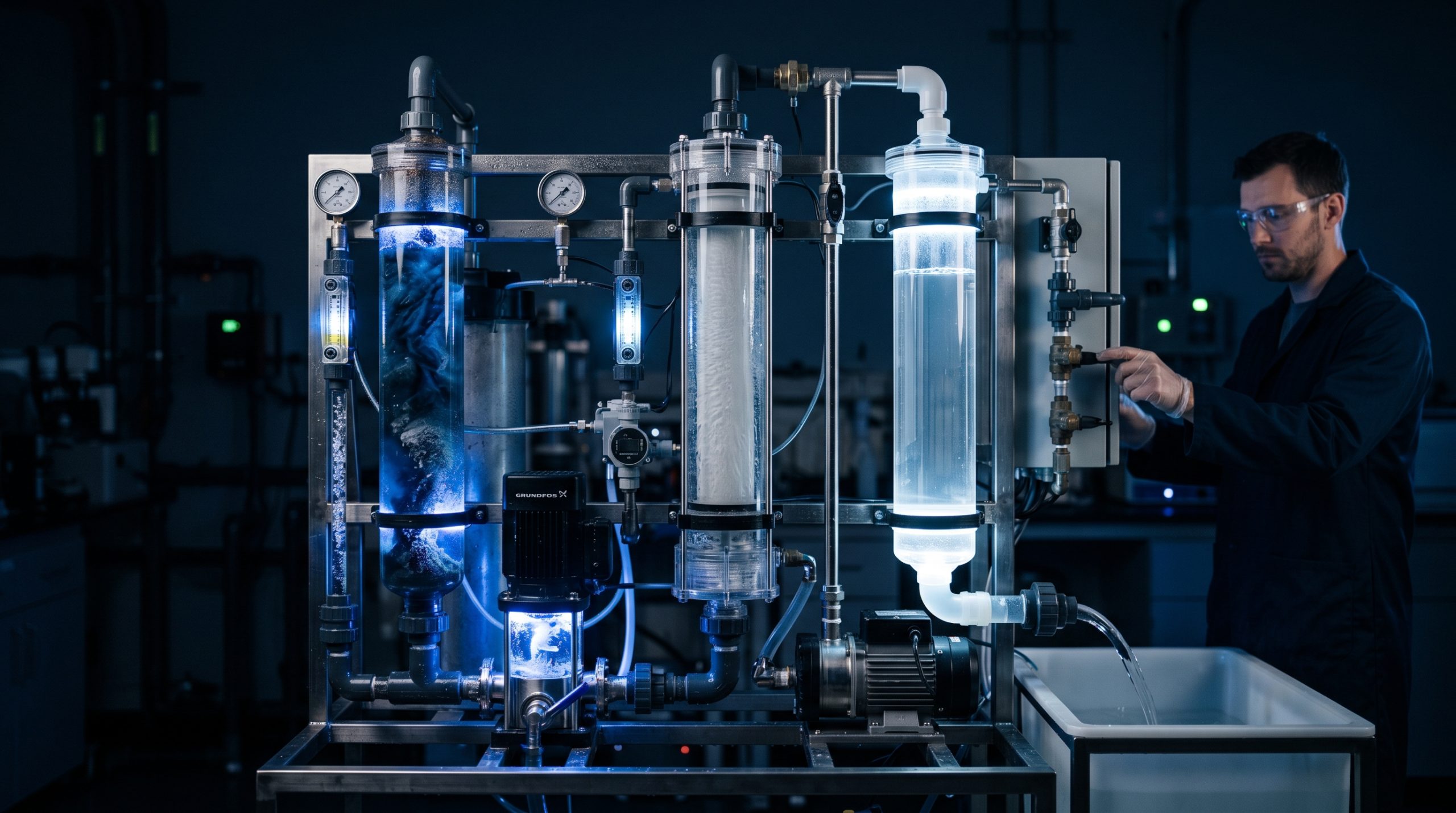
Reverse osmosis is the standard for brackish water purification. A properly designed BWRO system will remove 95-99% of dissolved salts, heavy metals, nitrates, and most organic contaminants in a single pass. The key design variables are the TDS of the source, the desired permeate quality, and the required flow rate.
Pre-Treatment Requirements
Pre-treatment ahead of the RO membranes typically includes multimedia filtration to remove suspended solids, activated carbon to strip chlorine and organics that would degrade the membrane, and antiscalant dosing to prevent calcium carbonate and sulfate scaling on the membrane surface. The American Water Works Association (AWWA) recommends SDI (Silt Density Index) testing before sizing any membrane system.
Two-Pass RO for High-TDS Sources
For very high-TDS brackish water above 5,000 ppm, a two-pass RO configuration may be appropriate, running permeate from the first membrane stage through a second set of membranes to achieve pharmaceutical-grade or boiler-feed-quality output.
Ion Exchange as a Polishing Step
Ion exchange is an alternative for lower-volume applications or for polishing after RO, particularly when specific ions like nitrates or hardness minerals are the primary concern. NSF International certifies both RO membranes and ion exchange resins under Standards 58 and 44 respectively.
RO vs. Electrodialysis vs. Ion Exchange: Which One Actually Wins?
Reverse osmosis handles the widest TDS range and the broadest contaminant list of the three, which is why it’s the default choice for most brackish water projects. Electrodialysis and ion exchange both work, but each one solves a narrower problem – and knowing which narrow problem matters before you spec a system.
Electrodialysis reversal (EDR) pulls dissolved ions through selective membranes using an electric field instead of pressure. It’s genuinely good at what it does. Periodically reversing polarity helps EDR shed scale that would otherwise clog an RO membrane, and some EDR configurations report water recovery above 90% (peer-reviewed EDR performance research, 2022). But it only removes ionic contaminants. Bacteria, viruses, and dissolved organics pass right through, and EDR’s practical ceiling sits around 5,000-6,000 ppm TDS – roughly the midpoint of the brackish range, not the top of it.
Ion exchange swaps unwanted ions (calcium, nitrate, specific anions) for a preferred one, usually sodium or hydrogen, using resin beads. It’s cheap and it’s precise for one job. It’s a poor fit as a standalone system for anything above roughly 1,500 ppm TDS, because the resin exhausts fast and needs constant regeneration, which means more brine waste, not less.
| Criterion | Reverse Osmosis | Electrodialysis (EDR) | Ion Exchange |
|---|---|---|---|
| Effective TDS Range | Up to 10,000+ ppm | Best under 5,000-6,000 ppm | Best under 1,500 ppm, or as a polish |
| Removes | Salts, heavy metals, nitrates, organics, pathogens | Dissolved ionic salts only | Targeted ions only |
| Typical Recovery | 50-85% | Up to ~90%+ in some setups | Near 100% product, high resin/brine waste |
| Scaling Tolerance | Moderate – needs antiscalant | Higher – polarity reversal sheds scale | Low – fouls from particulates fast |
| Best Fit | Full-spectrum brackish desalination, any scale | Cooling tower blowdown reuse, moderate-TDS niche cases | Small-scale polishing, single-contaminant targeting |
So why does RO end up as the industry standard for brackish water instead of EDR or ion exchange alone? Because it’s the only one of the three that handles the full contaminant picture – salts, nitrates, heavy metals, and pathogens – in a single pass, at any scale from a 500 GPD skid to a multi-million-gallon plant. That’s the whole reason AMPAC USA builds its commercial reverse osmosis systems and industrial reverse osmosis systems around RO as the core technology, with EDR and ion exchange reserved for the specific jobs where they genuinely outperform it (cooling tower reuse, final polishing, and similar edge cases).
Brackish Water vs. Seawater: Which System Do You Need?
| Parameter | Brackish Water RO | Seawater RO |
|---|---|---|
| Source TDS | 1,000-10,000 ppm | 30,000-45,000 ppm |
| Operating Pressure | 150-400 psi | 800-1,200 psi |
| Energy Use | 0.5-1.5 kWh/1,000 gal | 3-6 kWh/1,000 gal |
| Salt Rejection | 95-99% | 99-99.8% |
Industrial Applications for Brackish Water Treatment
- Municipal water supply: Coastal cities augmenting freshwater supplies with treated brackish groundwater
- Power generation: Boiler feed water requiring low-conductivity input
- Food and beverage: Process water and ingredient water requiring consistent TDS
- Pharmaceutical manufacturing: USP purified water production from brackish sources
- Agricultural irrigation: Treated brackish water for salt-sensitive crops
Brackish Water RO System Design: What Actually Changes at the Engineering Level
A brackish water RO system isn’t a scaled-down seawater plant. The membranes, the chemistry, and the recovery math are all built around a different problem – and getting any one of them wrong is usually what turns a “working” system into an expensive one within a year.
Membrane Selection and Staging
Brackish water RO (BWRO) membranes are rated for lower pressure than seawater RO (SWRO) membranes, typically 225-600 psi versus up to 1,200 psi for SWRO. That’s not a downgrade. It’s a deliberate design choice: at 1,000-10,000 ppm TDS, you don’t need SWRO-grade rejection to hit 95-99% salt removal, and pushing unnecessary pressure through the system just burns energy and shortens membrane life. Higher-TDS sources near the top of the brackish range often move to a two-pass configuration, running permeate from the first membrane stage through a second set for pharmaceutical-grade or boiler-feed water.
Antiscalant Dosing and Scaling Control
Brackish groundwater tends to carry more calcium, sulfate, and silica than seawater does, relative to its overall salinity – which sounds backward until you remember where it comes from: geology, not ocean chemistry. That makes scaling, not fouling, the primary threat to membrane life in most brackish installations. Antiscalant dosing is calculated against the feed water’s Langelier Saturation Index (LSI) rather than applied at a flat rate, and it runs continuously upstream of the membranes alongside multimedia filtration and, where chlorine is present, activated carbon. Skip this step or underdose it, and calcium carbonate scale will cut membrane life well before its rated service interval.
Recovery Rate Limits: Why Brackish Tops Out Lower Than You’d Expect
Well-designed BWRO systems typically recover 50-85% of feed water as usable permeate, with 70-85% being a realistic target for a properly staged design. That’s the ceiling, not a design flaw. Push recovery higher and the concentrate left behind gets proportionally saltier, which drives scaling risk up fast and can push dissolved salts past their solubility limit inside the membrane housing itself. Low-TDS process water systems, by contrast, can push recovery into the 90%+ range because there’s simply less dissolved solids concentrating in the reject stream to begin with. Recovery in brackish water treatment is a direct trade-off against concentrate volume, not just a knob you turn up for efficiency.
Concentrate and Brine Disposal
Every gallon of permeate a BWRO system produces comes with a concentrate stream that has to go somewhere, and inland brackish water plants don’t have a seawater plant’s option of an ocean outfall. Deep well injection under an EPA Underground Injection Control (UIC) Class I permit, evaporation ponds, and zero liquid discharge (ZLD) systems are the three most common paths, and the right one depends heavily on local geology and discharge regulations. This is usually the line item that gets underestimated in early-stage brackish water project budgets – it’s worth sizing before you finalize a recovery-rate target, not after.
AMPAC USA Brackish Water RO Systems
AMPAC USA designs industrial brackish water reverse osmosis systems from 500 gallons per day for small communities to multi-million gallon-per-day industrial plants. Each system is engineered to the actual TDS profile of the source water – there is no one-size-fits-all configuration for brackish sources, which vary widely in their ionic composition depending on geology, proximity to the coast, and agricultural runoff patterns.
If you are evaluating a brackish water treatment project, the first step is a complete source water analysis. Our engineering team can review your water quality data and specify the right membrane configuration, pre-treatment train, and recovery ratio for your application. Explore our commercial RO systems or browse our water treatment blog for more technical guides.
Which System Matches Your Feed Salinity
Salinity sets membrane type and operating pressure, which is why a brackish unit and a seawater unit are not interchangeable even at similar output volumes.
| Feed TDS | System family | Where to look |
|---|---|---|
| Below 1,000 ppm | Standard commercial RO. Low-pressure membranes, straightforward recovery. | Commercial RO systems |
| 1,000 to 10,000 ppm | Brackish water RO. Higher pressure than municipal feed, lower than seawater. | Brackish water RO |
| 10,000 to 35,000 ppm | Seawater RO. High-pressure pumps and energy recovery become part of the design. | Seawater desalination watermakers |
| Variable process feed | Industrial RO, where pretreatment is matched to what the upstream process leaves behind. | Industrial RO systems |
Salinity that swings with the season or the tide matters as much as the average. Send the range rather than a single figure when you request a quote.
Frequently Asked Questions About Brackish Water
What is the typical salinity range of brackish water?
Brackish water has a salinity between freshwater and seawater, typically ranging from 1,000 to 10,000 parts per million (ppm) of total dissolved solids (TDS). This makes it too salty for direct consumption without treatment, yet significantly less saline than ocean water.
How does brackish water reverse osmosis (BWRO) differ from seawater reverse osmosis (SWRO)?
BWRO systems operate at significantly lower pressures and energy consumption compared to SWRO systems. A BWRO typically runs at 150-400 psi, using 0.5-1.5 kWh per 1,000 gallons, whereas an SWRO system requires 800-1,200 psi and 3-6 kWh for the same volume due to seawater’s much higher salinity.
What are the essential pre-treatment steps for a brackish water RO system?
Essential pre-treatment for BWRO systems includes multimedia filtration to remove suspended solids, activated carbon to strip chlorine and organics, and antiscalant dosing to prevent membrane scaling. The AWWA recommends Silt Density Index (SDI) testing to properly size any membrane system.
What contaminants do brackish water reverse osmosis systems effectively remove?
A properly designed brackish water reverse osmosis (BWRO) system is highly effective, removing 95-99% of dissolved salts, heavy metals, nitrates, and most organic contaminants in a single pass. This makes the water suitable for various industrial and municipal applications.
When is a two-pass RO system recommended for brackish water treatment?
A two-pass RO configuration is appropriate for very high-TDS brackish water, specifically above 5,000 ppm. This setup runs the permeate from the first membrane stage through a second set of membranes, enabling the system to achieve ultra-pure outputs like pharmaceutical-grade or boiler-feed-quality water.
Conclusion
This post covered how brackish water differs from seawater and freshwater, the treatment technologies that handle it — reverse osmosis, electrodialysis, and ion exchange — and the engineering decisions, membrane selection, antiscalant dosing, and recovery limits, that determine whether a brackish water RO system holds up over time. If you’re sourcing from a brackish aquifer or evaluating a system for an existing site, AMPAC USA’s engineering team can review your water quality data and recommend the right configuration. Contact us at info@ampac1.com or (909) 548-4900 to discuss your brackish water treatment project.
AMPAC USA engineers custom water purification systems for commercial, industrial, and emergency applications — from 500 GPD to multi-million GPD. Trusted by municipalities, military, and industry worldwide.