
AMPAC USA prides itself on creating unique products for all the customers, be it household, commercial or industrial reverse osmosis seekers. Though all the products we create offer perfect water purity by trapping the contaminants, all the products have their own features. Here we are comparing two of our most loved products, AP10K-LX and SW100K-LX-C. Have a look and decide which one would serve you better.
Introduction
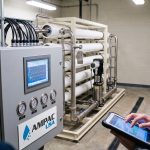
The AP10K-LX is an industrial reverse osmosis system that produces 10,000 GPD of water. It meets the requirements of commercial pure water consumers who have access to unclean, brackish or well sources of water.
In contrast, SW100K-LX-C is a fully automated reverse osmosis and seawater desalination system that can produce 100, 000 GPD of water. It is most suitable for communities and industries with bulk water needs and a natural source of this precious resource nearby.
Usage and Application
AP10K-LX is suitable for use by commercial establishments like coffee shops, restaurants, microbrewers, convenience stores, car wash facilities, food preparation operations, misting and humidification systems among others.
SW100K-LX-C is suitable for serving the huge water needs of industries like oil, energy, hospitality (resorts and giant hotels) among others. It is also suitable for communities where bulk water needs need to be met, and there is lack of pure water.
Treatment Options
AP10K-LX purifies water by using reverse osmosis technology while SW100K-LX-C makes use of both reverse osmosis and seawater desalination processes.
Built
AP10K-LX’s frames are built by using stainless steel pressure vessels and fastening hardware. It ensures strength and corrosion prevention which is a must in a commercial or industrial establishment. SW100K-LX-C has two 40′ containers, one of which is a high cube that includes desalination plant while the second has win Alternating 250KW Diesel Generators which can be used to power the plant.
Remote Access
SW100K-LX-C has a Siemens PLC controller with a web server and MODBUS communication which ensures remote monitoring and operation because this product is often used at remote locations where hiring an operator is not possible. AP10K-LX has no remote monitoring or operations available because it is usually installed near an establishment or industry.
Filters
SW100K-LX-C has a Multimedia Carbon Pre-Filter that gets rid of bacteria & chlorine while adjusting the pH of the water. It also has a Spin Down Pre-Filter for large particle removal & corrosion resistance and Sediment Pre-Filter for getting rid of sand, dirt, and sediment. AP10K-LX has multimedia KDF-Catalytic Carbon-Poly Phosphate Pre-Filter and Two 4” x 20” Big Blue Sediment Pre-Filter with 05 Micron in Parallel.
Pumps
AP10K-LX has a smart on-demand pump that increased feed water pressure 1HP while SW100K-LX-C has two pumps that supply the unit with seawater that was stored in settling tanks with needed pressure and flow. One of these is set on variable frequency drive, and the second is set on a pressure sensor.
Post Filtration
SW100K-LX-C has ceramic post filters that remove particles while keeping the mineral and oxygen content unchanged. AP10K-LX has a 4” x 10” Big Blue Carbon Post-Filter with 05 Micron.
UV Sterilization
Both these products recognize the value of ultraviolet sterilization as it eliminates microorganisms and disinfects water.
Conclusion
In essence, it can be seen that both these products have their own value. Though SW100K-LX-C has way more features and add-ons than AP10K-LX, the latter holds its own due to its own rich features. We suggest that anyone seeking any of these two products should not compare them but compare his or her needs with the features and select a product that meets their needs. You can also request AMPAC USA to create an amazing customized product for you with all the features you need. We have never failed to deliver and we won’t do it ever, it’s a promise!
Related Articles
- Reverse Osmosis System Maintenance Guide: Service Intervals and Procedures
- How Reverse Osmosis Works: The Complete Technical Guide | AMPAC USA
- Water Softener vs Reverse Osmosis: Which Do You Need? | AMPAC USA
- What Is Reverse Osmosis? The Complete 2026 Guide to RO Water Purification
Conclusion
AP10K-LX and SW100K-LX-C solve different problems: one’s sized for commercial operations pulling from brackish or well sources, the other’s built to turn seawater into 100,000 GPD for resorts, industry, or whole communities. Picking between them comes down to your water source and how much volume you’re actually moving, not just which one sounds more powerful. Both are engineered by AMPAC USA around the treatment demands of their specific use case rather than stretched to fit everything. If you’re not sure whether the SW100K-LX-C or the AP10K-LX fits your operation better, contact our team at info@ampac1.com or (909) 548-4900 and we’ll help you match capacity to need.
Selecting the Right AMPAC USA RO System: Key Comparison Factors
AMPAC USA manufactures reverse osmosis systems across a broad application spectrum — from compact 50 GPD residential drinking water units to multi-stage industrial systems producing 100,000+ GPD for manufacturing, food processing, pharmaceutical production, and municipal augmentation. Choosing between systems requires evaluating several interconnected technical parameters that determine whether a given system will meet your water quality and production volume requirements reliably and cost-effectively.
Membrane selection is determined primarily by feed water TDS. Brackish water (BW) membranes operate at 150-400 PSI and achieve 99%+ salt rejection on feed water up to approximately 10,000 mg/L TDS. Low energy (LE) membrane variants provide equivalent rejection at lower operating pressure, reducing energy consumption and pump wear for low-salinity feeds. High-rejection (HR) variants achieve 99.6%+ rejection for applications requiring ultra-low product water TDS. Seawater (SW) membranes are engineered for feeds above 10,000 mg/L TDS, operating at 600-1,200 PSI with specialized high-pressure pump and vessel components. Selecting the wrong membrane class — for example, applying a BW membrane to seawater feed — results in inadequate rejection, reduced membrane life, and potential mechanical failure.
Pre-treatment matching is equally critical. AMPAC USA system designs specify pre-treatment based on feed water analysis: SDI under 5 for RO membranes (requiring media filtration for surface water sources), chlorine-free feed (carbon filtration or bisulfite dosing for chlorinated feeds), antiscalant dosing for scaling ions (calcium, magnesium, barium, strontium, silica), and pH adjustment for carbonate system management. Systems with undersized or mismatched pre-treatment experience premature membrane fouling and shortened service intervals, increasing total operating cost significantly over the system’s life.
Frequently Asked Questions
What are the primary differences in capacity and application between AMPAC USA’s AP10K-LX and SW100K-LX-C RO systems?
The AP10K-LX is an industrial RO system producing 10,000 GPD for brackish or well water, ideal for commercial establishments. In contrast, the SW100K-LX-C is a fully automated seawater desalination system delivering 100,000 GPD, designed for bulk water needs in industries and communities utilizing ocean water.
Which AMPAC USA RO system is recommended for commercial businesses like restaurants or car wash facilities?
For commercial establishments such as coffee shops, restaurants, microbrewers, or car wash facilities, the AMPAC USA AP10K-LX system is highly recommended. It produces 10,000 GPD of pure water from brackish or well sources, meeting the specific demands of these operations efficiently.
Does the AMPAC USA SW100K-LX-C system offer autonomous operation for remote industrial sites?
Yes, the AMPAC USA SW100K-LX-C is engineered for autonomous operation, even in remote industrial or community settings. It is housed in two 40′ containers, including a high-cube desalination plant and a separate container with alternating 250KW Diesel Generators for self-sufficient power, complemented by a Siemens PLC with web remote access.
What types of feed water can the AMPAC USA AP10K-LX industrial RO system process?
The AMPAC USA AP10K-LX industrial reverse osmosis system is specifically designed to purify unclean, brackish, or well water sources. It effectively processes these feed waters to produce 10,000 GPD of high-purity water suitable for various commercial and industrial applications.
How does the water purification technology of the AMPAC USA SW100K-LX-C differ from the AP10K-LX?
The AMPAC USA AP10K-LX purifies water using standard reverse osmosis technology for brackish or well water. In contrast, the SW100K-LX-C employs both reverse osmosis and seawater desalination processes, enabling it to convert vast quantities of ocean water into 100,000 GPD of potable water for large-scale needs.
AMPAC USA engineers custom water purification systems for commercial, industrial, and emergency applications — from 500 GPD to multi-million GPD. Trusted by municipalities, military, and industry worldwide.