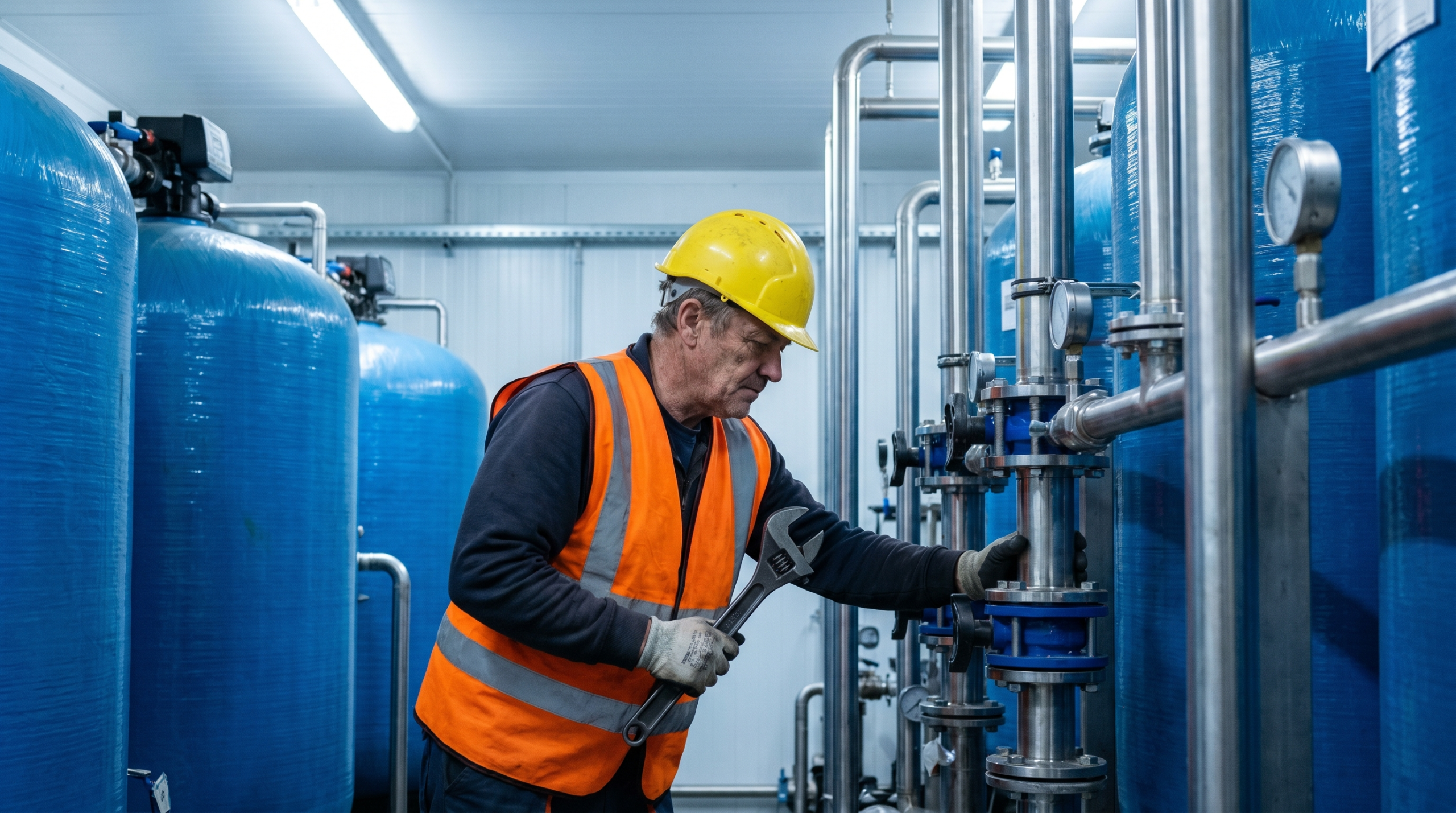

A reverse osmosis system running past its service intervals doesn’t fail dramatically – it just slowly stops working. Flux drops. TDS creep begins. Pressure differential across the membranes climbs. By the time someone notices a performance problem, you’re usually looking at fouled membranes that could have been saved with a scheduled service call six months earlier.
This guide covers every maintenance task on a commercial or industrial RO system, with service intervals and what happens when you skip them.
Pre-Filter Replacement
Pre-filters – sediment cartridges, carbon blocks, or multimedia filters – protect the RO membrane from particles, chlorine, and oxidants that cause irreversible damage. They’re the cheapest components in the system and the most important to stay current on.
- Sediment cartridges (5-20 micron): Replace every 3-6 months, or when inlet-to-outlet pressure differential across the pre-filter housing exceeds 10-15 psi. High-turbidity source water may require monthly replacement.
- Carbon block cartridges: Replace every 6-12 months. Carbon doesn’t give visible warning signs of exhaustion – you need to either track service hours or verify chlorine residual in the RO feed water regularly. Chlorine above 0.1 ppm at the membrane inlet will degrade polyamide membranes in weeks.
- Multimedia (sand/anthracite/garnet) filters: Backwash weekly to monthly depending on source water turbidity. Replace media every 3-5 years or when SDI consistently exceeds 5 after backwashing.
RO Membrane Service
Membranes are the highest-value components in an RO system and the most sensitive to operating conditions.
Expected Membrane Life
Under proper operating conditions with adequate pre-treatment, commercial RO membranes (FILMTEC BW30, BW30-400, or equivalent) last 3-5 years. SWRO membranes used in seawater desalination typically last 3-7 years. Membranes operating without proper pre-treatment – chlorine exposure, scaling, biological fouling – can fail in months.
When to Replace Membranes
- Salt rejection below 90%: A healthy membrane rejects 95-99%+ of dissolved solids. When product water TDS rises significantly above baseline (more than 10-15% increase), membrane degradation is likely.
- Normalized permeate flux decline exceeding 15%: Compare corrected-for-temperature flow rates to baseline. A 15% or greater flux decline indicates fouling or scaling.
- Differential pressure increase exceeding 15% over baseline: High pressure drop across the membrane elements indicates fouling, usually biological or colloidal.
Cleaning In Place (CIP) Before Replacement
Before replacing membranes on a commercial system, attempt CIP. Many membranes that appear to be failing recover significantly with proper cleaning. A CIP procedure involves circulating low- or high-pH cleaning solutions through the membrane elements to dissolve scale (acidic clean) or remove biofilm (alkaline clean). Standard CIP solutions include 0.1% HCl or citric acid (for carbonate/sulphate scale) and 0.1% NaOH at elevated pH (for biological fouling and silica).
System Sanitization
Commercial RO systems in food service, pharmaceutical, or drinking water applications require periodic sanitization to control biological growth. Biofilm in an RO system isn’t just a membrane fouling problem – it’s a water quality problem.
- Sanitization frequency: Every 6-12 months for most commercial systems. More frequently in warm-water environments or systems that run intermittently (stagnant water between production cycles accelerates biological growth).
- Acceptable sanitants for polyamide membranes: Sodium bisulfite, citric acid, or hydrogen peroxide at approved concentrations. Chlorine (sodium hypochlorite) at any concentration above 0.1 ppm damages polyamide membranes – never use chlorine bleach for sanitization.
- Procedure: Flush the system with sanitizing solution, allow contact time per manufacturer instructions (typically 30-60 minutes), flush thoroughly with product-quality water before returning to service.
Pressure Vessel and O-Ring Inspection
Fiberglass pressure vessels used in commercial RO systems typically last 10-15+ years, but their O-rings and end caps require inspection at membrane replacement time.
- O-rings: Inspect for cracking, swelling, or compression set during every membrane replacement. Replace if any deformation is visible. Failed O-rings allow concentrate to bypass the permeate port – your TDS will be elevated and rejection will appear to have failed, even with new membranes.
- End caps and ports: Verify threads are clean and undamaged. Cross-threading a pressure vessel end cap during membrane installation can crack the vessel.
- Stainless steel pressure vessels: Inspect for pitting or crevice corrosion at connections, especially in seawater applications.
High-Pressure Pump Service
The high-pressure pump is the most mechanically demanding component of an RO system. Commercial systems use multistage centrifugal pumps; industrial systems may use positive displacement (piston or plunger) pumps at higher pressures.
- Centrifugal pumps: Inspect mechanical seals annually. Replace at first sign of shaft seal leakage. Bearing noise (increase in vibration or acoustic signature) warrants inspection. Re-lubricate per manufacturer intervals – most sealed-bearing centrifugal pumps used in commercial RO don’t require re-lubrication.
- Positive displacement pumps: Inspect check valves and plunger seals annually. Change crankcase oil per manufacturer intervals (typically every 500-1,000 operating hours). Worn plunger seals cause erratic pressure and reduced flow.
- Motor: Verify correct rotation direction after any wiring work. Running an RO pump backwards at startup is a common service error and damages the pump.
Instrumentation and Controls Calibration
TDS monitors, flow meters, and pressure gauges drift. Inaccurate instrumentation leads to incorrect service decisions – you may change membranes that didn’t need changing, or miss fouling that develops behind a faulty pressure gauge.
- TDS/conductivity probes: Calibrate every 6-12 months using NIST-traceable calibration standards. Clean probe surfaces per manufacturer instructions before calibration.
- Pressure gauges: Verify against a calibrated reference gauge annually. Dead-band or sticky gauges are common on systems with water hammer.
- Flow meters: Verify against a calibrated bucket-and-timer test or calibrated reference meter annually. Paddle-wheel flow meters are especially prone to drift from fouling.
Antiscalant Dosing System Service
Systems treating hard water or high-TDS feed water typically use chemical antiscalant injection to prevent carbonate, sulphate, or silica scale on membranes. The dosing system requires its own maintenance.
- Inspect chemical metering pump diaphragms quarterly. A faulty diaphragm delivers no chemical and you won’t know until the membranes scale.
- Verify injection check valve is functioning – backflow of feed water into the chemical line dilutes the antiscalant.
- Keep antiscalant stock current. Expired antiscalant may polymerize and cause membrane fouling rather than preventing it.
Annual System Performance Evaluation
Once a year, document normalized system performance metrics from actual operating data:
- Normalized permeate flow: Correct measured flow rate for temperature and feed pressure. Compare to baseline established at system commissioning or after last membrane replacement.
- Salt rejection: Calculate from feed TDS and permeate TDS measurements.
- Recovery ratio: (Permeate flow / Feed flow) × 100. Document any unexplained drift.
- Differential pressure: Measure and record across individual membrane stages.
These four metrics together tell you membrane condition, fouling trends, and whether the system is ready for another year or due for service.
Maintenance Log
Keep a written or digital log of every service action: date, technician, components serviced, pre- and post-service TDS and pressure readings, and chemical lot numbers used for CIP or sanitization. A service log is the only way to spot trends, confirm warranty-relevant service history, and defend performance claims if membranes fail prematurely.
Service Support for AMPAC USA Systems
AMPAC USA provides technical support for RO systems manufactured at our Woods Cross, UT facility. If you have an AMPAC system and need service guidance, replacement membranes, or pre-filter cartridges, call our technical support line at 909-548-4900 or contact us below.
Frequently Asked Questions
How often should RO pre-filters be replaced?
Sediment cartridges every 3-6 months or when pressure differential exceeds 10-15 psi, carbon block cartridges every 6-12 months, and multimedia filter media every 3-5 years, with weekly to monthly backwashing depending on source water turbidity.
How long do commercial RO membranes typically last?
Under proper operating conditions with adequate pre-treatment, commercial RO membranes last 3-5 years, and seawater desalination membranes last 3-7 years. Without proper pre-treatment, membranes can fail in months.
What are the signs an RO membrane needs replacement?
Salt rejection dropping below 90 percent, normalized permeate flux declining more than 15 percent from baseline, or differential pressure increasing more than 15 percent over baseline. CIP cleaning should be attempted first since many membranes recover significantly with proper cleaning.
How often should a commercial RO system be sanitized?
Every 6-12 months for most commercial systems, more frequently in warm-water environments or systems that run intermittently. Acceptable sanitants for polyamide membranes include sodium bisulfite, citric acid, or hydrogen peroxide. Chlorine bleach should never be used, as it damages polyamide membranes.