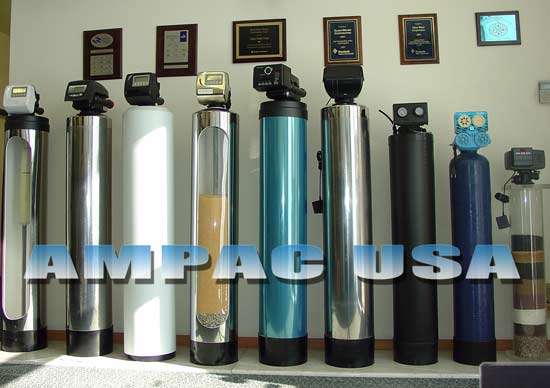

The affects of hard water can bring a lot of inconvenience into your daily life. Cleaning and washing can become a nightmare and not to mention the health hazards associated with drinking hard water. Understanding whether you need a Reverse Osmosis Systems requires no rocket science but choosing the best can be tricky.
- The first thing to consider is the size. A typical softener’s size is measured by grain removal capacity. The calculation is quite straightforward. It starts with a calculation of the grains of hardness of your water supply. Alternatively, you may consider the average hardness found in USA but that will only give you an approximate idea. The second thing to put into equation is the average consumption. Typically, a member of your home will consume around 70 gallons per day. So, here’s how you calculate the capacity:
- Find out the total demand: In this case, 70 gallons per day x X (the number of members in the family). If you have four members, then it’d look like: 4 x 70 = 280 gallons
- Multiply the demand with the grains of hardness; 280 x 10 (Assumed grains of hardness) = 2800. This will further be multiplied by the number of days in which the softener will regenerate (make all the grains fresh for conducting exchange of hardness ions with sodium).
- The final calculation: 2800 x 7 = 19600 + a 30% reserve = 26,000 grains (roughly)
- Note that the above method will remain the same while the given figures are subject to change according to your consumption, water supply condition, etc.
As per the above calculation, a water softener with the range of 24,000 or 32,000 will suffice. These configurations are the most widely used by average sized families across USA.
- The next thing is to look for adherence to NSF/ANSI 44 standard which will mean that the system will not only remove the required hardness but also use less than 5 US gallons of water for removing every 1000 grains.
- You should also consider the regeneration method offered by the softener. That is important because if it is not optimal, then you’ll start getting hard water time and again. A time-based method will trigger regeneration after a regular interval regardless of the amount used while a meter regenerated method will do the same only after detecting a certain amount of usage. In addition, there are methods which need manual regeneration as well. Dependent on your requirements, you can pick one that works the best for your home.
- Besides the above, its important to know the manufacturer credentials as you are very likely to need some troubleshooting help in future with these systems. If the company doesn’t offer a good after sales service, you’ll find yourself in a tough spot.
Worth mentioning again, it’s important to understand the hardness of your water supply. An accurate analysis will lead you to perfect selection of the softener.
Frequently Asked Questions
How quickly can an emergency water purification unit be deployed?
AMPAC USA's EPRO and mobile RO units can be operational within 30–60 minutes of arrival on-site. Trailer-mounted and skid-mounted systems are pre-plumbed and pre-wired, requiring only connection to a power source and water source. Units treat river water, lake water, or brackish groundwater.
What flow rates are available for emergency water treatment?
AMPAC USA's emergency systems range from 1,500 GPD portable units to 50,000+ GPD trailer-mounted systems. Military-specification units are available for forward operating base deployment, producing potable water meeting EPA and WHO drinking water standards from virtually any source.
Are emergency RO systems suitable for disaster relief operations?
Yes. AMPAC USA's emergency systems are used by FEMA, the U.S. military, and international NGOs for disaster relief. They treat flood water, contaminated groundwater, and brackish sources, removing bacteria, viruses, and chemical contaminants to produce safe drinking water on-site.
What power sources can emergency water purification systems use?
AMPAC USA's emergency systems can run on generator power (120/240V or 480V 3-phase), solar panels with battery backup, or vehicle power take-off (PTO). Low-power models consume as little as 0.5 kW, making them viable for off-grid deployment.
How durable are military-grade water purification systems?
AMPAC USA's military systems are built to MIL-SPEC standards with stainless steel frames, powder-coated components, and UV-resistant materials. They are designed to operate in temperatures from -20°F to 120°F and are vibration-tested for transport in military vehicles.
Related Articles
- Best Water Softener Salt: A Complete Guide to Choosing the Right Option
- How Long Does a Water Softener Last? Understanding Lifespan, Maintenance & Replacement
- The Real Impact of Using a Water Softener: An In-Depth Analysis!
- Is it time when my water softener needs regeneration? How does it actually work?
Conclusion
This post highlighted how emergency and military-grade water purification systems provide safe drinking water rapidly in the most challenging field conditions. For organizations requiring deployable water treatment capability, AMPAC USA engineers portable and trailer-mounted systems built to perform wherever they are needed. Contact our team at info@ampac1.com or (909) 548-4900 to discuss your emergency water treatment requirements.
AMPAC USA engineers custom water purification systems for commercial, industrial, and emergency applications — from 500 GPD to multi-million GPD. Trusted by municipalities, military, and industry worldwide.