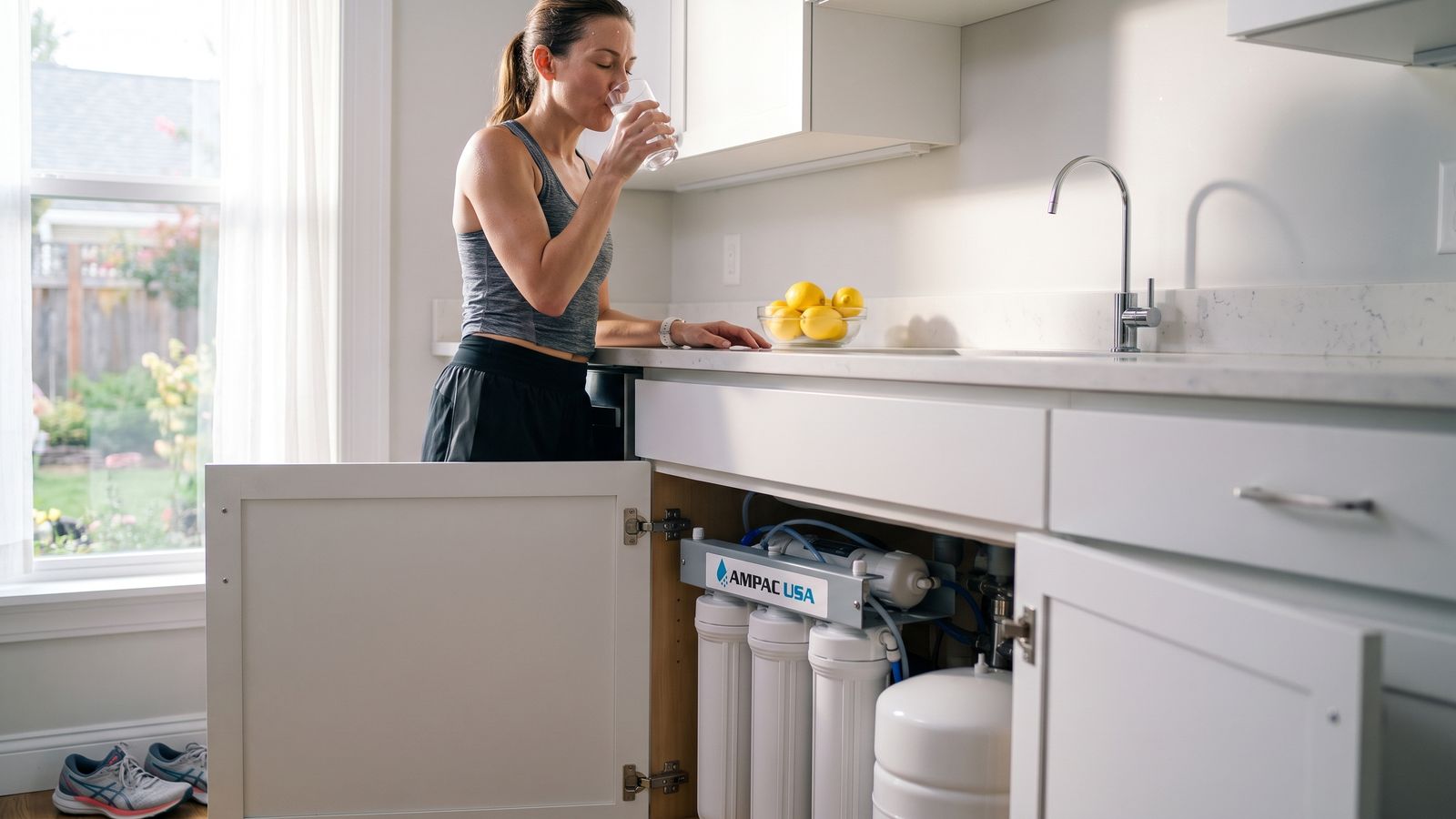

Short answer: purified water hydrates you the same way any safe water does. What it adds is fewer of the things you would rather not drink, and a cleaner taste that makes it easier to drink enough. Here are seven reasons that hold up, each with a source you can check.
1. It makes your daily water target easier to hit
The National Academies set an adequate intake for total water of 3.7 liters a day for young men and 2.7 liters for young women. That total includes the water in food. Drinking water and other beverages supply about 81 percent of it, which works out to roughly 13 cups for men and 9 cups for women, according to the National Academies report on dietary reference intakes for water. Water that tastes clean is the simplest way to get there without adding sugar, and removing chlorine taste is often what turns a glass of tap water into one you finish.
2. It lowers your lead exposure
EPA and the CDC agree that there is no known safe level of lead in a child’s blood. EPA estimates that drinking water can make up 20 percent or more of a person’s total lead exposure, and that infants who drink mostly mixed formula can get 40 to 60 percent of their exposure from the water used to mix it, as described on EPA’s page on lead in drinking water. Lead usually enters at the tap, from older pipes and fixtures, so treating the water where you drink it makes sense. Ask any seller for the lead reduction test documents for the exact model you plan to buy.
3. It can cut PFAS
On April 10, 2024, EPA announced enforceable limits for six PFAS in public drinking water, including 4.0 parts per trillion for both PFOA and PFOS. Those rules cover public water systems. If you are on a private well, or you want a second line of defense at the tap, point-of-use treatment is your own decision. EPA’s overview of drinking water treatment technologies lists reverse osmosis and granular activated carbon among the methods used to remove contaminants. Test your own water, since PFAS levels vary a great deal from one source to the next.
4. It tastes and smells better
Disinfectants keep tap water safe, but they can leave a taste, and they react with organic matter to form byproducts. EPA regulates two groups of them, trihalomethanes and haloacetic acids, under its Stage 1 and Stage 2 Disinfectants and Disinfection Byproducts Rules. Granular activated carbon is a proven way to adsorb many organic compounds, including disinfection byproduct precursors, and carbon stages are standard in home RO systems for exactly that reason.
5. It supports kidney stone prevention
The National Institute of Diabetes and Digestive and Kidney Diseases puts it plainly: drinking enough liquid, mainly water, is the most important thing you can do to prevent kidney stones. Unless you have kidney failure, many health care professionals recommend six to eight 8-ounce glasses a day, and you should check with your own clinician about the right amount for you. Purified water is not a stone treatment. Its job is to make that habit easier to keep.
6. It protects your appliances and plumbing
The USGS explains that when hard water is heated, calcium carbonate deposits form. That scale can shorten the life of equipment, raise heating costs, lower the efficiency of electric water heaters and clog pipes. Reverse osmosis removes most dissolved solids, including the calcium and magnesium behind hardness, so kettles, coffee makers and ice machines stay cleaner.
7. It protects infants from nitrate
EPA’s drinking water regulations set the limit for nitrate at 10 milligrams per liter, measured as nitrogen. The agency warns in its national primary drinking water regulations that infants younger than six months who drink water above that level could become seriously ill, with symptoms that include shortness of breath and blue-baby syndrome. Nitrate comes mainly from fertilizer runoff and septic systems, so private wells are the usual concern. If you have a well and a baby in the house, test the water first and then choose treatment that is proven for nitrate.
What purified water does not do
Reverse osmosis removes most dissolved minerals along with the contaminants. For most people, food supplies the minerals they need, but if you follow a medically supervised diet or have a kidney condition, ask your doctor before you change your drinking water. Some AMPAC USA home systems include an optional remineralization stage if you prefer a fuller taste.
Choosing a system for your home
Start with a water test, because what is in your water decides what you need. For one tap, an under-sink reverse osmosis system is the common choice. For every tap in the house, look at whole house systems, and browse our drinking water filters for simpler setups. Plan for upkeep from day one: filters and membranes wear out, and fresh replacement filters keep the system working as designed. If you would like help matching a system to your water, send us your test results through the quote form or call (909) 548-4900.
Frequently asked questions
Is purified water healthier than tap water?
For most people in most places, tap water that meets EPA standards is safe. Purified water gives you an extra layer: fewer contaminants such as lead, PFAS or nitrate where they are a concern, and a cleaner taste. The right choice depends on your water test.
Does purified water remove lead?
A system can remove lead only if it was designed and tested for it. Ask for the lead reduction test documents for the exact model, and keep the filters current.
Is purified water safe for babies?
Clean water matters for infants, because water is mixed into formula in large amounts. EPA says infants on mostly mixed formula can get 40 to 60 percent of their lead exposure from the water. Talk with your pediatrician about the best water for your baby.
Will I lose minerals if I drink purified water?
Reverse osmosis removes most dissolved minerals from the water itself. Most people get the bulk of their minerals from food. If you have a medical reason to watch your mineral intake, ask your doctor.
Sources
- National Academies, Dietary Reference Intakes for Water, Potassium, Sodium, Chloride, and Sulfate
- US EPA, Basic Information about Lead in Drinking Water
- US EPA, Per- and Polyfluoroalkyl Substances (PFAS) rule
- US EPA, Overview of Drinking Water Treatment Technologies
- US EPA, Stage 1 and Stage 2 Disinfectants and Disinfection Byproducts Rules
- US EPA, National Primary Drinking Water Regulations
- NIDDK, Eating, Diet, and Nutrition for Kidney Stones
- USGS, Hardness of Water
AMPAC USA engineers custom water purification systems for commercial, industrial, and emergency applications — from 500 GPD to multi-million GPD. Trusted by municipalities, military, and industry worldwide.