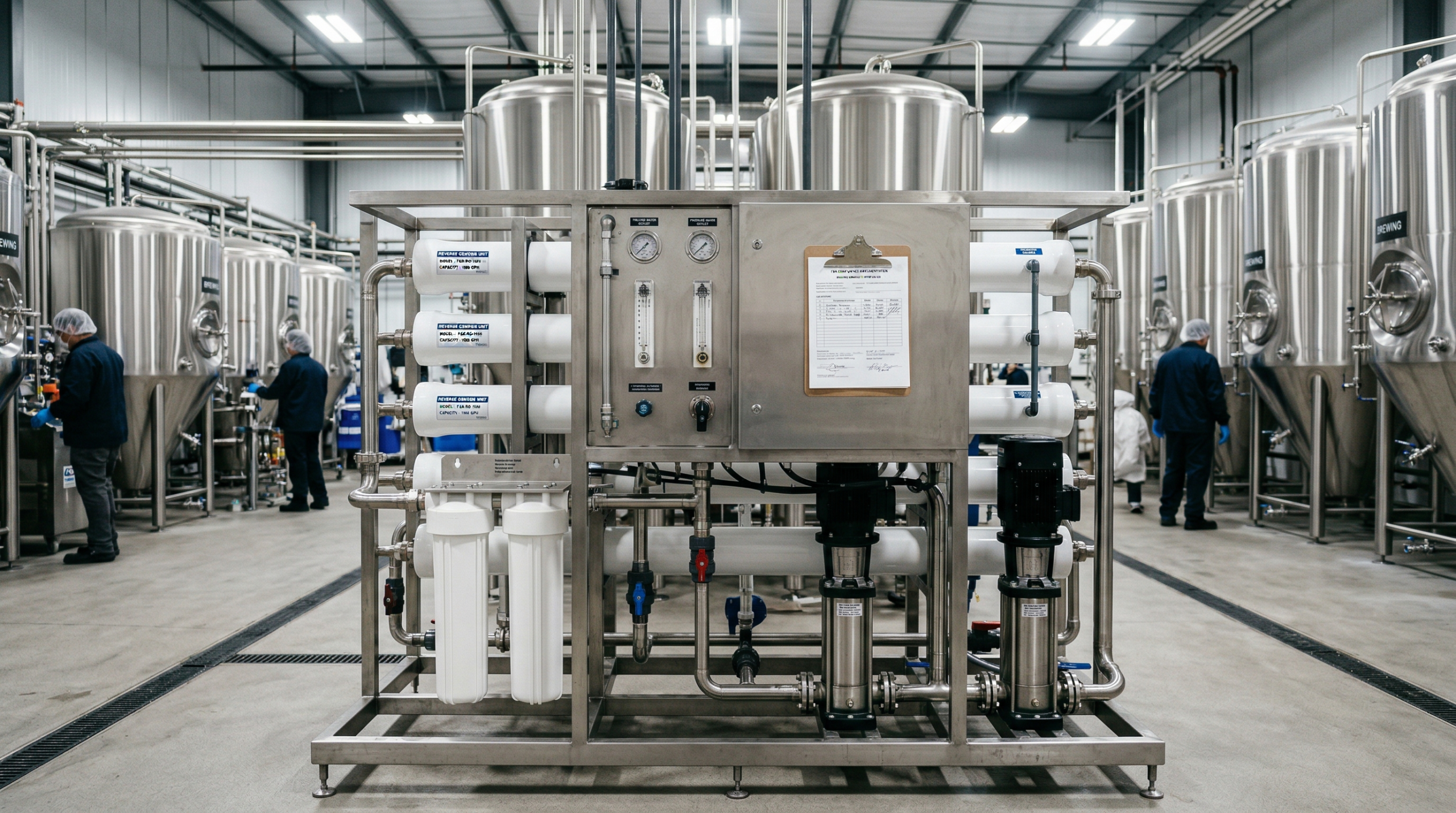

Water Treatment for Food & Beverage Manufacturing: RO Systems and FDA Compliance
Quick Answer: Food and beverage manufacturers must use water that meets FDA 21 CFR 129 standards and HACCP water quality requirements. Reverse osmosis (RO) is the preferred treatment technology for F&B production because it reduces TDS by 90-99%, removes bacteria, viruses, and chemical contaminants, and produces consistent water quality regardless of source water variability. Water quality requirements vary by product: soft drink production requires less than 10 ppm TDS, brewing requires less than 50 ppm, dairy processing requires less than 200 ppm, and pharmaceutical-grade water requires less than 1 ppm. AMPAC USA manufactures commercial and industrial RO systems specifically designed for food and beverage manufacturing compliance.
Water is the most used ingredient in food and beverage manufacturing. It accounts for up to 90% of the finished product in beverages and plays critical roles in cleaning, sanitation, steam generation, and cooling throughout F&B production facilities. Despite its fundamental importance, water quality is one of the most underestimated risk factors in food safety programs. Inconsistent or inadequately treated water can cause product recalls, microbial contamination, off-flavors, equipment scaling, regulatory violations, and significant financial losses.
This guide covers the regulatory framework governing water use in food and beverage manufacturing, specific water quality targets by product type, how commercial reverse osmosis systems address these requirements, and practical guidance for implementing water treatment in your F&B facility.
FDA Water Quality Regulations for Food Manufacturing
The U.S. Food and Drug Administration (FDA) regulates water used in food and beverage manufacturing through several interconnected regulations. Understanding these requirements is essential for compliance, audit readiness, and consumer safety.
21 CFR 129: Processing and Bottling of Bottled Drinking Water
FDA 21 CFR Part 129 establishes current Good Manufacturing Practice (cGMP) regulations for the processing and bottling of bottled drinking water. This regulation applies to any facility that processes water intended for human consumption as a packaged product. Key requirements include source water protection and monitoring, treatment process validation, microbiological testing protocols (total coliform, E. coli, and heterotrophic plate count), chemical contaminant limits aligned with EPA National Primary Drinking Water Regulations, and facility sanitation and equipment maintenance standards.
Under 21 CFR 129.35, product water and operations water must be obtained from an approved source and must comply with the applicable standards of quality established in 21 CFR 165.110. This means that even if your municipal water supply meets EPA standards at the point of delivery, your facility is responsible for ensuring it continues to meet standards at the point of use in your production process.
21 CFR 110: Current Good Manufacturing Practice for Food
FDA 21 CFR Part 110 (now largely incorporated into 21 CFR Part 117 under FSMA) establishes general cGMP requirements for all food manufacturing facilities. Section 110.37 specifically addresses water supply requirements, mandating that water used in food manufacturing must be safe and of adequate sanitary quality, that water that contacts food or food-contact surfaces must meet applicable EPA drinking water standards, and that steam used in direct contact with food must be free from contaminants. These regulations apply to water used as an ingredient, water used for washing and rinsing food products, water used for cleaning food-contact surfaces and equipment, and water used for cooling and heating operations.
FSMA Preventive Controls (21 CFR 117)
The Food Safety Modernization Act (FSMA) Preventive Controls for Human Food rule (21 CFR Part 117) requires food manufacturers to implement a written food safety plan that identifies and evaluates known or reasonably foreseeable hazards, including water quality hazards. Under FSMA, facilities must conduct a hazard analysis that evaluates water as both an ingredient and a process aid, implement preventive controls for identified water quality hazards, establish monitoring procedures and verification activities, and maintain detailed records of water quality testing and treatment system performance.
Key Takeaway: FDA regulations require food and beverage manufacturers to proactively manage water quality, not merely test it. Compliance requires documented water treatment processes, ongoing monitoring, corrective action procedures, and comprehensive record-keeping. An RO system with continuous TDS monitoring provides the documented, consistent water quality that FDA inspectors expect to see during facility audits.
HACCP Water Quality Standards
Hazard Analysis and Critical Control Points (HACCP) is a systematic preventive approach to food safety that is mandatory for juice, seafood, and meat processors and widely adopted across all food and beverage manufacturing sectors. Water quality is a fundamental component of every HACCP plan.
Water as a Critical Control Point (CCP)
In many F&B processes, water quality represents a Critical Control Point where failure to maintain standards could result in a food safety hazard reaching the consumer. When water is identified as a CCP in your HACCP plan, you must establish critical limits for water quality parameters (TDS, turbidity, microbial counts, specific contaminant levels), implement continuous or frequent monitoring at the CCP, define corrective actions when monitoring indicates a deviation from critical limits, establish verification procedures to confirm the CCP is functioning correctly, and maintain documentation and records of all monitoring and corrective actions.
HACCP Prerequisite Programs for Water
The HACCP framework also requires prerequisite programs that support CCP management. For water quality, prerequisite programs typically include annual comprehensive water testing by a certified laboratory, monthly or quarterly on-site testing for key parameters, water treatment system maintenance schedules, backflow prevention device testing, and water storage tank inspection and cleaning protocols. The International Association for Food Protection (IAFP) and the Global Food Safety Initiative (GFSI) both emphasize that water quality prerequisite programs must be documented, maintained, and available for auditor review.
Water Quality Requirements by Food & Beverage Sector
Different food and beverage products have vastly different water quality requirements. The following table summarizes the critical water quality parameters for major F&B manufacturing sectors based on industry standards, trade association guidelines, and production best practices.
| F&B Sector | Max TDS (ppm) | Max Turbidity (NTU) | Chlorine Limit | pH Range | Key Concerns |
|---|---|---|---|---|---|
| Soft Drink / Carbonated Beverage | <10 | <0.5 | 0 ppm (must be removed) | 6.5-7.0 | Flavor consistency, CO2 interaction, alkalinity |
| Brewing (Beer) | <50 | <1.0 | 0 ppm | 5.2-9.5 (varies by style) | Mineral profile affects flavor; chlorine creates chlorophenols |
| Dairy Processing | <200 | <1.0 | <0.5 ppm | 6.5-7.5 | Microbiological safety, CIP water quality |
| Bakery / Dough Production | <300 | <5.0 | <2.0 ppm | 6.0-8.0 | Mineral content affects gluten development and yeast activity |
| Bottled Water | Per label claim | <0.5 | 0 ppm | 6.5-8.5 | Consistency, taste, 21 CFR 165.110 compliance |
| Juice / Non-Carbonated Beverage | <50 | <1.0 | 0 ppm | Product-specific | Flavor neutrality, microbial safety |
| Pharmaceutical (USP Purified) | <1 | N/A | 0 ppm | 5.0-7.0 | USP <1231> compliance, endotoxin control, conductivity |
| Confectionery / Candy | <100 | <1.0 | <0.5 ppm | 6.5-7.5 | Sugar crystallization, flavor purity |
| Meat / Poultry Processing | EPA potable std | <1.0 | Residual required | 6.5-8.5 | USDA-FSIS requirements, pathogen control in wash water |
| Infant Formula | <50 | <0.5 | 0 ppm | 6.5-7.5 | Nitrate <10 ppm, heavy metals near zero, strictest standards |
Key Takeaway: Soft drink manufacturers, brewers, pharmaceutical producers, and infant formula manufacturers require the strictest water quality. Reverse osmosis systems that achieve less than 10 ppm TDS with zero chlorine provide the baseline water quality these sectors demand. Manufacturers can then precisely add back specific minerals (such as calcium chloride or gypsum for brewing) to achieve their desired water profile.
Why Reverse Osmosis Is the Standard for F&B Water Treatment
Reverse osmosis has become the de facto standard for water treatment in food and beverage manufacturing for several compelling reasons that no other single technology can match.
Comprehensive Contaminant Removal
Commercial RO membranes reject 95-99% of dissolved solids, 99%+ of bacteria and viruses, 96-99% of heavy metals (lead, arsenic, cadmium, mercury), 99% of pesticides and herbicides, and 90-99% of pharmaceutical residues. This broad-spectrum removal capability means a single RO system addresses multiple water quality requirements simultaneously, simplifying your treatment train and reducing the number of individual treatment technologies needed.
Consistent Output Quality
Unlike chemical treatment methods that require precise dosing adjustments as source water quality fluctuates, RO systems produce consistent permeate quality across a wide range of feed water conditions. Whether your source water TDS varies from 200 to 800 ppm seasonally, the RO permeate will consistently fall within a narrow quality range. This consistency is critical for product quality control in F&B manufacturing, where even small water chemistry variations can affect taste, texture, shelf life, and appearance.
Scalability and Modular Design
Commercial RO systems are inherently modular. AMPAC USA designs commercial RO systems that can be configured from 1,000 GPD for small artisan producers up to 500,000+ GPD for large-scale manufacturing operations. Modular design means you can start with capacity matched to current production and add membrane elements or parallel trains as production grows, without replacing the entire system.
Regulatory Compliance Documentation
Modern commercial RO systems include integrated monitoring and data logging that directly support FDA and HACCP compliance. Continuous TDS monitoring with alarm setpoints, flow rate logging for permeate and concentrate streams, pressure monitoring across pre-filters and membranes, and automated data recording with timestamped logs provide the documentation that auditors require. AMPAC commercial systems can be configured with PLC controls, HMI touchscreens, and remote monitoring capabilities that generate the compliance reports your quality team needs.
Sizing an RO System for Food & Beverage Production
Proper system sizing is critical for F&B applications. An undersized system creates production bottlenecks and forces the system to operate at maximum capacity continuously, reducing membrane life. An oversized system wastes capital and may develop biological growth during periods of low demand. The following methodology helps determine the right system capacity for your facility.
Step 1: Calculate Total Daily Water Demand
Total water demand includes ingredient water (water that becomes part of the finished product), process water (used in blanching, cooking, cooling, and other production steps), Clean-in-Place (CIP) water for equipment and line sanitation, boiler feed water for steam generation, and utility water for general facility use. Most F&B facilities find that total water demand is 2-5 times the volume of ingredient water alone. A beverage manufacturer producing 10,000 gallons of finished product per day may require 30,000-50,000 gallons of total treated water per day when CIP, boiler, and utility demands are included.
Step 2: Determine Required Water Quality
Not all water streams in your facility require the same quality level. Ingredient water typically requires the highest quality (lowest TDS, zero chlorine, microbial safety). CIP final rinse water should match ingredient water quality. CIP pre-rinse water can use lower-quality water. Boiler feed water requires low TDS to prevent scaling but does not need to be potable-grade. Segregating water quality requirements by use allows you to optimize system design and reduce treatment costs.
Step 3: Apply System Sizing Factors
| Facility Size / Production Volume | Recommended RO Capacity (GPD) | Recovery Rate | Typical System Configuration |
|---|---|---|---|
| Small artisan / craft (under 1,000 gal/day product) | 3,000-5,000 | 50-65% | Single-stage, single membrane vessel |
| Mid-size producer (1,000-5,000 gal/day product) | 10,000-25,000 | 65-75% | Multi-stage with concentrate recirculation |
| Large producer (5,000-20,000 gal/day product) | 25,000-100,000 | 75-85% | Multi-train with redundancy, PLC controls |
| Industrial scale (20,000+ gal/day product) | 100,000-500,000+ | 80-90% | Multi-train, energy recovery, full automation |
Always size the system 20-30% above calculated peak demand to account for membrane aging, seasonal source water variation, and unexpected production increases. This design margin ensures your facility never faces water supply constraints during peak production periods.
Water Quality Monitoring for F&B Production
Continuous water quality monitoring is not optional in food and beverage manufacturing. It is a regulatory expectation and a production quality necessity. A comprehensive monitoring program includes real-time inline monitoring and periodic laboratory testing.
Real-Time Inline Monitoring Parameters
| Parameter | Monitoring Method | Frequency | Purpose |
|---|---|---|---|
| TDS / Conductivity | Inline conductivity meter | Continuous | Confirms RO membrane performance; triggers alarm if rejection drops |
| pH | Inline pH sensor | Continuous | Product consistency; corrosion control; CIP effectiveness |
| Chlorine (free/total) | Amperometric or colorimetric sensor | Continuous | Protects RO membranes; confirms removal for beverage production |
| Turbidity | Inline turbidimeter | Continuous | Pre-filter performance; membrane protection |
| Flow rate | Flow meter (permeate and concentrate) | Continuous | Recovery rate monitoring; production capacity verification |
| Pressure | Pressure transducers | Continuous | Membrane fouling detection; pump performance |
| Temperature | RTD or thermocouple | Continuous | Normalizes flux calculations; seasonal adjustment |
Periodic Laboratory Testing Schedule
| Test | Frequency | Method / Standard | Purpose |
|---|---|---|---|
| Total coliform / E. coli | Weekly minimum | EPA Method 9223B (Colilert) | Microbial safety verification |
| Heterotrophic plate count | Monthly | Standard Method 9215 | General microbial quality; biofilm indicator |
| Full mineral panel | Quarterly | EPA 200.7 (ICP-OES) | Comprehensive water chemistry profile |
| Heavy metals (Pb, As, Cd, Hg) | Quarterly | EPA 200.8 (ICP-MS) | Regulatory compliance; safety verification |
| Pesticide / herbicide screen | Semi-annually | EPA 525.2 / 515.3 | Agricultural contamination check |
| VOCs | Semi-annually | EPA 524.2 | Industrial contamination screening |
| Endotoxin (pharmaceutical only) | Per batch | USP <85> LAL | Pyrogen control for pharmaceutical water |
Case Study: Beverage Manufacturer RO System Implementation
The following case study illustrates a typical RO system implementation for a mid-size beverage manufacturing facility, demonstrating how commercial reverse osmosis addresses the specific water quality challenges in F&B production.
Facility Profile
A regional beverage manufacturer producing flavored water, sports drinks, and carbonated beverages at a volume of 8,000 gallons of finished product per day. The facility uses municipal water with a TDS of 420 ppm, hardness of 280 ppm as CaCO3, chlorine residual of 1.5 ppm, and seasonal turbidity spikes up to 3 NTU during spring runoff. Production quality requirements specify less than 10 ppm TDS for carbonated products, less than 50 ppm TDS for non-carbonated products, zero chlorine in all product water, and turbidity below 0.5 NTU at all times.
System Design Solution
The facility installed a 40,000 GPD commercial RO system with the following treatment train configuration. The pretreatment stage includes a multimedia filter for turbidity reduction to below 1 NTU, followed by activated carbon filtration for chlorine removal to protect the RO membranes. The primary treatment is a two-stage RO system with 8040-size low-energy membranes operating at 75% recovery, producing permeate at 8-15 ppm TDS from 420 ppm feed water. Post-treatment includes a UV sterilizer for microbial safety, a remineralization option for non-carbonated products, and a 5,000-gallon treated water storage tank with nitrogen blanket. The control system features a PLC with HMI touchscreen, continuous conductivity and pH monitoring, automated flush cycles, and remote monitoring capability with alarm notification.
Results and ROI
| Metric | Before RO Installation | After RO Installation | Improvement |
|---|---|---|---|
| Product water TDS | 420 ppm (municipal supply) | 8-12 ppm (RO permeate) | 97-98% reduction |
| Chlorine in product water | 0.8-1.5 ppm | Non-detect | 100% removal |
| Product taste consistency | Seasonal variation complaints | Consistent year-round | Eliminated variation |
| Boiler descaling frequency | Quarterly | Annually | 75% reduction in maintenance |
| FDA audit water findings | 2 observations (previous audit) | 0 observations | Full compliance |
| Water cost per 1,000 gallons | $2.10 (municipal only) | $3.85 (municipal + RO treatment) | Increased by $1.75 |
| Product rejection rate | 1.8% (taste/quality) | 0.3% | 83% reduction in waste |
| Annual net savings | Baseline | $47,000/year | ROI achieved in 14 months |
The increased water treatment cost of $1.75 per 1,000 gallons was more than offset by reduced product waste, lower equipment maintenance costs, and elimination of FDA audit findings. The system achieved a full return on investment within 14 months of installation.
Common Water Quality Challenges in F&B Manufacturing
Food and beverage manufacturers face water quality challenges that differ from residential or general commercial applications. Understanding these challenges helps you design the right treatment solution from the start.
Seasonal Source Water Variation
Municipal water supplies and well water sources experience significant seasonal variation in TDS, turbidity, organic content, and microbial load. Spring snowmelt can double turbidity levels. Summer algal blooms introduce taste and odor compounds. Agricultural runoff seasonally elevates nitrate levels. An RO system with robust pretreatment absorbs these variations and produces consistent output quality, but the system must be designed to handle worst-case source water conditions, not just average values.
Biofilm Formation in Distribution Systems
Treated water stored in tanks or distributed through piping systems is susceptible to biofilm formation, especially when chlorine has been removed by RO treatment. Biofilms harbor bacteria that can recontaminate finished products. Effective countermeasures include UV sterilization at the point of use, ozone injection in storage tanks, regular CIP sanitation of distribution piping, maintaining water velocity above 3 feet per second in distribution lines to prevent stagnation, and dead-leg elimination in piping design.
Chloramine Removal
An increasing number of municipal water systems are switching from chlorine to chloramine (chloramine is a combination of chlorine and ammonia) as a secondary disinfectant. Chloramine is more persistent than chlorine and is not effectively removed by standard granular activated carbon (GAC) filters. Catalytic carbon filters or significantly larger GAC beds with extended contact times are required for chloramine removal. This is particularly critical in brewing, where chloramine creates chlorophenol off-flavors at concentrations as low as 1-2 parts per billion.
RO System Maintenance for F&B Compliance
Maintaining your RO system is not just an equipment concern in food and beverage manufacturing. It is a compliance requirement. FDA inspectors and GFSI auditors evaluate maintenance records as part of facility assessments. A preventive maintenance program for a commercial F&B RO system should include the following schedule.
| Maintenance Task | Frequency | Documentation Required |
|---|---|---|
| Pre-filter cartridge replacement | Monthly or by differential pressure | Date, filter type, pressure readings before/after |
| Carbon filter media replacement or regeneration | Per manufacturer schedule (typically 6-12 months) | Date, media type, chlorine breakthrough test results |
| RO membrane cleaning (CIP) | Quarterly or when normalized permeate flow drops 10-15% | Date, cleaning chemicals used, flux before/after |
| RO membrane replacement | Every 2-5 years depending on feed water quality | Date, membrane model, rejection test results |
| Instrument calibration (pH, conductivity, flow) | Monthly | Calibration standards used, before/after readings |
| Storage tank inspection and sanitation | Quarterly | Visual inspection notes, sanitation method, microbial test results |
| UV lamp replacement | Annually or at 9,000 hours | Date, lamp model, UV intensity reading before/after |
| System performance review | Monthly | Trending report: TDS, flow, pressure, recovery, temperature |
Third-Party Certifications and Standards
Selecting an RO system with recognized third-party certifications provides additional assurance for FDA compliance and customer audits. The following certifications are most relevant for F&B water treatment equipment.
NSF/ANSI 58 (Reverse Osmosis Drinking Water Treatment Systems): Validates TDS reduction claims and confirms materials safety for drinking water contact. NSF International is the most widely recognized testing and certification organization for water treatment equipment in North America.
NSF/ANSI 61 (Drinking Water System Components): Certifies that all system components that contact water (membranes, housings, fittings, tubing) do not leach harmful substances into the treated water. This certification is often required by state health departments.
WQA Gold Seal: The Water Quality Association’s certification program validates performance claims and confirms compliance with industry standards. WQA certification provides an additional layer of third-party validation for food safety auditors.
3-A Sanitary Standards: For dairy and pharmaceutical applications, equipment that meets 3-A Sanitary Standards is designed for cleanability and constructed from materials that resist bacterial harboring. While not all RO components carry 3-A certification, the post-RO distribution system in dairy facilities should meet these standards.
📚 References & Further Reading
- FDA: Water Activity in Foods
- NSF/ANSI 61 – Drinking Water System Components
- Food Safety Magazine: Water Quality in Food Processing
- AMPAC USA – Commercial RO Systems for Food & Beverage
Frequently Asked Questions About F&B Water Treatment
What are the FDA water quality standards for food and beverage manufacturing?
Food and beverage manufacturers must adhere to FDA 21 CFR 129 standards and HACCP water quality requirements. These regulations cover source water protection, treatment validation, and microbiological testing protocols. Specific TDS targets vary by product, such as less than 10 ppm for soft drinks and under 50 ppm for brewing.
Why is reverse osmosis the preferred water treatment for food and beverage production?
Reverse osmosis (RO) is preferred because it consistently reduces Total Dissolved Solids (TDS) by 90-99%, effectively removing bacteria, viruses, and chemical contaminants. This ensures a stable water quality regardless of source water variability, crucial for product consistency and safety. AMPAC USA designs RO systems specifically for F&B compliance.
What are the specific TDS requirements for water in different food products?
Water quality requirements vary significantly by product type. Soft drink production demands less than 10 ppm TDS, brewing requires under 50 ppm, and dairy processing needs less than 200 ppm. For pharmaceutical-grade water, the standard is less than 1 ppm TDS.
What risks do food and beverage manufacturers face with inadequate water treatment?
Inadequate water treatment poses significant risks, including product recalls, microbial contamination, and off-flavors that compromise product quality. It can also lead to equipment scaling, regulatory violations, and substantial financial losses. Water quality is a critical, yet often underestimated, factor in food safety.
Does FDA 21 CFR 129 apply to all food manufacturing facilities?
FDA 21 CFR Part 129 specifically establishes cGMP regulations for facilities involved in the processing and bottling of packaged drinking water. While its direct application is for bottled water, its principles of source water protection, treatment validation, and microbiological testing are foundational for water quality in broader food and beverage manufacturing.
Partner with AMPAC USA for F&B Water Treatment
AMPAC USA has been engineering water treatment solutions for food and beverage manufacturers for over two decades. Our commercial reverse osmosis systems are designed to meet the demanding requirements of FDA compliance, HACCP programs, and GFSI-benchmarked audit schemes. Every system is custom-engineered based on your source water analysis, production volume, product specifications, and facility layout.
Our engineering team works directly with your quality and operations staff to design a treatment system that integrates seamlessly into your production workflow. We provide complete system design and engineering, installation support and commissioning, operator training and documentation, ongoing technical support, and replacement membranes and consumables.
Ready to upgrade your facility’s water treatment? Contact AMPAC USA for a complimentary water quality assessment and system recommendation. Provide your source water analysis and production requirements, and our engineers will design a treatment solution tailored to your operation. Call 909-548-4900 or request a quote online today.
Related Articles
- Water Treatment for Food and Beverage Manufacturing: RO Systems Guide | AMPAC USA
- PFAS Contamination Near Military Bases and Airports: Water Treatment Guide
- EPA PFAS Water Regulations 2024-2026: What Commercial Facilities Must Know
- TDS Levels in Drinking Water: What They Mean and Why They Matter [Complete Guide]
Conclusion
This post outlined the critical factors in selecting and operating commercial and industrial water purification systems for high-demand applications. For businesses and organizations requiring large-scale water treatment solutions, AMPAC USA engineers custom systems designed to your flow rate, water quality, and regulatory requirements. Contact our team at info@ampac1.com or (909) 548-4900 to discuss your water treatment needs.