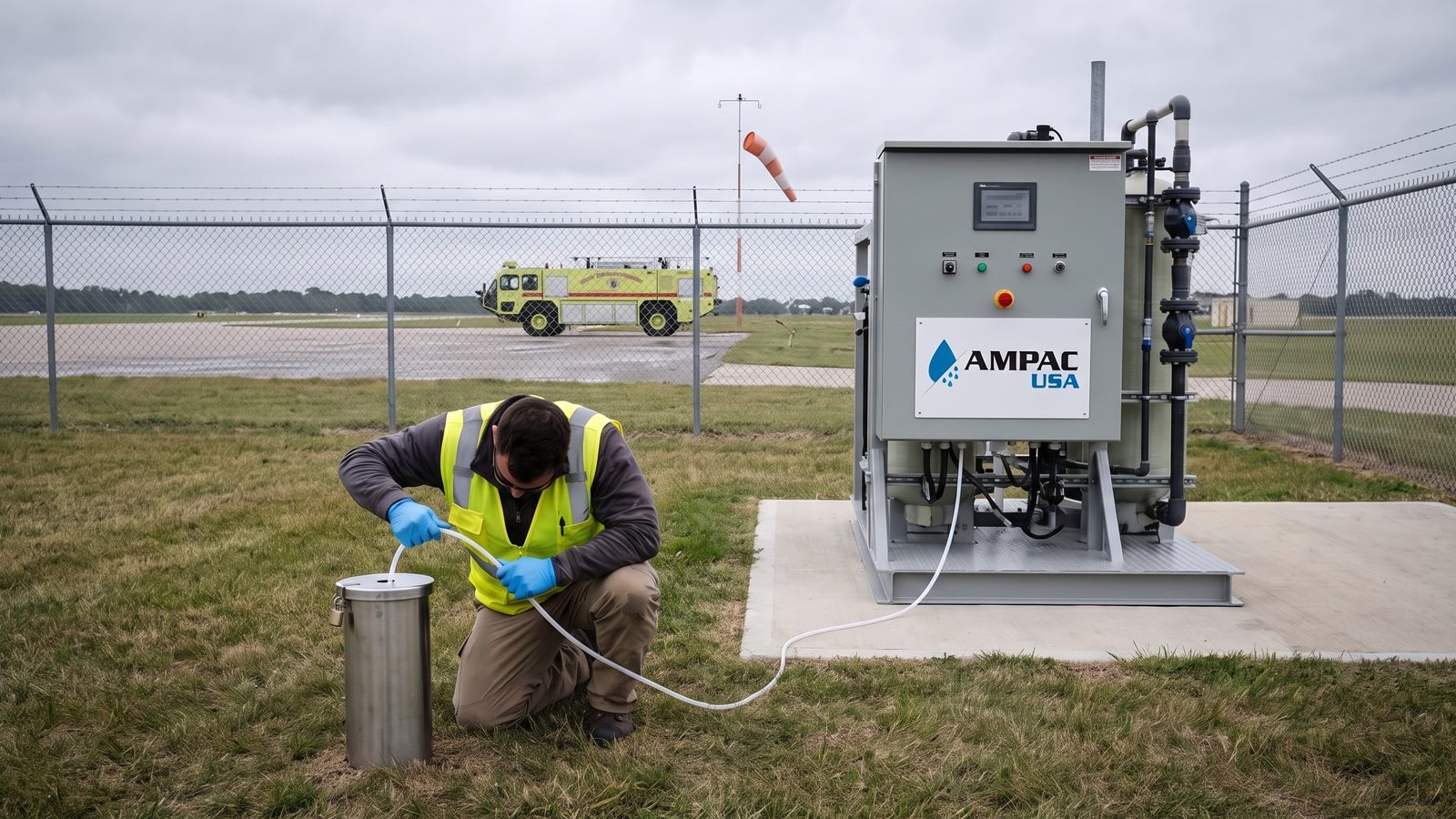

If your facility sits within a few miles of a military airfield, fire training area, or commercial airport, your groundwater has a higher-than-average chance of PFAS contamination. This isn’t speculative — the DoD has formally identified over 700 military installations with confirmed or suspected PFAS in groundwater, almost all traced to the same source: aqueous film-forming foam.
Why AFFF Is the Primary Contamination Source
Aqueous film-forming foam (AFFF) was developed in the 1960s for military and aviation fire suppression. The fluorosurfactant chemistry creates a vapor-sealing film over fuel fires that conventional foam can’t match. Those same fluorosurfactants are PFOA and PFOS precursors. When AFFF is used in training exercises or emergency response, it soaks into soil and eventually migrates into groundwater. It doesn’t degrade. PFAS applied in a 1975 training exercise is still present in groundwater near that site today.
Military airfields conducted live-fire AFFF training for decades. So did commercial airports, most of which were required by FAA regulations to maintain AFFF capability until a 2021 rule began the phase-out. The combination of military and civilian aviation sites means that PFAS groundwater plumes from AFFF are geographically widespread — concentrated near base perimeters and airport fencelines but often extending one to three miles into surrounding communities and industrial areas.
Which Commercial Facilities Are Most at Risk
- Location within one mile of a military airfield or fire training area. Hangars, flight lines, and dedicated AFFF training pads are the highest-concentration source points. Groundwater plumes are well-documented at sites including Pease Air Force Base (NH), Camp Lejeune (NC), Travis AFB (CA), and dozens of others.
- Location within one to two miles of a commercial airport. Most major commercial airports used AFFF in crash rescue training areas. Smaller regional airports often operated with fewer site assessments.
- Industrial or light commercial properties that draw from shallow or intermediate groundwater. Deeper municipal wells sometimes avoid PFAS plumes that affect shallower private and commercial wells in the same area.
- Properties that were formerly part of base housing or adjacent to base operations. Base realignment and closure (BRAC) sites have extensive PFAS histories that don’t always transfer cleanly in property records.
For on-base supply, see AMPAC USA’s military water treatment systems.
How to Test: Methods, Labs, and Cost
PFAS testing is not included in standard water quality panels. You have to ask for it explicitly, and the lab must be certified for the relevant EPA method.
EPA Method 537.1 covers 40 PFAS compounds and is the most widely used method for drinking water. Detection limits are in the 1–5 ppt range for most compounds.
EPA Method 533 is a newer method that expands coverage to shorter-chain PFAS compounds not fully captured by 537.1 — including PFBS and some PFAS precursors that Method 537.1 misses. If your site is near AFFF use and you want a complete picture, specify Method 533.
Cost per sample runs $150–400 at a state-certified environmental lab. Collect samples per EPA protocol — use lab-supplied containers, avoid contact with PTFE-containing equipment during collection, and document chain of custody.
Why RO Is Preferred Over GAC for AFFF-Contaminated Sites
Both granular activated carbon (GAC) and reverse osmosis are recognized by EPA as Best Available Technology for PFAS. At AFFF-contaminated sites specifically, RO has a practical advantage.
AFFF formulations contain a mix of long-chain PFAS (PFOA, PFOS) and shorter-chain compounds (PFBS, PFHxS, PFHpA). GAC adsorption is highly effective for longer-chain PFAS, which have stronger affinity for carbon surfaces. Shorter-chain PFAS have weaker carbon affinity and pass through GAC beds at higher rates. As GAC approaches capacity, competitive desorption can actually push shorter-chain PFAS through at elevated concentrations.
RO doesn’t discriminate by chain length in the same way. Rejection rates for shorter-chain compounds (PFBS: 80–92%, PFHxS: 88–95%) are lower than for PFOA/PFOS (95–99%), but the mechanism is consistent and doesn’t degrade with loading the way GAC does. For facilities where source water contains a mixed PFAS profile — the norm for AFFF-contaminated groundwater — RO provides more predictable, full-spectrum rejection.
System Sizing and Pre-Treatment for PFAS-Impacted Groundwater
PFAS-contaminated groundwater near military sites frequently carries co-contaminants that drive pre-treatment requirements. A typical commercial RO system configuration for PFAS-impacted groundwater:
- Sediment pre-filtration — 5-micron cartridge minimum; dual-stage for high-turbidity sources. Target SDI below 5 before the membrane elements.
- Iron removal — oxidation/filtration or greensand filtration if iron exceeds 0.1 mg/L.
- Antiscalant injection — required above roughly 200 mg/L hardness to prevent carbonate scaling at the concentrate end of the membrane train.
- RO membrane train — sized for design flow rate. Systems targeting sub-4 ppt permeate for PFOA/PFOS often operate at 70–75% recovery rather than 80–85%, to reduce concentration polarization at the membrane surface.
- Post-treatment — pH adjustment and possibly disinfection depending on application.
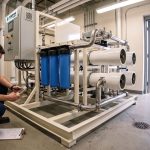
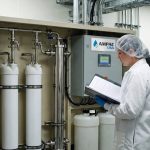
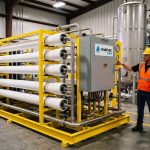
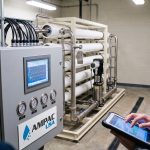
AMPAC commercial RO systems are available from 1,000 to 100,000 GPD and are configurable for PFAS-impacted groundwater. Systems include FILMTEC membranes with documented PFAS rejection performance, stainless steel pressure vessels, and PLC controls for flow, pressure, and recovery monitoring.
Concentrate Disposal: A Compliance Consideration Often Overlooked
RO systems don’t destroy PFAS — they concentrate it in the reject stream. For a system operating at 75% recovery, roughly 25% of the inlet flow exits as PFAS-concentrated reject water at approximately four times the inlet concentration.
Discharge of PFAS-concentrated reject water is regulated in several states and may require permits under the Clean Water Act if discharged to surface water or a POTW. California, Michigan, and New Jersey have active guidance or rules affecting PFAS-laden wastewater discharges. Before commissioning a commercial RO system for PFAS removal, the reject stream disposal pathway needs to be characterized and, if necessary, permitted.
Commercial RO Systems for AFFF-Contaminated Groundwater
AMPAC USA has designed and manufactured commercial RO systems since 1994, including systems for PFAS-impacted source water near military and aviation sites. We review your water analysis, size the pre-treatment and membrane train, and configure for your specific PFAS profile. Made in USA. 2-year warranty. FILMTEC membranes.
Frequently Asked Questions
Why is PFAS contamination common near military bases and airports?
Aqueous film-forming foam (AFFF), used since the 1960s for fire suppression, contains fluorosurfactants that are PFOA and PFOS precursors. The DoD has identified over 700 military installations with confirmed or suspected PFAS in groundwater, almost all traced to AFFF use in training and emergency response.
Why is reverse osmosis preferred over GAC for AFFF-contaminated sites?
AFFF contains a mix of long-chain PFAS (PFOA, PFOS) and shorter-chain compounds. GAC adsorbs longer-chain PFAS well but shorter-chain compounds pass through GAC beds at higher rates, especially as the carbon approaches capacity. RO rejects across the full spectrum more consistently.
How much does PFAS water testing cost?
PFAS testing runs 150 to 400 dollars per sample at a state-certified lab. EPA Method 537.1 covers 40 PFAS compounds, while EPA Method 533 expands coverage to shorter-chain compounds like PFBS that Method 537.1 misses.
What happens to the PFAS that RO removes?
RO does not destroy PFAS, it concentrates it in the reject stream. At 75 percent recovery, roughly 25 percent of inlet flow exits as reject water at about four times the inlet PFAS concentration, and its disposal is regulated in several states including California, Michigan, and New Jersey.