
In short: Endocrine-disrupting chemicals (EDCs), compounds that interfere with hormone function even at very low concentrations, are turning up in drinking water systems across Europe, the US, and elsewhere, mostly at low levels but measurably present. A 2024 three-year investigation of Italian drinking water systems found nonylphenol and bisphenol A (BPA) in nearly every sample tested, and the EU’s revised Drinking Water Directive now requires member states to actively monitor for beta-estradiol and nonylphenol specifically. Reverse osmosis membranes remove these compounds effectively, with published removal rates above 90% for natural and synthetic estrogens and 87% or higher for BPA. This isn’t a reason to panic about tap water. It’s a reason to understand what’s in it and what actually gets it out.
What Are Endocrine-Disrupting Chemicals, and Why Do They Matter in Water?
Endocrine-disrupting chemicals are compounds that mimic, block, or otherwise interfere with the hormones your body produces, things like estrogen, testosterone, and thyroid hormone. Unlike most contaminants, where “the dose makes the poison” applies fairly linearly, EDCs can produce biological effects at very low concentrations because they’re interacting with a signaling system built to respond to trace amounts of hormone in the first place.
The list of compounds researchers watch for in water includes bisphenol A (BPA, from plastics and can linings), nonylphenol (an industrial surfactant breakdown product), natural hormones like estradiol and estrone (excreted by humans and livestock), and synthetic hormones like ethinylestradiol (found in oral contraceptives). None of these are supposed to be in drinking water in meaningful amounts. The question monitoring programs are trying to answer is how much actually gets through, and from where.
Are Endocrine Disruptors Actually Showing Up in Real Drinking Water Systems?
Yes, though generally at low concentrations that vary by treatment stage and source water quality. The most detailed recent look comes from a three-year investigation of Italian drinking water systems, published in 2024, that combined chemical analysis with effect-based bioassay testing across multiple treatment plants.
Nonylphenol was detected in effectively every sample collected, followed closely by BPA. Estrogenic activity, meaning measurable hormone-mimicking effect rather than just chemical presence, was found in only two samples, and even those came in well below the safety trigger value researchers use for drinking water (0.9 ng/L estradiol-equivalent). Sporadic contamination by octylphenol and natural estrogens like estrone and estradiol appeared only in raw source water, not in finished tap water, and ethinylestradiol, the synthetic hormone from birth control, was never detected at all.
The study’s most useful finding for anyone thinking about home water quality: contaminant levels sometimes increased at intermediate treatment steps before the final stage brought them back down. The researchers traced the final water quality directly to the last treatment barrier, activated carbon filtration. That detail matters because it confirms something water treatment engineers already know: the last line of defense in a treatment train carries a disproportionate share of the actual protection.
Why Is the EU Specifically Monitoring for These Compounds Now?
The European Union’s recast Drinking Water Directive, which entered into force in January 2021 with member states required to comply by January 2023, added beta-estradiol and nonylphenol to the substances water utilities must actively monitor throughout the entire supply chain, not just at the treatment plant outlet. That’s a meaningful regulatory shift. Older drinking water rules tended to focus on things like bacteria, nitrates, and heavy metals. Naming specific endocrine-active compounds in a binding directive signals that EU regulators consider hormone-mimicking contamination a distinct category worth its own monitoring requirement, not something that gets caught incidentally by broader chemical screening.
Separately, related research looking at treated wastewater discharged into European rivers, drawing on 56 treatment plant effluents across 15 countries, found endocrine-disrupting compounds present in nearly all of them, with adverse mixture effects showing up even when individual compounds sat below their own thresholds. That’s the upstream picture: rivers and groundwater that feed drinking water intakes are picking up EDCs from wastewater discharge long before the water reaches a treatment plant.
Is the United States Tracking the Same Problem?
The US approaches it from a different regulatory angle, but the underlying concern is the same. The EPA’s Endocrine Disruptor Screening Program has been evaluating chemicals for hormone-disrupting potential since the late 1990s, working from a universe of roughly 10,000 chemicals covered under federal food, drug, and safe drinking water law. In parallel, the EPA’s Contaminant Candidate List, the mechanism used to flag substances for potential future drinking water regulation, is on its sixth draft cycle, with the most recent version identifying 75 chemicals, 4 chemical groups, and 9 microbes for evaluation, screened down from a pool of 274 candidates.
Neither of these US programs mandates active nationwide monitoring for EDCs the way the EU directive now does for beta-estradiol and nonylphenol specifically. That’s a real regulatory gap, and it’s part of why household-level treatment matters more in the US than a “the utility will handle it” assumption would suggest. Municipal treatment removes what it’s required and equipped to remove. It doesn’t automatically remove everything a hormone-active compound screening would flag.
Can Reverse Osmosis Actually Remove These Compounds?
Yes, and the removal rates are well documented. Reverse osmosis works by forcing water through a semi-permeable membrane with pores small enough to block most dissolved contaminants, including molecules considerably larger than water itself. Estrogenic compounds, both natural hormones like estradiol and synthetic ones like ethinylestradiol, are relatively large, structurally complex molecules. That size works against them at an RO membrane: published removal rates for these compounds typically exceed 90%.
BPA is a slightly tougher case because it’s a smaller, more polar molecule, but commercial RO membranes have still demonstrated removal efficiencies around 87% at meaningful feed concentrations, and combined treatment systems that pair RO with UV oxidation or activated carbon push that figure considerably higher. Broader studies looking at recycled water treatment trains that include RO have found overall removal above 97% across a range of pharmaceutical and endocrine-disrupting compounds, bringing product water concentrations down to a small fraction of a microgram per liter for most of them.
The mechanism lines up with what the Italian drinking water study found about activated carbon being the decisive final barrier. RO membranes and activated carbon filtration attack the problem differently, one through physical size exclusion, the other through adsorption, but both land in the same category: they’re the treatment steps doing the real work against compounds that slip past earlier stages of a conventional system.
Does This Mean Everyone Needs an RO System at Home?
It depends on your water source and how much certainty you want. Municipal treatment plants, especially ones running modern multi-barrier processes with activated carbon as a finishing step, are already knocking down EDC levels substantially before water reaches your tap, which is exactly what the Italian data showed. But that data also showed levels creeping up at intermediate treatment stages, and it showed that source water, particularly from rivers downstream of wastewater discharge, carries a real EDC load that treatment has to work against.
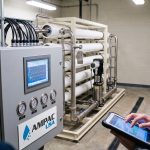
For households on private wells, in areas near agricultural runoff or industrial discharge, or simply wanting a documented reduction in hormone-active compounds rather than a general assumption that municipal treatment is handling it, point-of-use reverse osmosis adds a verifiable additional barrier. AMPAC USA’s residential reverse osmosis systems are built around the same membrane technology behind the removal rates cited above, engineered for consistent performance rather than a best-case lab number.
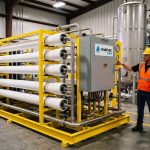
The same logic applies at larger scale for facilities that can’t rely on municipal treatment alone, food and beverage manufacturers, pharmaceutical operations, hospitals, anywhere water quality is a compliance issue rather than a preference. Our commercial reverse osmosis water purification systems are designed for that volume and consistency requirement, built to hold removal performance steady across continuous operation, not just a single test run.
What Should People Actually Take Away From This?
Endocrine-disrupting chemicals in drinking water are a real, measurable, monitored issue, not a fringe concern. The EU’s decision to name specific compounds in binding drinking water regulation, and the consistent detection of nonylphenol and BPA in systems that were otherwise performing well, both point to a category of contaminant that conventional treatment reduces but doesn’t always fully eliminate. At the same time, the data doesn’t support alarm. The Italian study found estrogenic activity in only two of many samples, both well under the safety threshold, and traced good water quality directly to a specific, well-understood treatment step.
The practical conclusion is straightforward: know what’s actually going into your water treatment train, and understand that the technologies with the strongest track record against EDCs, reverse osmosis and activated carbon, aren’t exotic. They’re proven, well-studied, and available at both the household and facility scale.
Frequently Asked Questions
What are the most common endocrine-disrupting chemicals found in drinking water?
Nonylphenol and bisphenol A (BPA) are the most consistently detected, according to the 2024 Italian drinking water study. Natural hormones like estradiol and estrone, along with octylphenol, show up more sporadically and mostly in source water rather than finished tap water.
Does reverse osmosis remove bisphenol A (BPA) from water?
Yes. Published removal efficiencies for commercial RO membranes reach around 87% for BPA at meaningful feed concentrations, and combining RO with activated carbon or UV oxidation pushes removal higher still.
Is tap water in Europe safe from endocrine disruptors?
Generally yes, based on current monitoring. The 2024 Italian study found estrogenic activity in only two samples out of a large multi-year dataset, both well below the safety trigger value used for drinking water. The EU’s Drinking Water Directive now requires active monitoring for beta-estradiol and nonylphenol specifically, which is a stronger regulatory standard than most countries apply.
Why does activated carbon matter alongside reverse osmosis for removing these chemicals?
Activated carbon removes contaminants through adsorption, RO removes them through physical size exclusion at the membrane. The Italian drinking water study found that activated carbon filtration was the treatment step most responsible for a plant’s final water quality, and combining it with RO covers a broader range of compound sizes and chemistries than either method alone.
Should I be worried about EDCs in my home’s drinking water?
Not to the point of alarm, but it’s worth checking your water source and treatment. If you’re on a private well, live near agricultural or industrial discharge, or simply want a verified additional barrier beyond municipal treatment, point-of-use reverse osmosis is a well-documented way to reduce EDC exposure at home.
Sources: European Commission (Drinking Water Directive, recast 2020/2184); Heliyon/ScienceDirect, “Endocrine disrupting chemicals in Italian drinking water systems: Insights from a three-year investigation combining chemical and effect-based tools” (2024); PMC, “Endocrine disrupting chemicals entering European rivers: Occurrence and adverse mixture effects in treated wastewater”; U.S. EPA, Endocrine Disruptor Screening Program; U.S. EPA, Drinking Water Contaminant Candidate List 6 (Draft, 2026); IWA Publishing/Water Science & Technology, “Treatment of Bisphenol A (BPA) in water using UV/H2O2 and reverse osmosis (RO) membranes.”
AMPAC USA engineers custom water purification systems for commercial, industrial, and emergency applications — from 500 GPD to multi-million GPD. Trusted by municipalities, military, and industry worldwide.