
The regulatory landscape for PFAS in drinking water moved from draft to law in April 2024. If you manage a commercial facility’s water supply — whether you’re on a public system or operating your own well — the rules create real compliance obligations with real deadlines. Here’s what the regulation actually says, who it covers, and what “Best Available Technology” means in practice.
The Timeline: What Happens When
EPA finalized the National Primary Drinking Water Regulation for PFAS on April 10, 2024. The rule establishes the first legally enforceable MCLs for specific PFAS compounds in the United States. The compliance schedule runs in phases:
- April 2024: Final rule published. MCLs are established.
- 2027 (3-year mark): Public water systems must complete initial monitoring for all covered PFAS compounds. Systems must notify the public of results.
- 2029 (5-year mark): Systems exceeding MCLs must have treatment in place or be actively implementing compliance plans.
- 2031 (7-year mark): Full compliance required. Systems above MCLs face enforcement.
Seven years sounds like a long runway. It isn’t, for large-scale treatment infrastructure. Engineering, permitting, equipment lead times, and installation for a large commercial system can consume four to five of those years. Facilities that wait until 2028 to start the process are likely to miss 2031.
Which PFAS Compounds Have MCLs
The April 2024 rule established MCLs for six PFAS compounds. Two are set as individual limits; four are grouped under a Hazard Index (HI) framework:
Individual MCLs:
- PFOA: 4 parts per trillion (ppt)
- PFOS: 4 parts per trillion (ppt)
Hazard Index (MCL = HI of 1.0, individual benchmarks used):
- HFPO-DA (GenX chemicals): 10 ppt
- PFNA: 10 ppt
- PFHxS: 10 ppt
- PFHPA: 10 ppt
Separate individual MCL:
- PFBS: 2,000 ppt
The 4 ppt limit for PFOA and PFOS is effectively at the practical quantitation limit for many certified labs. Treatment systems need to deliver consistent sub-4 ppt permeate — not just average-under-4 ppt performance. That distinction drives system design toward higher-rejection membranes and lower recovery rates for contaminated source water.
Who Is Covered — and Who Isn’t
The federal MCLs apply to public water systems (PWS) serving 25 or more people or 15 or more service connections. Private wells and commercial self-supply systems are not covered by the federal rule. A manufacturing facility, farm, or industrial park on its own well is not a PWS and has no federal compliance obligation under this rule.
That said, “not federally covered” is not the same as “no obligation.” State-level PFAS standards are moving independently of federal timelines, and several are already stricter.
State Standards That Already Exceed Federal MCLs
California: MCLs include PFOA at 5.1 ppt and PFOS at 3.7 ppt — below the federal PFOA limit and roughly comparable for PFOS. California also has broad authority over private well users near contaminated sites under other statutes.

Massachusetts: Adopted a combined MCL of 20 ppt for the sum of six PFAS (PFOA, PFOS, PFHxS, PFNA, PFDeA, PFBS) in 2020. Massachusetts DEP has also required testing and remediation at sites with known PFAS contamination under the Massachusetts Contingency Plan, which covers private supply.
Michigan: PFAS standards include PFOA at 8 ppt and PFOS at 16 ppt, with additional MCLs for nine other PFAS compounds. Michigan has been aggressive in enforcing PFAS testing near former manufacturing sites and military installations.
Other states — Vermont, New Hampshire, New Jersey, Washington, and Wisconsin — have adopted or are finalizing PFAS standards. If your facility is in any of these states and draws from groundwater, the assumption that private well status provides a compliance shield is legally risky.
Best Available Technology for PFAS: What EPA Recognizes
EPA’s final rule designates Best Available Technology (BAT) for PFAS compliance. EPA recognized two primary BATs:
Granular activated carbon (GAC) adsorbs PFAS onto carbon media. Effective for longer-chain PFAS (PFOA, PFOS) but less effective for shorter-chain compounds. GAC beds require periodic replacement and PFAS-laden carbon must be managed as a waste stream.
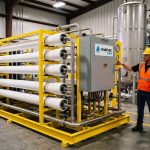
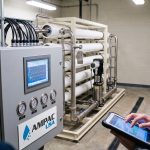
Reverse osmosis (RO) physically rejects PFAS across the full spectrum — including shorter-chain compounds that GAC misses — via size exclusion and charge repulsion through the membrane. Rejection rates for PFOA and PFOS consistently reach 95–99%. RO generates a PFAS-concentrated reject stream that requires proper disposal. For commercial and industrial facilities, RO is generally the preferred BAT where the full PFAS spectrum is a concern.
What Commercial Facilities Should Do Right Now
- Identify your supply source. Are you on a municipal PWS or self-supply? If PWS, request PFAS monitoring data from your supplier. If self-supply, you’re outside the federal mandate but inside state risk depending on your location.
- Test your source water. EPA Method 533 or EPA Method 537.1 at a certified lab. Testing costs $150–400 per sample. If you’re near a military installation, airport, industrial site, or agricultural area with biosolid application history, treat this as a priority.
- Check your state’s rules. If you operate in California, Massachusetts, Michigan, Vermont, New Hampshire, New Jersey, or Washington, confirm whether your facility falls under state PFAS regulations independent of the federal rule.
- Spec treatment if concentrations are elevated. For commercial self-supply with PFAS above MCLs, RO is the most defensible BAT for the full PFAS spectrum.
- Document everything. Testing records, treatment specifications, and compliance decisions create the paper trail that protects facilities in enforcement actions or property transactions.
Commercial RO Systems Configured for PFAS Compliance
AMPAC USA manufactures commercial and industrial RO systems from 1,000 to 100,000 GPD, Made in USA since 1994. Our FILMTEC-equipped systems are specified for PFAS-impacted source water and carry a 2-year warranty.
Frequently Asked Questions
When do commercial facilities need to comply with EPA’s PFAS drinking water rule?
EPA finalized the rule in April 2024. Public water systems must complete initial PFAS monitoring by 2027, have treatment plans in place by 2029 for systems exceeding limits, and reach full compliance by 2031.
What are the EPA MCLs for PFOA and PFOS?
Both PFOA and PFOS are capped at 4 parts per trillion individually. Four other compounds (GenX, PFNA, PFHxS, PFHpA) are grouped under a Hazard Index framework at 10 ppt each, and PFBS has a separate limit of 2,000 ppt.
Does the federal PFAS rule apply to private wells and self-supplied facilities?
No. The federal MCLs apply only to public water systems serving 25 or more people or 15 or more service connections. Several states, including California, Massachusetts, and Michigan, have their own PFAS standards that can apply regardless of federal coverage.
What does EPA recognize as Best Available Technology for PFAS removal?
Granular activated carbon (GAC) and reverse osmosis. GAC is effective for longer-chain PFAS but less effective for shorter-chain compounds, while RO physically rejects PFAS across the full spectrum via size exclusion and charge repulsion.