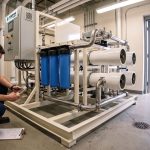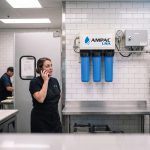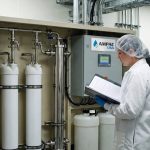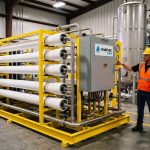

Commercial water treatment is not a product category. It’s a decision about which combination of technologies your facility needs, in what sequence, at what flow rate — and which of those choices actually addresses your specific water problem versus which ones a vendor is upselling you on.
This guide covers how to think through that decision, what each technology actually does, what commercial systems cost, and what questions to ask before buying.
What “Commercial Water Treatment” Actually Means
The term covers any water treatment system designed for business use — typically above 1,000 gallons per day (GPD) and up to several million GPD for large industrial facilities. The commercial category is broad because the applications are genuinely different: a restaurant needs water that tastes right and doesn’t scale espresso equipment; a semiconductor fab needs 18 megohm-cm ultrapure water; a hotel chain wants soft water for laundry and reduced scale in 200 shower heads.
What most commercial applications share is this: municipal tap water — even clean tap water — has dissolved minerals, chlorine, and occasionally contaminants that create problems at commercial scale. Scaling destroys boilers and heat exchangers. Chlorine degrades RO membranes and affects food and beverage flavor. High TDS water leaves spots on commercial glassware. The treatment system exists to address those specific problems, not to produce universally “pure” water.
The Five Core Commercial Water Treatment Technologies
1. Reverse Osmosis (RO)
RO forces water through a semipermeable membrane at pressure, rejecting 95–99% of dissolved solids including hardness minerals, heavy metals, nitrates, PFAS, bacteria, and most organic compounds. It’s the most versatile commercial treatment technology and the starting point for high-purity applications.
- Best for: Food and beverage production, pharmaceutical manufacturing, boiler feedwater, electronics rinsing, dialysis water, water store equipment
- Not ideal for: Applications that only need partial TDS reduction; very high-turbidity source water (needs pre-treatment first)
- Commercial flow rates: 100 GPD to 1,000,000+ GPD
- Rejection rate: 95–99.5% TDS depending on membrane type and operating conditions
- Recovery: Typically 60–80% for brackish water RO (20–40% becomes reject/concentrate)
2. Water Softening (Ion Exchange)
Softeners exchange calcium and magnesium ions (hardness) for sodium ions using a resin bed. They eliminate scale buildup but do not reduce TDS — they replace one dissolved mineral with another. Salt efficiency matters at commercial scale: a properly sized commercial softener uses 3–6 lbs of salt per 1,000 grains removed.
- Best for: Scale prevention in boilers, cooling towers, laundry, dishwashers, HVAC systems; water that’s only problematic for hardness
- Not ideal for: Applications needing TDS reduction, iron removal above 0.3 ppm, or sodium-restricted water
- Commercial sizing: Sized by daily grain removal capacity (hardness in GPG × daily flow rate in GPD)
3. Multimedia and Sediment Filtration
Layered filter beds (typically anthracite, sand, and garnet) remove suspended solids, turbidity, and fine particles down to 10–25 microns. Used as pre-treatment upstream of RO systems or softeners to protect downstream equipment, or as standalone treatment when only turbidity is the issue.
- Best for: Well water with iron or sediment, surface water with variable turbidity, pre-treatment before RO
- Operating note: Backwash weekly to monthly; media replacement every 3–5 years
4. Carbon Filtration
Activated carbon removes chlorine, chloramine, volatile organic compounds (VOCs), and taste/odor compounds through adsorption. Critical upstream of RO systems because chlorine rapidly degrades polyamide RO membranes. Carbon beds are rated by service hours, not by visible condition — a carbon filter that looks fine may be chlorine-exhausted.
- Best for: Chlorine removal, taste and odor improvement, VOC removal, RO pre-treatment
- Not for: TDS reduction, hardness removal, bacteria, or heavy metals
- Replacement interval: Every 6–12 months for cartridge carbon; every 2–4 years for granular activated carbon (GAC) beds
5. UV Disinfection
UV systems expose water to 254-nm ultraviolet light, which deactivates bacteria, viruses, and protozoa by disrupting their DNA. No chemicals added, no residual in the water, no effect on TDS or mineral content. Effective only for clear water — turbidity or iron blocks UV penetration.
- Best for: Post-RO disinfection, food and beverage applications, bottled water lines, well water with biological risk
- Not for: Water with turbidity above 1 NTU or iron above 0.3 ppm (without pre-filtration)
- Lamp replacement: Annually; dosage validation recommended for regulated applications
Commercial Water Treatment System Costs
| System Type | Flow Rate Range | Equipment Cost | Installation | Annual Operating Cost |
|---|---|---|---|---|
| Commercial RO — small (restaurant, café, lab) | 100–1,000 GPD | $2,000–$12,000 | $500–$2,000 | $300–$800 (membranes, filters, electricity) |
| Commercial RO — mid-size (light manufacturing, food production) | 1,000–10,000 GPD | $12,000–$60,000 | $2,000–$8,000 | $2,000–$8,000 |
| Industrial RO (heavy manufacturing, pharmaceutical, large food/bev) | 10,000–100,000 GPD | $60,000–$350,000 | $10,000–$50,000 | $15,000–$80,000 |
| Commercial water softener | 10–500 GPM | $1,500–$25,000 | $500–$3,000 | $600–$6,000 (salt, regeneration water) |
| Multimedia pre-filter system | 10–500 GPM | $2,000–$30,000 | $1,000–$5,000 | $500–$3,000 (media replacement, backwash water) |
| UV disinfection system | 1–500 GPM | $500–$8,000 | $200–$1,500 | $100–$600 (lamps, sleeves) |
These ranges are wide because system cost is highly site-specific. Source water chemistry, required output quality, available space, electrical infrastructure, and local labor rates all affect the number. A proper quote requires a water analysis report and site survey.
Commercial Water Treatment by Industry
Food and Beverage Manufacturing
Water quality directly affects product taste, consistency, and shelf life. FDA food facility registration requires that water used in food contact meets potable water standards, but “potable” is a floor, not a target. Most food and beverage manufacturers run water well below potable limits.
Typical system: Multimedia pre-filtration → carbon filtration (chlorine removal) → RO → UV disinfection → point-of-use carbon polish. TDS target: 50–150 ppm for most beverage applications; hardness target: below 2 GPG to protect equipment.
Hotels and Hospitality
Hard water is the primary problem for hospitality properties — it deposits scale on laundry equipment, dishes, glassware, showerheads, and HVAC systems. Scale buildup on a hotel boiler reduces efficiency and can require $15,000–$30,000 in repair or replacement over a decade.
Typical system: Commercial water softener for the main supply (laundry, kitchen, HVAC) plus a dedicated RO system for the restaurant and bar. RO water for ice machines extends the cleaning interval and improves ice clarity significantly.
Cannabis Cultivation
Cannabis requires precise nutrient ratios that cannot be achieved reliably with variable municipal water chemistry. Growers typically start with RO water (near-zero TDS) and add back specific nutrients in known concentrations, giving them complete control over the nutrient solution.
Typical system: Commercial RO sized at 1.5–2× the daily usage need (to account for RO recovery rate); carbon pre-filtration to protect the membrane from chloramine in municipal water. Target: <20 ppm TDS on the RO product water.
Pharmaceutical and Life Sciences
USP defines water quality grades for pharmaceutical manufacturing: Purified Water (conductivity ≤1.3 µS/cm), Water for Injection (WFI), and Sterile Water. Purified Water is produced by RO followed by electrodeionization (EDI); WFI requires distillation or other validated processes. cGMP compliance requires validated systems, change control, and regular monitoring.
Typical system: Multimedia pre-filter → softener → carbon → RO → EDI → distribution loop with continuous recirculation. This is a regulated application — system design should involve a pharma water specialist.
Car Washes
Spot-free rinse requires water below 10 ppm TDS. High-TDS water leaves mineral deposits on vehicle surfaces after the final rinse, which customers see as spots and streaks. An RO system on the spot-free rinse circuit is the standard solution — it eliminates the spotting without changes to the rest of the wash process.
Typical system: Dedicated RO on the final rinse circuit only, sized at 200–2,000 GPD depending on wash volume. The rest of the wash water does not need treatment.
How to Size a Commercial Water Treatment System
- Determine daily flow rate: Total gallons used per day, with a 25–30% buffer for peak demand. Don’t design to average — size for peak usage periods.
- Get a water analysis: A laboratory water analysis ($50–$200) identifies specific contaminants, TDS, hardness, iron, pH, and biological indicators. It’s the only reliable basis for system selection — treating without knowing what you’re treating wastes money.
- Define the output target: What TDS, hardness, bacterial count, and contaminant levels does your application require? Food production has different targets than irrigation; pharmaceutical water has different targets than hotel softening.
- Match technology to problem: Use the minimum treatment necessary. Softening for a hardness problem only; softening + RO for food production; full treatment train for pharmaceutical or electronics applications.
- Account for reject water: RO systems reject 20–40% of feed water as concentrate. Factor this into your water budget and drainage planning.
Questions to Ask Before Buying a Commercial Water Treatment System
- Is the system factory-tested? A reputable manufacturer tests every system before shipment and provides documentation of actual flow rate and rejection performance at the factory.
- What membranes does it use? Ask for the manufacturer and model number. FILMTEC (DowDuPont) and Hydranautics are the industry standards; reject any system with unlisted or private-label membranes at comparable price points.
- What is the warranty on the membrane system vs. the whole unit? Membranes typically carry a 1-year performance warranty; vessels and frames 3–5 years. Get this in writing.
- Who handles service? Local service availability matters more than purchase price. A system that costs 10% less but requires the manufacturer to fly in a technician for membrane replacement is not the better deal.
- What is the replacement media cost? Get pricing on membrane elements, pre-filter cartridges, and UV lamps. Some manufacturers sell proprietary consumables at a significant markup over commodity equivalents.
- Is the system designed for your source water? A commercial RO system designed for low-TDS municipal water may not perform acceptably on well water with high iron or hardness. Verify the design was based on your actual water analysis.
AMPAC USA: Commercial and Industrial Water Treatment Systems
AMPAC USA has manufactured commercial and industrial water treatment systems in Woods Cross, UT since 1994. Every system ships factory-tested with documented flow rate and TDS rejection. We use FILMTEC membranes across our commercial RO line, and all wetted components meet NSF/ANSI 61 requirements for potable water contact.
Flow rates from 100 GPD to 250,000+ GPD. Custom engineering available for non-standard source water, containerized deployment, or specific regulatory requirements.
Frequently Asked Questions
What are the five core commercial water treatment technologies?
Reverse osmosis, water softening (ion exchange), multimedia/sediment filtration, carbon filtration, and UV disinfection, each addressing a different water quality problem from dissolved solids and hardness to particulates, chlorine, and biological contamination.
How do I know which water treatment technology I actually need?
Start with a laboratory water analysis, then match technology to the specific problem: softening alone for a hardness-only issue, RO for TDS or contaminant reduction, and a full treatment train for pharmaceutical or electronics-grade requirements.
What questions should I ask before buying a commercial water treatment system?
Is the system factory-tested with documented flow rate and rejection performance? What membrane brand is used? What is the warranty on membranes versus the whole unit? Who provides local service? What does replacement media cost?
How much does a commercial RO system cost?
Small commercial RO (100-1,000 GPD) for a restaurant or lab runs 2,000 to 12,000 dollars in equipment. Mid-size systems (1,000-10,000 GPD) run 12,000 to 60,000 dollars. Industrial systems (10,000-100,000+ GPD) run 60,000 to 350,000 dollars.