

Water scarcity continues to affect billions globally, especially in coastal and arid regions. In these areas, seawater is abundant but undrinkable without treatment. Enter solar-powered desalination machines – an innovative, eco-friendly solution that uses the power of the sun to turn seawater into clean, potable water.
In this guide, we’ll break down how these systems work, what makes them so efficient, and why they are becoming the preferred choice for off-grid and remote applications.
What Is a Solar-Powered Desalination Machine?
A solar desalination machine is a system that removes salt and impurities from seawater using solar energy as its power source. Most modern solar desalination systems are built using reverse osmosis (RO) technology, powered by photovoltaic solar panels.
These units are ideal for areas lacking reliable grid electricity, including island communities, disaster zones, rural agricultural sites, and military deployments.
Key Components of a Solar RO Desalination System
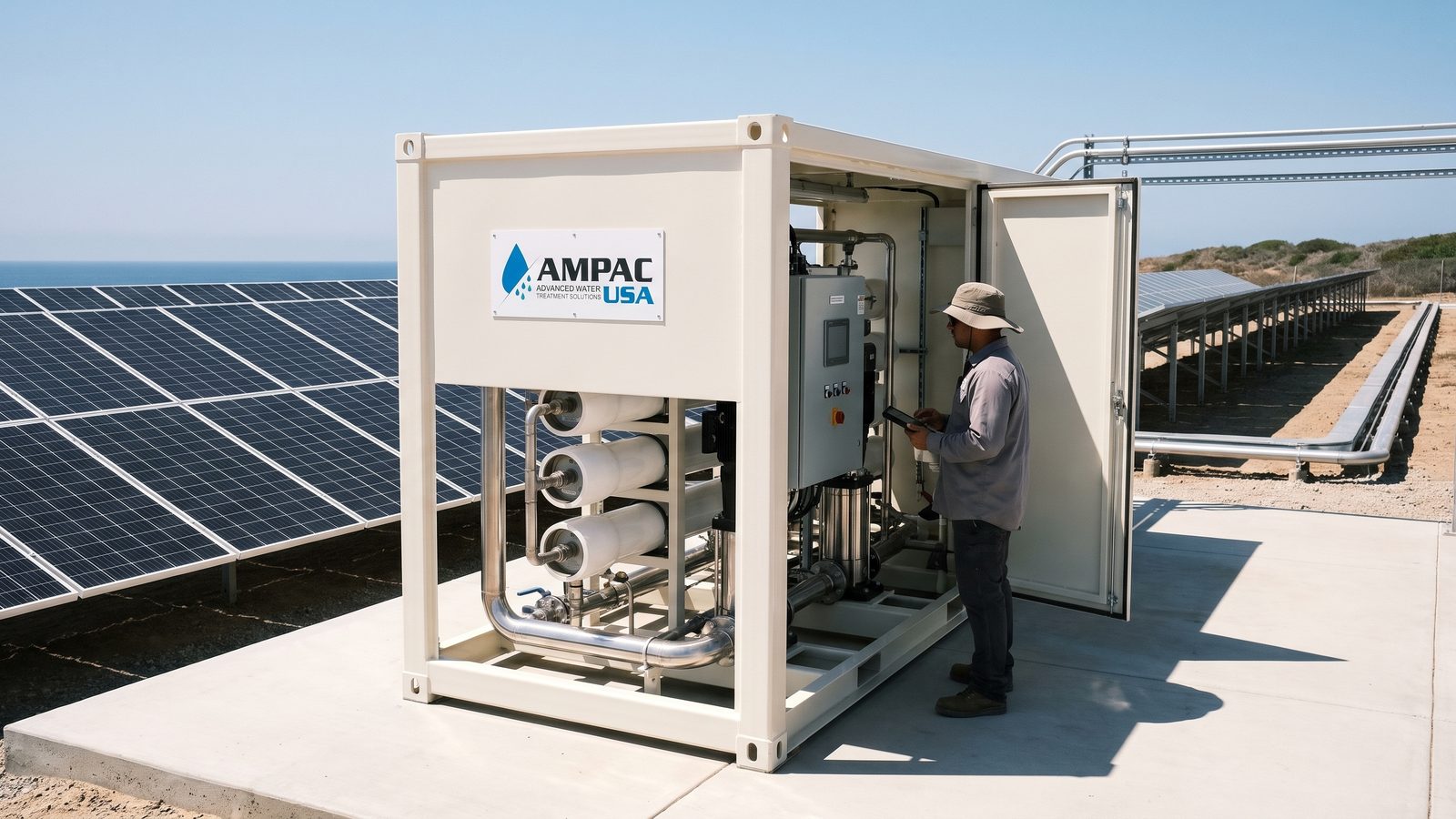
AMPAC USA’s solar seawater desalination machines are a benchmark in the industry. Here’s what typically powers the process:
1. Photovoltaic Solar Panels
Solar panels generate DC electricity from sunlight, which powers pumps and controllers within the unit.
2. Pre-Treatment Filtration
Raw seawater passes through sediment filters to remove large particles and organic matter.
3. High-Pressure RO Membrane
The heart of the system, RO membranes filter out up to 99.9% of salts, bacteria, and heavy metals from seawater.
4. Post-Treatment
UV sterilizers or activated carbon filters enhance water quality and safety for drinking and other uses.
5. Smart Controllers
These adjust flow rates and optimize energy use based on available sunlight.
6. Brine Discharge Control
Wastewater is safely discharged or recycled using environmentally safe techniques.
Step-by-Step: How the Desalination Process Works
- Solar Power Generation: Sunlight hits the PV panels, creating power for the system.
- Water Intake: Seawater is pumped into the system.
- Filtration: Pre-filters remove particles and biological contaminants.
- Reverse Osmosis: Water is forced through membranes, separating clean water from brine.
- Post-Treatment: Final filtration polishes the water for taste and safety.
- Storage or Direct Supply: Freshwater is sent to a tank or distributed for immediate use.
Benefits of Using Solar RO Desalination Machines
- Off-Grid Ready: Operates independently of electricity grids or diesel generators
- Eco-Friendly: Reduces carbon emissions and energy costs by up to 90%
- Highly Portable: Ideal for military, disaster relief, or mobile medical units
- Customizable Capacities: Systems available from 2,500 to 15,000 GPD
- Minimal Maintenance: Automated operation with smart controllers
- Safe & Reliable: High water recovery and salt rejection rates
Common Applications
- Coastal villages and island communities
- Humanitarian relief camps
- Military field operations
- Offshore installations and ships
- Remote agricultural farms
- Disaster-hit zones with no power
Why Choose AMPAC USA for Solar Seawater Desalination?
Remote sites need equipment that keeps working when the grid does not. AMPAC USA has been building water treatment systems in Woods Cross, Utah since 1994, and our solar-powered reverse osmosis systems are designed for coastal, island and off-grid locations. Each one is configured around your site, your water source and how much fresh water you need each day.
Browse our solar power water systems, or talk with an engineer about your location.
Final Thoughts
As climate change worsens global water scarcity, solar desalination emerges as a scalable, sustainable solution. Whether you’re looking to power a coastal facility or support a remote field camp, a solar RO machine ensures consistent, clean water – with zero fuel costs and minimal ecological impact.
Related Articles
- The Future of Water Treatment: Trends in Solar-Powered Desalination Technology
- Solar-Powered Water Purification: The Complete Off-Grid Solutions Guide 2026
- Solar Desalination vs. Traditional RO Systems: Which Is Better for Water Purification?
- Seawater Desalination in 2026: Technologies, Costs, and the Future of Fresh Water
Conclusion
Solar desalination works because it pairs two mature technologies — photovoltaic power and reverse osmosis — rather than inventing something new, which is exactly why it’s reliable enough for off-grid deployment. The panels handle the energy side, the RO membrane handles the salt removal, and smart controllers keep the system running efficiently as sunlight varies through the day. That combination is what makes it a realistic option for coastal communities, remote facilities, and disaster response sites that can’t count on grid power. For more on where this technology is headed, see our solar desalination trends guide. Contact our team at info@ampac1.com or (909) 548-4900 to see if a solar RO system fits your site.
Solar Desalination: System Components and Operating Principles
Solar-powered desalination integrates renewable energy generation with membrane or thermal water treatment to produce fresh water from saltwater or brackish water without fossil fuel consumption. The dominant and most scalable approach is photovoltaic-powered reverse osmosis (PV-RO), in which solar panels generate DC or AC electricity that powers the high-pressure pump at the core of the RO system. Understanding each component’s function helps in selecting and sizing solar desalination systems for specific applications.
The PV array must be sized to provide adequate power for the RO high-pressure pump under worst-case solar irradiance conditions for the deployment location. Solar irradiance data (available from NASA and local meteorological services) informs array sizing. For a 5,000 GPD SWRO system requiring 15 kW of pump power, a 20-25 kW PV array (accounting for losses and peak demand) with 80-100 kWh of battery storage provides 20+ hours of daily operation at typical coastal irradiance. Battery storage is critical for systems requiring nighttime or cloudy-day operation — lithium iron phosphate (LiFePO4) batteries offer the best cycle life and safety profile for marine applications.
The RO system in a solar-powered unit is engineered for variable-speed operation — since solar power output varies with cloud cover and time of day, the RO pump speed must vary proportionally without causing membrane damage or excessive flux variation. Variable frequency drive (VFD) controllers maintain appropriate membrane flux within safe operating ranges across available power input. Automated control systems monitor solar power availability, battery state of charge, water production, and water quality, making intelligent decisions about production rate, flushing, and battery management. AMPAC USA solar-compatible SWRO systems are designed with VFD-ready pump selections, solar interface specifications, and pre-engineered control logic for solar power integration.
Frequently Asked Questions
What is the typical daily water output of a solar-powered desalination system?
Modern PV-powered reverse osmosis (RO) solar desalination systems can produce a significant volume of clean water, ranging from 200 to over 50,000 liters per day. This scalability makes them suitable for diverse needs, from small communities to larger industrial applications, operating solely on solar energy.
What is the most efficient technology used in modern solar desalination machines?
The most efficient and scalable technology for modern solar desalination is photovoltaic (PV)-powered reverse osmosis (RO). These systems utilize solar panels to power high-pressure pumps, forcing seawater through RO membranes to remove up to 99.9% of salts and impurities. While solar stills and membrane distillation also exist, PV-RO offers superior output and energy efficiency.
For what types of applications are solar-powered desalination machines most suitable?
Solar-powered desalination machines are ideal for off-grid and remote applications where reliable grid electricity is unavailable. This includes island communities, disaster relief zones, rural agricultural sites, and military deployments. AMPAC USA’s systems are designed for these challenging environments, providing sustainable water purification.
What are the essential components of an AMPAC USA solar RO desalination system?
An AMPAC USA solar RO desalination system typically comprises photovoltaic solar panels for power generation, pre-treatment filtration, and a high-pressure RO membrane that removes up to 99.9% of impurities. Post-treatment (UV/activated carbon) ensures water safety, while smart controllers optimize energy use and brine discharge control manages wastewater responsibly.
How effectively do solar-powered reverse osmosis systems remove salt from seawater?
Solar-powered reverse osmosis (RO) systems are highly effective at removing salt from seawater, with high-pressure RO membranes capable of filtering out up to 99.9% of salts, bacteria, and heavy metals. This process transforms undrinkable seawater into clean, potable water suitable for drinking and other essential uses.
AMPAC USA engineers custom water purification systems for commercial, industrial, and emergency applications — from 500 GPD to multi-million GPD. Trusted by municipalities, military, and industry worldwide.