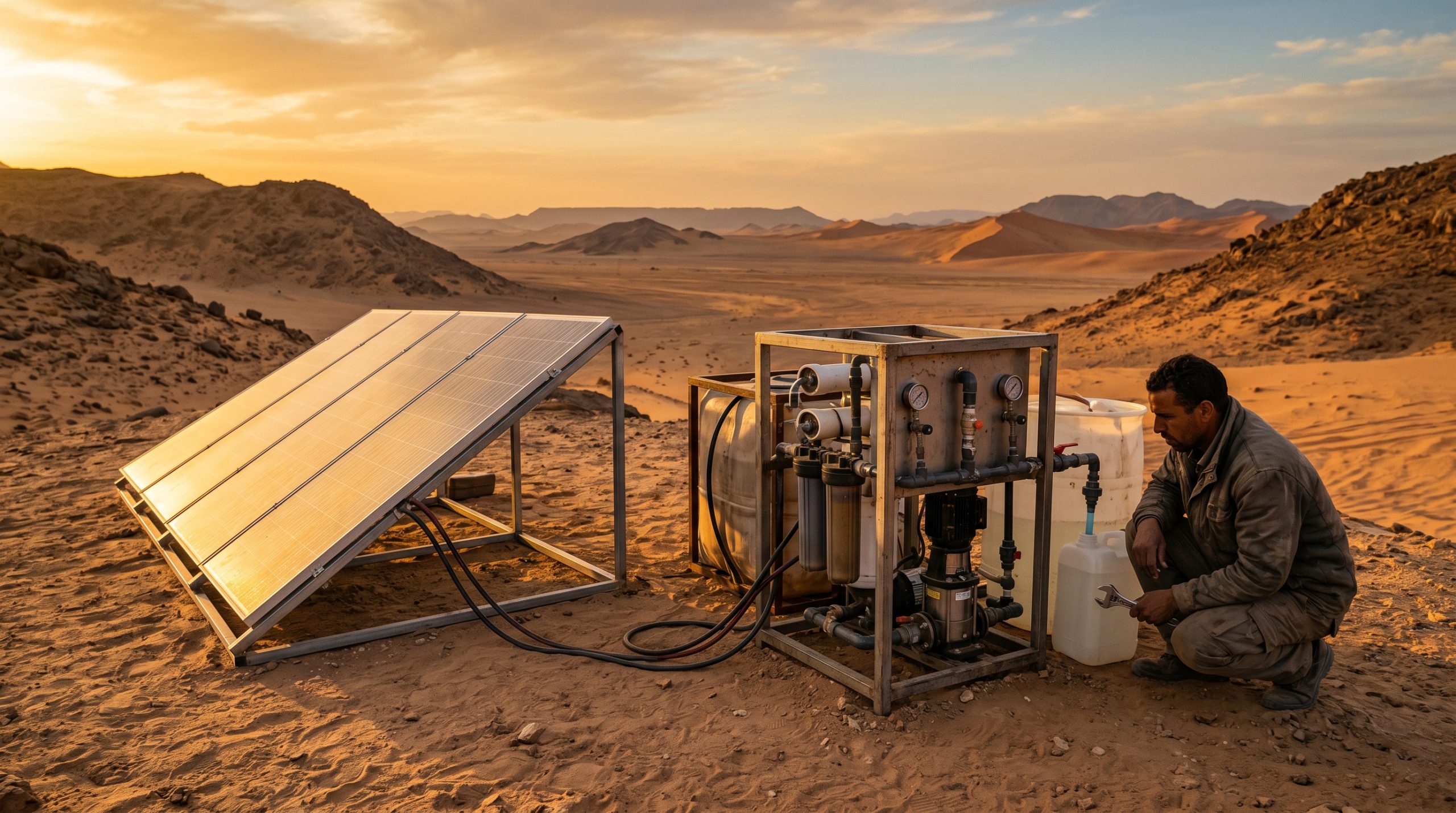

Solar reverse osmosis (RO) systems deliver clean drinking water in remote and off-grid locations by combining photovoltaic solar panels with high-rejection RO membranes – no grid electricity, no diesel fuel required. These systems can purify seawater, brackish groundwater, or surface water to WHO drinking water standards at flow rates from 500 to 15,000 gallons per day, making them the most practical water purification solution for isolated communities, military field operations, island installations, and disaster relief deployments worldwide.
- Flow capacity: 500-15,000 GPD (standard units); larger custom systems available
- Power source: photovoltaic solar panels (no grid power or diesel required)
- Salt rejection: 97-99.7% depending on membrane type (BWRO or SWRO)
- Energy consumption: 0.8-2.5 kWh/m³ (brackish); 3-5 kWh/m³ (seawater)
- Applications: remote villages, island resorts, military bases, disaster relief, offshore platforms
- Deployment time: 1-7 days for modular containerized systems
- AMPAC USA: over 30 years designing water treatment systems
Why Clean Water Access Remains a Challenge in Remote Areas
According to the World Health Organization and UNICEF’s Joint Monitoring Programme, approximately 2.2 billion people worldwide lack access to safely managed drinking water services. The vast majority of these individuals live in rural, remote, or island communities where extending water supply infrastructure – water mains, treatment plants, distribution networks – is prohibitively expensive or physically impossible.
The challenge is not just geographic isolation but energy isolation. Conventional water treatment systems require reliable grid electricity or consistent fuel supply for pumps, controls, and UV disinfection. In the world’s most water-stressed regions – sub-Saharan Africa, South and Southeast Asia, Pacific island nations, and conflict-affected areas – neither reliable electricity nor fuel supply chains can be taken for granted.
Traditional solutions have involved borewell drilling (contaminated aquifer risk), water trucking (expensive and unreliable), and community rainwater harvesting (climate-dependent and insufficient). Solar reverse osmosis systems address this challenge differently: they produce safe drinking water continuously from whatever water source is available – seawater, brackish groundwater, or surface water – using only sunlight as their energy input.
AMPAC USA, founded in 1994, designs and builds solar-powered water purification systems for remote communities, military installations and humanitarian operations. This guide covers how solar RO systems work, their key benefits, and how to select the right system for specific off-grid applications.
How Solar Reverse Osmosis Systems Work
The Core Technology: Reverse Osmosis
Reverse osmosis is a pressure-driven membrane separation process. Feed water is pressurized and forced through thin-film composite (TFC) polyamide membranes with pore sizes of approximately 0.0001 microns – far smaller than bacteria (0.1-10 microns), viruses (0.02-0.3 microns), protozoa, and dissolved ionic contaminants. Water molecules pass through as purified permeate while dissolved salts, heavy metals, bacteria, viruses, and organics are rejected and exit as concentrate.
For brackish water feed (1,000-15,000 mg/L TDS), RO systems operate at 100-300 PSI and achieve salt rejection of 97-99.5%, producing permeate at 15-300 mg/L TDS. For seawater feed (32,000-45,000 mg/L TDS), seawater RO membranes operate at 800-1,160 PSI and achieve 99-99.7% salt rejection. AMPAC USA’s reverse osmosis systems cover both brackish and seawater feed categories.
Solar Power Integration
Solar PV panels generate direct current (DC) electricity from sunlight. In solar RO systems, this DC power drives the high-pressure pump that forces water through the RO membranes. The system design must account for the diurnal (day/night) power availability cycle and seasonal variation in solar irradiance at the installation location.
Two primary solar integration approaches are used:
- Direct-drive solar RO (no battery storage): The RO system operates only during daylight hours when solar panels generate sufficient power. Produced water is stored in a cistern or tank for 24-hour supply. This is the simplest and most cost-effective approach for applications where water storage is practical.
- Battery-buffered solar RO: Battery banks store excess daytime solar energy for nighttime or cloudy-day operation, providing 24-hour continuous production. Higher capital cost but provides true operational independence from sun availability.
Variable-frequency drive (VFD) technology allows solar RO pump speeds to automatically adjust to available solar power, enabling smooth operation across the daily power variation curve without requiring battery storage in many installations. AMPAC USA’s solar RO systems incorporate VFD control as standard on systems designed for direct-drive operation.
Pre-Treatment and Post-Treatment
Solar RO systems include pre-treatment components upstream of the membranes to protect against fouling: sediment pre-filters remove particles and turbidity; activated carbon filters remove chlorine and organics; and antiscalant dosing prevents mineral scale on membrane surfaces. Post-treatment typically includes a final carbon polishing filter and UV disinfection to ensure microbiological safety and product water taste quality.
Key Benefits of Solar RO Systems for Remote and Off-Grid Locations
1. Complete Energy Independence
The most transformative benefit of solar RO is complete independence from grid electricity and fossil fuel supply chains. In remote communities, the cost of diesel fuel – including transportation logistics to remote sites – can reach $2-5 per liter. A diesel-powered water purification system for a community of 500 people may consume 30-50 liters of diesel per day, representing an annual fuel cost of $20,000 – $90,000 that many communities simply cannot sustain.
Solar RO eliminates this ongoing fuel cost. After the initial capital investment in the solar array, the energy input is free for the 20-25 year design life of the solar panels. Life cycle cost analyses consistently show that solar RO achieves lower total cost of water over a 10-20 year period compared to diesel-powered alternatives in most remote deployment scenarios.
2. Lowest Long-Term Operating Cost
Solar RO systems have inherently low operating costs after installation. The primary consumables are pre-filter cartridges (replaced every 3-6 months), membrane elements (replaced every 3-7 years with proper operation), antiscalant chemical (used at very low dosing rates), and UV lamp bulbs (replaced annually). In well-designed systems with high-quality components, annual operating costs excluding labor typically represent 5-10% of capital cost per year.
This compares favorably to diesel-powered systems, where fuel costs alone can represent 30-60% of capital cost annually. The cost advantage of solar RO grows with remoteness: the more expensive diesel logistics are at a given site, the more compelling the solar RO economics.
3. Proven Pathogen Removal to WHO Standards
Solar RO systems using properly sized and maintained RO membranes with nominal 0.0001-micron pore size provide reliable log-reduction values (LRV) of:
- Bacteria: 6+ log reduction (99.9999% removal)
- Viruses: 4+ log reduction (99.99% removal)
- Protozoa (Giardia, Cryptosporidium): complete removal
- Dissolved heavy metals (lead, arsenic, chromium): 95-99%+ removal depending on species
- Nitrates and nitrites: 85-95% removal
- Dissolved TDS: 97-99.7% reduction
This multi-barrier performance exceeds WHO drinking water safety guidelines across all major contaminant categories, making solar RO one of the most comprehensive point-of-production water purification technologies available for remote deployments. AMPAC USA designs its systems to meet the standards that apply to each model and application. Ask us what documentation exists for the system you are considering.
4. Low Maintenance Requirements and Smart Automation
Remote locations typically cannot support resident technical staff. Solar RO systems must therefore be designed for high reliability with minimal intervention. AMPAC USA’s systems incorporate PLC-based automation that:
- Automatically starts and stops the system based on available solar power and product tank level
- Monitors permeate conductivity continuously and alarms if membrane performance degrades
- Performs automatic membrane flushing at system shutdown to prevent biological fouling during standby
- Logs operational data for remote performance analysis
- Provides simple operator interface with visual fault indication
This automation reduces the technical skill requirement for daily operation to a level that can be managed by trained local community operators after a brief training program – an important consideration for sustainable deployment in developing country contexts.
5. Rapid Deployment Capability
AMPAC USA designs solar RO systems in containerized or skid-mounted configurations that can be transported by truck, helicopter, or boat and commissioned in 1-7 days on site. This rapid deployment capability is essential for:
- Emergency response: Providing clean water in the immediate aftermath of natural disasters (hurricanes, earthquakes, floods) before fixed infrastructure is restored
- Military operations: Establishing forward operating base water supply in austere locations with 24-72 hour setup targets
- Temporary settlements: Providing water for refugee camps, construction camps, or seasonal worker housing
- Pilot deployments: Proving system performance before committing to permanent infrastructure investment
AMPAC USA holds US military and government contracts for deployable water purification systems, including solar-powered variants designed for rapid air or sea transport. Explore our applications portfolio including military and humanitarian deployment cases.
6. Zero Emissions and Environmental Sustainability
Solar RO systems produce zero direct greenhouse gas emissions during operation. For communities and organizations with environmental sustainability commitments – NGOs, eco-resorts, island municipalities, military units operating under green energy mandates – solar RO is the only water purification technology that achieves both water security and carbon neutrality simultaneously.
The environmental footprint comparison with alternatives is stark: a diesel-powered 5,000 GPD water purification system emits approximately 15,000-20,000 kg of CO₂ per year from fuel combustion. An equivalent solar RO system emits zero operational CO₂, with only the embedded carbon in manufacturing and installation (typically recovered within 1-3 years of operation from a lifecycle carbon perspective).
7. Scalable and Modular Design
Solar RO systems can be scaled from very small (500 GPD for a small clinic or school) to large community-scale installations (50,000+ GPD for a small town) by adding additional RO membrane arrays and solar panels in parallel configurations. This modularity allows:
- Starting with initial capacity sized for current population and adding modules as the community grows
- Combining multiple smaller systems distributed across a community for resilience (no single point of failure)
- Repurposing and relocating systems if community water needs change
Solar RO System Applications by Use Case
Remote Villages and Rural Communities
Communities of 100-5,000 people in areas with no grid power and limited groundwater quality are the primary market for community-scale solar RO systems. Typical flow requirements are 10-15 liters per person per day for basic drinking and cooking water (WHO minimum) or 20-50 liters per person per day for comprehensive domestic use. A village of 1,000 people requires approximately 15,000-50,000 liters (4,000-13,000 gallons) per day – well within the range of standard AMPAC USA solar RO systems.
Island Communities and Resorts
Islands are uniquely suited to solar seawater desalination: surrounded by unlimited seawater, facing high fuel logistics costs, and typically with excellent solar irradiance. Island communities in the Pacific, Caribbean, Indian Ocean, and Mediterranean that currently depend on expensive water barge deliveries or diesel-powered generators face strong economic incentives to deploy solar SWRO systems. Island eco-resorts and dive operations use solar seawater RO to achieve both operational sustainability and reduced logistics costs. Explore AMPAC USA’s seawater desalination solutions for island applications.
Military Field Bases
US military doctrine emphasizes water security as a critical logistics enabler. Forward operating bases (FOBs) in arid or coastal environments require reliable water purification capability that does not depend on fuel resupply – a major logistics vulnerability. Solar RO systems designed for military use incorporate ruggedized components rated for extreme temperatures (-40°C to +55°C), military connectors, camouflage-compatible housing, and compatibility with military logistics systems. AMPAC USA’s military water purification systems have been deployed by US and allied forces in desert, tropical, and maritime environments.
Disaster Relief and Humanitarian Response
Natural disasters – hurricanes, earthquakes, tsunamis, floods – routinely destroy water supply infrastructure, creating immediate public health crises from lack of safe drinking water. Waterborne disease (cholera, typhoid, hepatitis A) outbreaks following disasters can kill more people than the initial event. Rapidly deployable solar RO systems that can be airlifted or sealifted to disaster sites within hours provide life-saving water purification capability in the critical post-disaster period.
AMPAC USA’s portable solar RO units are designed for this mission: trailer-mounted or containerized configurations that can be set up and producing potable water within 4-8 hours of arrival on site, without any external power source or site infrastructure. Contact us for emergency procurement specifications.
Offshore Platforms and Marine Operations
Oil and gas platforms, research vessels, autonomous underwater monitoring systems, and remote aquaculture operations require fresh water at locations with unlimited seawater access. Solar-powered SWRO eliminates the cost and environmental risk of freshwater supply logistics to offshore facilities. For smaller platforms and buoys, ultra-compact solar RO systems can be integrated directly into platform design. For larger operations, modular solar SWRO provides cost-effective alternative to fuel-powered freshwater production.
Solar RO System Sizing Guide
| Application | Population/Scale | Daily Water Demand | Recommended System Size |
|---|---|---|---|
| Small clinic/school | 50-150 people | 500-2,000 GPD | 500-2,500 GPD solar RO |
| Small village | 200-500 people | 2,000-7,500 GPD | 2,500-10,000 GPD solar RO |
| Medium community | 500-2,000 people | 7,500-30,000 GPD | 10,000-40,000 GPD solar RO |
| Island resort | 50-200 guests | 5,000-20,000 GPD | 5,000-25,000 GPD solar SWRO |
| Military FOB | 100-500 personnel | 3,000-15,000 GPD | 5,000-20,000 GPD solar RO |
| Disaster relief | 1,000-10,000 people | 15,000-150,000 GPD | 20,000-200,000 GPD (multiple units) |
System sizing also depends on source water type (seawater requires more energy and pressure than brackish water), available solar irradiance at the site, ambient temperature (warmer water requires higher pressure), required water recovery, and whether battery backup is included. AMPAC USA provides complimentary system sizing and solar resource assessment as part of project feasibility services. Contact our engineering team to discuss your specific requirements.
Comparison: Solar RO vs. Alternative Off-Grid Water Solutions
| Technology | Energy Source | Water Cost ($/m³) | Carbon Emissions | Maintenance Complexity | Best For |
|---|---|---|---|---|---|
| Solar RO | Solar (free) | $0.50-2.00 (lifecycle) | Zero operational | Low | Any remote water source |
| Diesel-powered RO | Diesel fuel | $2.00-8.00+ | High | Medium | Short-term emergency |
| Solar still (passive) | Solar (free) | High (very low output) | Zero | Very Low | Individual survival use only |
| Boiling | Fuel/biomass | Medium-High | High (if fuel) | Very Low | Does not remove salt/TDS |
| Water trucking | Diesel logistics | $5.00-20.00+ | High | None | Small volumes, emergency only |
For sustained clean water production in remote and off-grid locations, solar RO is the clear choice in terms of lifecycle cost, environmental impact, and water quality – particularly when source water is brackish or saline. Visit our water treatment systems page or applications overview for more detail.
AMPAC USA Solar Desalination Systems
AMPAC USA, founded in 1994, designs and manufactures solar-powered seawater desalination and brackish water RO systems for remote and off-grid applications worldwide. Our solar RO product line features:
- Capacities from 500 GPD to 15,000 GPD in standard configurations; larger custom systems available
- High-efficiency Dow FILMTEC or equivalent SWRO/BWRO membranes
- Monocrystalline or polycrystalline solar array sized to site irradiance data
- VFD-controlled high-pressure pumps for smooth operation across solar power variation
- Optional battery storage for 24-hour operation or cloudy-day backup
- PLC automation with simple operator interface, alarm management, and optional remote monitoring
- Stainless steel and powder-coated aluminum construction for corrosion resistance in coastal environments
- Compact skid-mount or containerized designs for easy transport and installation
- Documentation packages available for your application
AMPAC USA’s over 30 years of water purification engineering experience helps ensure that every solar RO system we deliver meets its design flow, quality, and reliability specifications – whether it’s serving a Pacific island community, a US military forward operating base, or a remote research station in Antarctica. Explore our solar-powered water systems product page.
Frequently Asked Questions: Solar RO Systems for Remote Areas
What types of water can solar RO systems purify and to what standard?
Solar RO systems are designed to purify a wide range of challenging water sources, including seawater, brackish groundwater, and surface water. They consistently produce clean drinking water that meets stringent WHO drinking water standards, achieving 97-99.7% salt rejection depending on the membrane type.
What is the typical daily water production capacity of AMPAC USA solar RO systems?
AMPAC USA offers standard solar RO systems with daily production capacities ranging from 500 to 15,000 gallons per day (GPD). For larger requirements, custom-engineered systems are available, leveraging our 30+ years of experience in commercial and industrial water purification.
How much energy do solar RO systems consume to produce clean water?
Solar RO systems are highly energy-efficient, operating solely on photovoltaic solar panels without requiring grid electricity or diesel fuel. Energy consumption typically ranges from 0.8-2.5 kWh/m³ for brackish water purification and 3-5 kWh/m³ for seawater desalination.
How quickly can solar RO systems be deployed in remote or emergency situations?
Modular containerized solar RO systems can be rapidly deployed, typically within 1 to 7 days, making them ideal for urgent needs. This quick setup is crucial for applications like disaster relief, military field operations, and establishing water access in isolated communities.
Why are solar RO systems considered the most practical water solution for remote and off-grid areas?
Solar RO systems overcome the challenges of geographic and energy isolation by operating independently of grid electricity and fuel supply chains. They eliminate the need for expensive infrastructure, unreliable water trucking, or climate-dependent rainwater harvesting, providing continuous, reliable access to safe drinking water using only sunlight. AMPAC USA systems use NSF/ANSI 58 components for trusted performance.
Get Solar-Powered Water Security for Your Remote Location
AMPAC USA has been engineering water purification solutions for the world’s most challenging locations since 1994. Our solar RO systems combine proven RO membrane technology with solar power integration, backed by over 30 years of experience in water treatment.
Whether your application is a remote Pacific island, a military forward operating base, a disaster relief operation, or an off-grid eco-resort, AMPAC USA has a solar RO system sized for your needs and engineered for your operating environment. Contact our engineering team for a complimentary feasibility assessment, or explore our solar water treatment product range, applications portfolio, and company background.
Related Articles
- Mobile Solar water filtration Systems Purify Water in Remote Areas
- Top 5 Benefits of Purified Water for Your Skin
- 6 Key Benefits of Using Seawater Desalination
- Solar-Powered Water Purification: The Complete Off-Grid Solutions Guide 2026
Conclusion
The case for solar RO in remote locations comes down to independence — no fuel deliveries, no grid connection, and no generator maintenance schedule to plan around. That’s why it shows up so often in the same places: island communities, disaster relief camps, military field bases, and rural villages where running new infrastructure isn’t realistic. Beyond the operational savings, the pathogen removal performance holds up to WHO standards, so going off-grid doesn’t mean a tradeoff on water quality. For a broader look at off-grid water strategies, see our off-grid water purification guide. Contact our team at info@ampac1.com or (909) 548-4900 to talk through a solar RO system for your remote site.
AMPAC USA engineers custom water purification systems for commercial, industrial, and emergency applications — from 500 GPD to multi-million GPD. Trusted by municipalities, military, and industry worldwide.