

Island nations in the Caribbean and Pacific face a paradox: surrounded by water, they are among the most water-stressed communities on earth. The freshwater that sustains human life – the kind that can be drunk, used for agriculture, and run through industrial processes – is scarce, fragile, and increasingly threatened by climate-driven extreme weather.
The Caribbean: Hurricane Damage and Groundwater Dependency
Most Caribbean islands depend on three sources for freshwater: rainwater catchment, shallow groundwater, and imported desalinated water. None of these is inherently stable. Rainwater catchment is vulnerable to drought periods, which have become more frequent and severe with climate variability. Shallow coastal aquifers are susceptible to saltwater intrusion as sea levels rise and over-extraction reduces the freshwater lens that sits above the saltwater table.
Hurricanes compound the problem. When Category 4 or 5 storms make landfall – as Hurricane Maria did in Puerto Rico and Dominica in 2017, and as Dorian did in the Bahamas in 2019 – they destroy water distribution infrastructure that may take years to fully repair. The Pan American Health Organization (PAHO) documented that Puerto Rico’s water system was still operating at partial capacity 11 months after Maria, affecting 1.5 million residents.
Smaller islands, including many in the Lesser Antilles, have essentially no groundwater resources and rely entirely on desalination and rainwater harvesting. Aruba, the Netherlands Antilles, and the British Virgin Islands have operated desalination as a primary water source for decades.
The Pacific: Atoll Nations and Freshwater Lens Collapse
Pacific atoll nations – Kiribati, Tuvalu, the Marshall Islands, and the Maldives – face an existential water challenge. These islands are coral formations that sit just meters above sea level. Their only freshwater source is a thin “freshwater lens” – a layer of rainwater that floats on top of the denser seawater in the porous limestone substrate.
This lens is fragile. A single severe drought can reduce it from several meters deep to less than a meter. Storm surges, which are becoming more frequent and powerful, can completely contaminate the lens with seawater in hours. The United Nations has identified freshwater access as an acute immediate risk for low-lying Pacific nations – not a future scenario.
Larger Pacific island nations – Fiji, Papua New Guinea, Solomon Islands – have more abundant rainfall and river systems but face distribution challenges: mountainous terrain, dispersed populations, and limited infrastructure investment mean that rural communities often rely on unimproved water sources that carry significant disease burden.
Desalination Solutions for Island Communities
For island nations without groundwater or consistent rainfall, desalination is not optional – it is the only viable path to water security. The challenge is matching the right technology to the context:
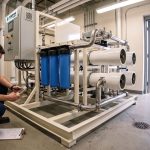
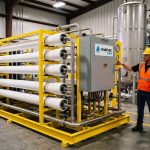
- Containerized SWRO systems: Pre-engineered seawater RO units in standard 20- or 40-foot containers can be shipped, installed, and operational within weeks. They are ideal for post-hurricane emergency deployment and for small island communities without the engineering capacity to build custom facilities.
- Solar-powered RO: Most Pacific islands have high solar irradiance and high diesel fuel costs (often $2-$4/liter due to shipping). Solar-powered RO eliminates the fuel logistics chain and can achieve energy costs below $0.10/kWh in off-grid configurations with battery storage.
- Emergency and disaster-response units: Trailer-mounted or skid-mounted RO systems with 500-10,000 gallon per day capacity serve as rapid-response water supply after hurricanes and typhoons, before fixed infrastructure is repaired.
AMPAC USA in Island and Remote Deployments
AMPAC USA has supplied containerized seawater reverse osmosis systems, solar-powered RO units, and emergency water treatment equipment to island communities, military installations, and humanitarian operations across the Caribbean and Pacific regions. Our systems are engineered for remote deployment – built to operate on diesel or solar power, with minimal footprint and straightforward maintenance protocols suited to communities without specialized water treatment technicians on staff.
For island community projects, government water authority inquiries, or emergency response procurement, visit ampac1.com.
Frequently Asked Questions
Why do Caribbean islands struggle with water access despite being surrounded by ocean?
Seawater cannot be consumed without treatment. Most Caribbean islands have limited groundwater, making them dependent on rainfall catchment and desalination – both of which are disrupted by hurricanes and climate variability.
What is a freshwater lens and why does it matter for Pacific islands?
A freshwater lens is a thin layer of rainwater that accumulates in the porous substrate of low-lying coral atolls, floating above the denser saltwater below. It is the primary – often only – source of freshwater for atoll communities. Drought and storm surge can destroy the lens within days.
What type of desalination system works best for small island nations?
Containerized seawater reverse osmosis systems are the preferred solution – pre-engineered, shippable, and operational quickly. Solar-powered variants are particularly well-suited to Pacific islands with high fuel costs and strong solar resources.
Sources: Pan American Health Organization | United Nations Water | IDA Desalination | World Bank Water
Related Articles
- Seawater Desalination in 2026: Technologies, Costs, and the Future of Fresh Water
- What Is Brackish Water? & How Do You Treat It?
- Seawater Desalination Systems: Turning the Tide on Global Water Scarcity
- The Future of Water Treatment: Trends in Solar-Powered Desalination Technology
Conclusion
Caribbean and Pacific island nations face a stark reality: they’re surrounded by water they can’t drink, whether the threat comes from a hurricane-damaged well or a shrinking freshwater lens under a low-lying atoll. Desalination has become the most reliable way to close that gap, since it doesn’t depend on the rainfall patterns that hurricanes and rising seas keep disrupting. AMPAC USA builds containerized and solar-powered desalination units sized for exactly these conditions, from small atoll communities to larger coastal municipalities recovering from storm damage. If your island or coastal facility needs a dependable freshwater source, see our guide to modern seawater desalination technology. Contact our team at info@ampac1.com or (909) 548-4900 to talk through sizing for your location.
Island Water Security: Challenges and Technology Solutions
Small island developing states (SIDS) face some of the world’s most severe water security challenges despite being surrounded by ocean. The paradox — “Water, water, everywhere, nor any drop to drink” as Coleridge wrote — stems from the physical characteristics of small islands: limited land area restricts rainfall catchment capacity, most islands have thin, vulnerable freshwater lenses (freshwater floating above denser saltwater in coastal aquifers), and population densities are often too small to justify large-scale water infrastructure investment but high enough to place significant demand on limited resources.
Climate change compounds these structural vulnerabilities. Sea-level rise drives saltwater intrusion into coastal freshwater lenses — the primary groundwater source for many low-lying Pacific atolls (Tuvalu, Marshall Islands, Kiribati) whose maximum elevation may be only 1-3 meters above sea level. More intense tropical cyclones cause infrastructure damage and saltwater contamination of both surface water catchments and groundwater during storm surge events. Changing precipitation patterns in both the Caribbean (drying trend) and Pacific (increased El Nino variability) create longer dry seasons and more intense wet season flooding that challenge storage capacity.
The technology response must be adapted to island-specific constraints: solar-powered RO and rainwater harvesting with treatment provide the best resilience for remote communities. Containerized SWRO units powered by solar PV with battery storage can provide drought-proof water supply at community scale without diesel fuel logistics. Decentralized rainwater harvesting with ceramic or biosand filter treatment serves households where centralized infrastructure is not feasible. AMPAC USA has designed and deployed solar-powered desalination and water treatment systems for Pacific and Caribbean island communities, optimized for minimal maintenance requirements, local spare parts availability, and operator training needs of communities with limited technical capacity.
Frequently Asked Questions
Why are small island developing states (SIDS) particularly vulnerable to water stress?
SIDS face unique challenges: limited land restricts natural catchment areas, climate variability makes rainfall unpredictable, and small populations often limit large-scale infrastructure investment. Additionally, rising sea levels threaten coastal freshwater lenses and increase saltwater intrusion into aquifers. This creates a paradox where islands surrounded by ocean still struggle for potable water.
How do hurricanes affect freshwater supply and infrastructure in the Caribbean?
Major hurricanes, like Maria in Puerto Rico (2017) or Dorian in the Bahamas (2019), devastate water distribution infrastructure, leading to prolonged outages. The Pan American Health Organization (PAHO) noted Puerto Rico’s system was still at partial capacity 11 months after Maria, affecting 1.5 million residents. These storms compound existing vulnerabilities, particularly for islands dependent on shallow groundwater or vulnerable catchment systems.
What is a freshwater lens and why is it critical for Pacific atoll nations?
A freshwater lens is a thin layer of rainwater that floats on top of denser seawater within the porous limestone substrate of low-lying atolls. It’s the sole natural freshwater source for nations like Kiribati and Tuvalu. This lens is extremely fragile, susceptible to collapse from severe droughts, over-extraction, and saltwater intrusion caused by rising sea levels.
What are the most effective solutions for addressing water scarcity in Caribbean and Pacific island nations?
Effective solutions combine rainwater harvesting, robust desalination, groundwater protection, and comprehensive climate resilience planning. Desalination, particularly reverse osmosis, is crucial for many islands, providing a stable, drought-proof water source. AMPAC USA, with over 30 years of experience, designs and manufactures commercial and industrial RO systems tailored for these challenging environments, drawing on field expertise from 150+ countries.
Which Caribbean islands rely heavily on desalination for their primary water supply?
Several Caribbean islands, particularly those with minimal groundwater resources, have long depended on desalination as their primary water source. Aruba, the Netherlands Antilles, and the British Virgin Islands are prominent examples, having operated desalination plants for decades. This technology provides a stable water supply in regions where natural freshwater is scarce and vulnerable.
AMPAC USA engineers custom water purification systems for commercial, industrial, and emergency applications — from 500 GPD to multi-million GPD. Trusted by municipalities, military, and industry worldwide.