
Last updated on January 12th, 2026 at 01:26 pm
Access to clean, consistent, and safe water is a critical operational requirement for businesses across hospitality, healthcare, food & beverage, education, and commercial facilities. A Commercial Reverse Osmosis (RO) System is one of the most reliable and widely adopted water purification technologies designed to meet high daily water demands while maintaining strict quality standards.
Unlike residential systems, commercial RO systems are engineered for higher flow rates, continuous operation, robust construction, and long-term reliability. This guide explains how commercial reverse osmosis systems work, where they are used, how to size and maintain them, and how businesses can select the right system for long-term performance and cost efficiency.
What Is a Commercial Reverse Osmosis System?
A commercial reverse osmosis system is a pressure-driven water purification system that removes dissolved salts, chemicals, heavy metals, microorganisms, and total dissolved solids (TDS) from water using a semi-permeable RO membrane.
Commercial RO systems typically range from 500 GPD (gallons per day) to over 20,000 GPD, depending on application and demand. These systems are commonly installed in:
- Restaurants and commercial kitchens
- Hotels and resorts
- Hospitals and laboratories
- Bottled water and refill stations
- Schools, colleges, and institutions
- Corporate offices and industrial canteens
How Commercial Reverse Osmosis Works (Step-by-Step)
- Pre-Filtration
Incoming water passes through sediment and carbon filters to remove suspended solids, chlorine, and organic matter that could damage RO membranes. - High-Pressure Pumping
Water is pressurized using an industrial-grade high-pressure pump, enabling it to pass through RO membranes. - Reverse Osmosis Membrane Filtration
The RO membrane rejects up to 95–99% of dissolved salts, TDS, fluoride, arsenic, and heavy metals. - Permeate & Reject Separation
Purified water (permeate) is collected for use, while concentrated contaminants (reject water) are discharged or reused where possible. - Post-Treatment (Optional)
UV sterilization, ozonation, or mineral dosing may be added depending on application requirements.
Read More: How Natural Disasters Impact Water Infrastructure
Key Components of a Commercial RO System
A high-performance commercial RO system consists of:
- Multi-media or sediment pre-filters
- Activated carbon filters
- High-pressure pumps (stainless steel)
- Commercial-grade RO membranes
- Membrane housings
- Electrical control panel (manual or PLC-based)
- Flow meters, pressure gauges, and conductivity meters
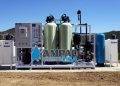
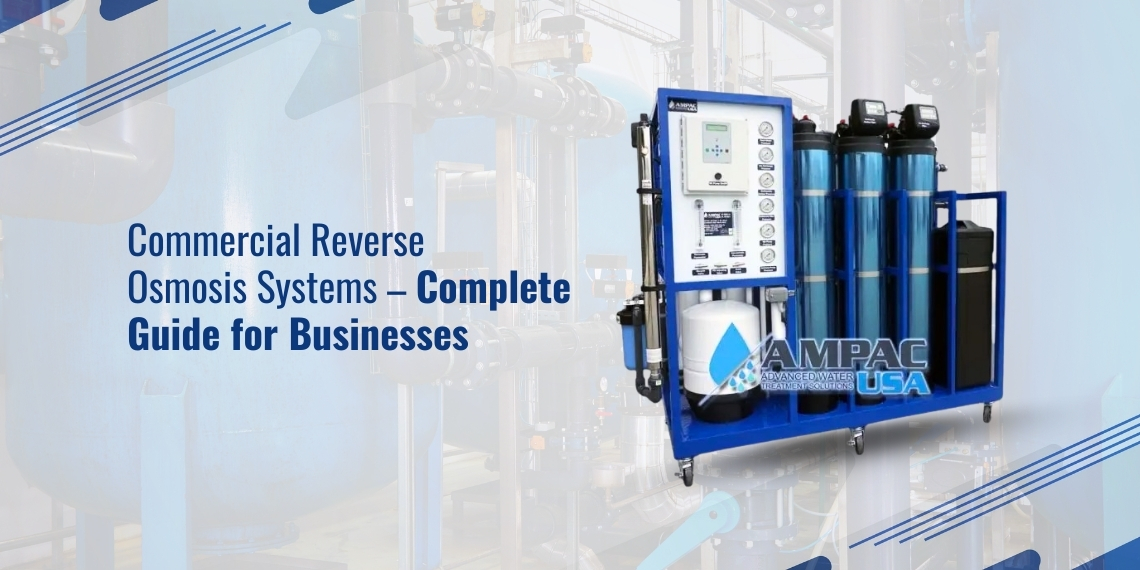
Premium commercial systems—such as those manufactured by AMPAC USA—are designed with modular construction, allowing easy expansion, maintenance, and automation.
Commercial RO vs Industrial RO Systems
|
Feature |
Commercial RO |
Industrial RO |
|
Typical Capacity |
500–20,000 GPD |
20,000+ GPD |
|
Applications |
Drinking & process water |
Manufacturing & process |
|
Automation |
Manual / Semi / PLC |
Advanced PLC & SCADA |
|
Footprint |
Compact |
Large-scale |
|
Water Quality |
Potable & food-grade |
Process-specific |
Commercial RO systems prioritize drinking water safety, taste consistency, and compliance, whereas industrial RO systems focus on production and equipment protection.
Commercial RO System Capacity & Sizing Guide
Choosing the correct system size is critical. Oversizing increases costs, while undersizing leads to operational failure.
Key Sizing Factors:
- Daily water consumption (GPD or LPD)
- Peak usage hours
- Feed water TDS & hardness
- Recovery rate requirements
- Future expansion plans
Typical Capacity Ranges:
- 500–1,000 GPD → Cafés, small restaurants
- 2,000–5,000 GPD → Hotels, schools
- 10,000–20,000 GPD → Bottled water plants, hospitals
Read More: Packaged Reverse Osmosis vs Traditional RO Systems
Applications of Commercial Reverse Osmosis Systems
Restaurants & Commercial Kitchens
RO water improves food taste, beverage quality, and protects steamers, dishwashers, and coffee machines from scaling.
Hotels & Resorts
Provides consistent drinking water quality for guests while reducing bottled water costs and supporting sustainability initiatives.
Hospitals & Healthcare Facilities
Ensures purified water for dialysis, laboratories, sterilization, and patient care.
Bottled Water & Refill Stations
Commercial RO systems form the backbone of packaged drinking water operations.
Educational Institutions
Delivers safe, economical drinking water for students and staff.
Water Quality & Contaminant Removal
Commercial RO systems effectively remove:
- Total Dissolved Solids (TDS)
- Fluoride
- Arsenic
- Nitrates
- Heavy metals (lead, mercury)
- Bacteria & viruses (with UV integration)
This makes them ideal for areas with borewell water, high salinity, or poor municipal supply.
Installation Requirements
Before installation, businesses must evaluate:
- Floor space and drainage
- Electrical supply (single or three-phase)
- Raw water pressure and quality
- Storage tank requirements
Professional installation ensures optimal recovery rate, membrane life, and system performance.
Maintenance & Performance Optimization
Routine Maintenance Includes:
- Pre-filter replacement (3–6 months)
- Membrane cleaning or replacement (2–3 years)
- Pressure and TDS monitoring
- Pump inspection
Preventive maintenance contracts (AMC) significantly reduce downtime and extend system lifespan.
Energy Efficiency & Sustainability
Modern commercial RO systems are designed for:
- Higher recovery rates
- Lower energy consumption
- Reduced wastewater discharge
- Integration with rainwater harvesting & reuse systems
This supports ESG goals and sustainable water management.
Automation & Smart Monitoring
Advanced systems include:
- PLC-based automation
- Real-time TDS monitoring
- Auto-flush and safety shutdowns
- Remote diagnostics
Automation reduces manual intervention and improves reliability. Choose Ampac USA a trusted manufacturer with custom engineering capabilities ensures long-term success.