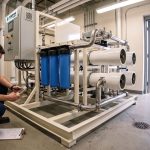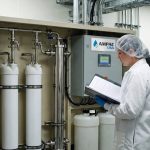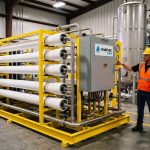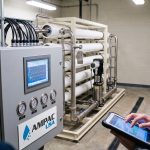


In the field, water supply is a logistics problem before it’s a chemistry problem. A unit that can’t purify what it finds — river water, a questionable well, brackish groundwater — becomes dependent on a supply chain that can be cut. That’s why the US military developed the ROWPU, and why the same technology shows up everywhere from FEMA disaster response to offshore platforms in the middle of the ocean.
What ROWPU Stands For
ROWPU is an acronym: Reverse Osmosis Water Purification Unit. The name is literal — it’s a self-contained, ruggedized system that can convert almost any raw water source (rivers, lakes, brackish groundwater, seawater) into drinking water that meets military standards. “Unit” is accurate in both the equipment sense and the operational sense: a ROWPU is built to be deployed, operated, and maintained by a small crew without fixed infrastructure. No municipal hookup. No permanent building. Just the system, a water source, and an operator.
A Brief History
The US Army adopted ROWPU technology in the 1970s, replacing older distillation-based field equipment that had become a maintenance burden. Distillation units were slow, fuel-hungry, and hard to service in the field. Reverse osmosis worked faster, ran leaner, and — critically — it handled a much wider range of water sources. That flexibility is what made it stick.
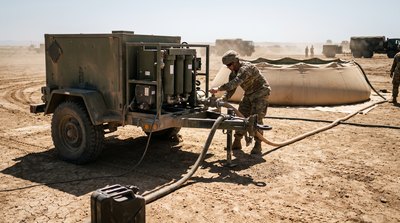
Today’s standard Army variants run at 600 gallons per hour (GPH) and 3,000 GPH — roughly 14,400 GPD and 72,000 GPD respectively. The 600 GPH unit supports a battalion-sized element. The 3,000 GPH version is a division-level asset that can supply an entire forward operating base. Both are trailer-mounted for rapid deployment and can be reconfigured for seawater or brackish water depending on what’s in the ground.
How a ROWPU System Works
The process runs in six stages, each one setting up the next. Skip or cut corners on any of them and the membrane either clogs or fails to meet output standards.
- Raw water intake: A submersible or surface pump pulls water from the source. Intake screens catch gross debris before it reaches anything sensitive.
- Coagulation and flocculation: Chemicals — typically alum or polyaluminum chloride — are injected to bind suspended particles into clumps large enough to filter out. This step is what makes the system work on turbid river water that would otherwise destroy the membrane.
- Multimedia filtration: Water moves through a layered filter bed (anthracite, sand, and garnet) that removes flocculated particles and drops turbidity and SDI to levels the RO membrane can actually handle.
- RO membrane stage: High-pressure pumps force water through semi-permeable membranes that reject dissolved solids, bacteria, viruses, heavy metals, and chemical contaminants. This is where the real purification happens.
- Disinfection: UV treatment or chemical dosing (chlorine, sodium hypochlorite) is applied post-membrane for microbiological safety.
- Storage and distribution: Purified water goes to bladder tanks or rigid storage for distribution to the population being served.
Military vs. Commercial: Key Differences
A commercial RO system is engineered around a known, relatively stable feed water source. A ROWPU has to handle whatever’s in the river that week. That single difference drives most of what makes military systems more expensive and more capable. See AMPAC USA’s military water treatment systems.
- Feed water variability: The pre-treatment train on a ROWPU is proportionally more robust than anything you’d find in a typical commercial installation. It has to be.
- Ruggedized construction: Military systems use powder-coated aluminum or stainless steel frames rated for transport over unpaved roads and operation in extreme temperatures. Commercial systems are generally designed for indoor installation.
- Self-contained power: Most ROWPU units include a generator or are designed to integrate with one. No shore power assumed.
- Operator training profile: US Army water purification specialists (68M MOS) are trained to operate and field-maintain these systems. The design accounts for that — maintenance procedures are simplified, parts are standardized, and the controls don’t require an engineering degree.
- Seawater capability: Standard configurations can be adapted for seawater feed at higher operating pressure (800–1,200 psi).
Applications Beyond the Military
The same qualities that make ROWPU systems valuable in combat — feed water flexibility, rapid deployment, self-contained operation — make them the right tool in a handful of civilian situations where municipal water infrastructure isn’t available or has failed.
- FEMA disaster response: After hurricanes, floods, or earthquakes, water treatment is often one of the first pieces of infrastructure to fail. A mobile RO unit with ROWPU-equivalent feed flexibility can restore potable water supply within hours of deployment — before any permanent repairs are possible. That’s the design intent.
- Humanitarian missions: NGOs and international aid organizations use military-specification RO systems for refugee camps and remote community water projects where grid power and municipal water are both absent.
- Remote industrial sites: Mining operations, oil and gas exploration, and remote construction camps routinely lack access to municipal water. A skid-mounted system with ROWPU-equivalent feed water handling can supply an entire camp from a local source.
- Island and coastal water supply: Islands with limited freshwater resources use large-scale RO to produce municipal water supply from seawater. The same membrane technology, scaled up.
- Marine and offshore: Vessels and offshore platforms use compact RO watermakers for crew water supply directly from seawater.
AMPAC USA Military and ROWPU-Grade Systems
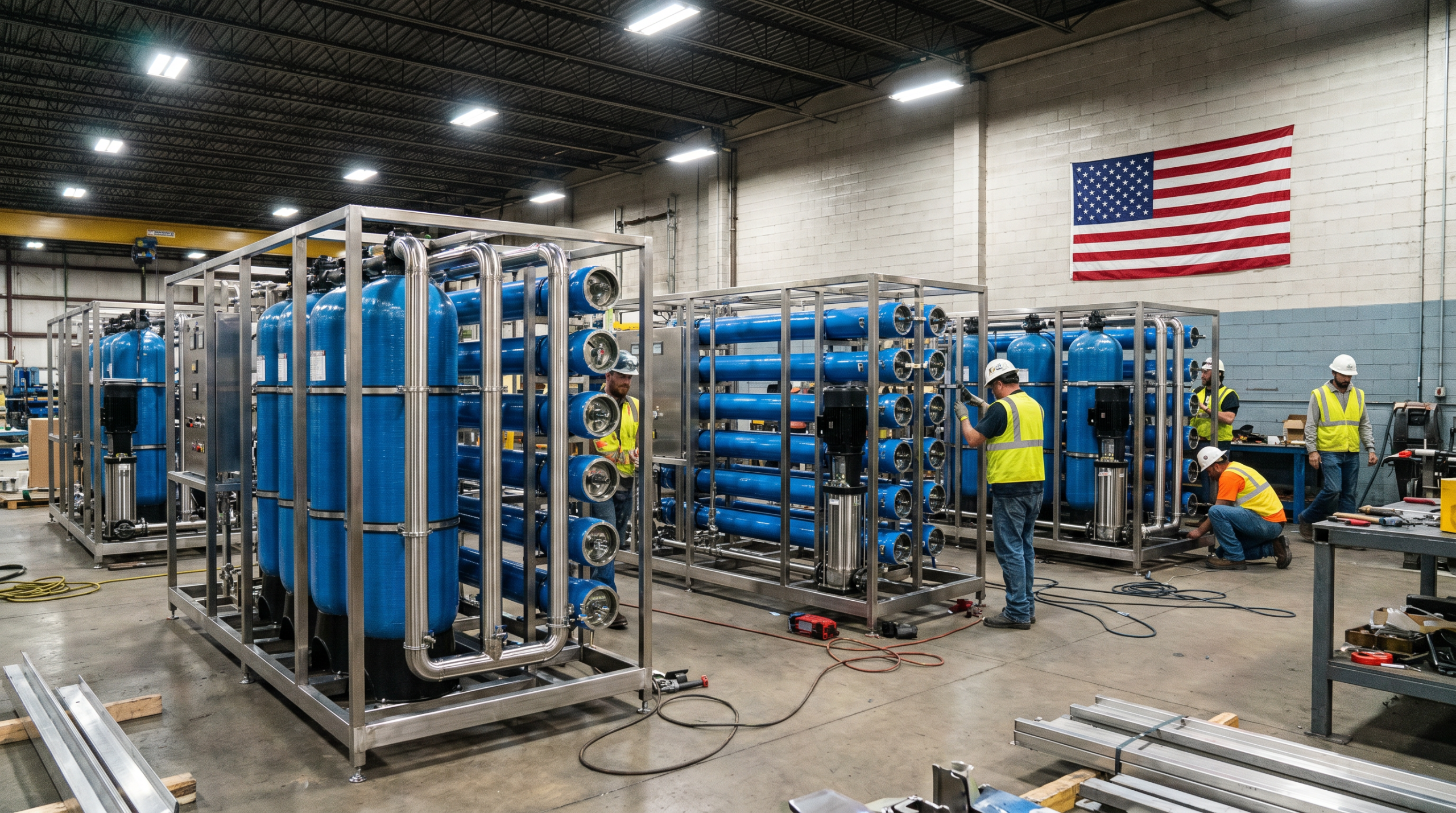
AMPAC USA manufactures military and military-specification RO water purification systems from its Woods Cross, UT facility. The product line covers:
- Portable units from 600 GPD: Compact skid-mounted systems for small unit support, emergency response, or remote sites.
- Mid-range systems (10,000–50,000 GPD): Trailer-mounted or containerized systems configured for extended field operation, humanitarian missions, and industrial remote sites.
- Large-scale containerized systems to 100,000+ GPD: ISO container-based installations with self-contained pre-treatment, RO, and disinfection — deployable by standard shipping and logistics infrastructure.
All AMPAC military-grade systems use FILMTEC membranes and are built for field conditions: stainless steel frames, industrial-grade high-pressure pumps, controls designed for ease of operation and field serviceability. Each system ships factory-tested from our Woods Cross, UT facility with documented performance data.
Current models are listed under ROWPU water purification units.
How to Specify a Military-Grade RO System
These four questions determine everything else about the system spec. Get them answered before you start evaluating options.
- What is the source water type? Seawater, brackish groundwater, and surface water require different pre-treatment configurations and operating pressures. The answer changes the system meaningfully.
- What is the deployment environment? Desert, tropical, and arctic environments impose different demands on seals, lubricants, materials, and controls. This affects hardware selection, not just operating procedures.
- What is the flow requirement? 600 GPH (14,400 GPD) covers a battalion-equivalent population. 3,000 GPH (72,000 GPD) covers a division-equivalent. For civilian deployments, calculate your peak demand first — then size up by 20%.
- What is the power supply? Generator-powered, shore power, or solar-assisted hybrid. Generator systems need to be matched to available generator output. This is often the constraint that changes the rest of the design.
Need a Military-Grade Water Purification System?
AMPAC USA’s engineering team has designed and deployed ROWPU-equivalent systems for military, government, humanitarian, and industrial clients. Tell us your source water, flow requirement, and deployment conditions.
Frequently Asked Questions
What does ROWPU stand for?
Reverse Osmosis Water Purification Unit. It is a self-contained, ruggedized system built to convert almost any raw water source, including rivers, lakes, brackish groundwater, or seawater, into drinking water meeting military standards, without fixed infrastructure.
How much water can a standard military ROWPU produce?
The standard Army variants run at 600 gallons per hour (roughly 14,400 GPD), supporting a battalion-sized element, or 3,000 gallons per hour (roughly 72,000 GPD), a division-level asset supplying an entire forward operating base.
What makes a military ROWPU different from a commercial RO system?
A ROWPU must handle whatever feed water is available on site rather than a known, stable source, so its pre-treatment train is proportionally more robust. It also uses ruggedized construction rated for unpaved-road transport and extreme temperatures, and typically includes self-contained power.
What civilian applications use ROWPU-equivalent systems?
FEMA disaster response, humanitarian missions in refugee camps, remote industrial sites like mining and oil exploration camps, island and coastal municipal water supply, and marine or offshore vessel crew water supply.