


Water is the foundation of life and industry. From drinking supplies to industrial processes, agriculture, and municipal systems, water treatment chemicals play a critical role in maintaining quality, safety, and compliance. As water scarcity rises and contamination risks grow worldwide, the demand for efficient and reliable treatment solutions has never been greater.
At AMPAC USA, we combine decades of expertise in advanced reverse osmosis (RO) systems with an extensive range of water treatment chemicals that ensure optimum performance, safety, and sustainability across residential, commercial, and industrial applications.
What Are Water Treatment Chemicals?
Water treatment chemicals are specialized substances added to water to improve its quality, remove harmful impurities, or condition it for a specific purpose. These chemicals are vital in protecting human health, extending the life of water systems, and ensuring compliance with international WHO water quality standards.
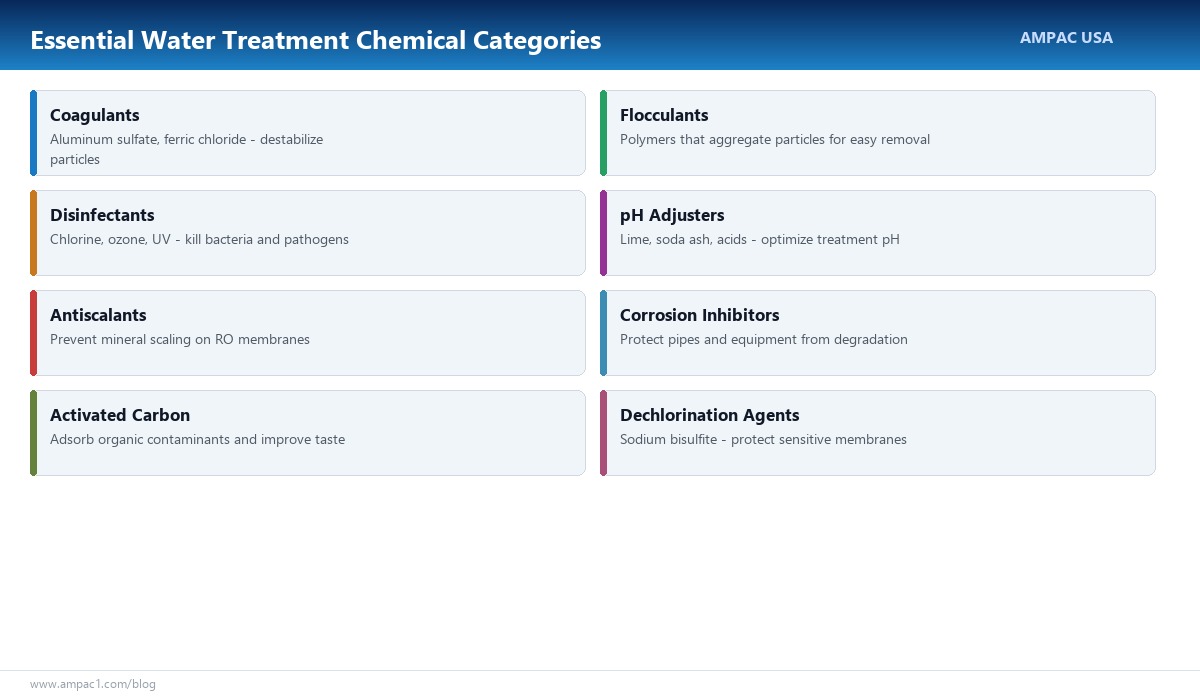
Broadly, they can be categorized as:
-
Coagulants and Flocculants – For aggregating suspended solids and improving filtration.
-
Disinfectants – For killing or inactivating harmful microorganisms.
-
Scale and Corrosion Inhibitors – For protecting pipes, membranes, and equipment.
-
pH Adjusters – For stabilizing water acidity or alkalinity.
-
Specialty Chemicals – For desalination, wastewater treatment, and industrial conditioning.
Why Are Water Treatment Chemicals Important?
1. Protecting Human Health
Contaminated water can harbor pathogens, heavy metals, and toxic chemicals. Using the right disinfectants and coagulants ensures that drinking water meets WHO and EPA safety guidelines.
2. Extending Equipment Life
Industrial water systems, boilers, and RO membranes are prone to scaling, fouling, and corrosion. Proper anti-scalants and corrosion inhibitors reduce maintenance costs and prevent system downtime.
3. Optimizing Water Quality
Different applications—pharmaceutical, food & beverage, municipal supply, or seawater desalination—require varying water purity levels. Chemicals ensure that treated water meets the exact quality specifications.
4. Supporting Sustainability
Chemicals minimize waste, enhance efficiency, and reduce the need for repeated treatment cycles. This supports AMPAC USA’s mission of delivering eco-friendly and cost-effective water solutions worldwide.
Types of Water Treatment Chemicals
1. Coagulants and Flocculants
-
Used to remove suspended solids, dirt, and organic matter.
-
Common chemicals include aluminum sulfate (alum) and polyaluminum chloride (PAC).
-
Essential for pretreatment in AMPAC USA Reverse Osmosis Systems, where membrane clogging must be prevented.
2. Disinfectants
-
Chemicals such as chlorine, chlorine dioxide, and ozone kill harmful bacteria, viruses, and protozoa.
-
In combination with AMPAC USA’s UV sterilizers, they ensure absolute pathogen-free water.
3. Anti-Scalants
-
Prevent mineral buildup in RO membranes.
-
AMPAC USA supplies advanced anti-scalants to protect desalination systems from calcium carbonate, silica, and sulfate scaling.
-
A must-have for seawater desalination units like AMPAC’s SW-9000 LX land-based system.
4. Corrosion Inhibitors
-
Used in pipelines and cooling systems to prevent rust and leaks.
-
AMPAC USA recommends these for clients using industrial watermakers in oil & gas, power, and manufacturing industries.
5. pH Adjusters
-
Chemicals such as sulfuric acid, sodium hydroxide, and lime maintain ideal pH levels.
-
Critical in AMPAC’s commercial RO systems (1200 GPD to 100,000 GPD) to ensure optimum performance.
6. Specialty Chemicals
-
Defoamers, biocides, and ion exchange resins are tailored for complex processes.
-
AMPAC integrates these into solutions for municipal wastewater plants and industrial effluent treatment.
AMPAC USA: Beyond Chemicals, Complete Solutions
What sets AMPAC USA apart is not just providing chemicals, but delivering integrated water treatment systems. Each AMPAC solution is designed to work synergistically with treatment chemicals, ensuring peak efficiency and reliability.
Featured AMPAC USA Systems Supporting Chemical Treatment
-
Seawater Desalination Systems – From compact marine units to large-scale municipal plants.
-
Commercial RO Systems – Ideal for hotels, resorts, and industries requiring continuous clean water.
-
Military & Emergency Watermakers – Deployable units that rely on anti-scalants and disinfectants for reliable performance in harsh conditions.
-
Water Store RO Systems – Designed for retail water businesses, requiring consistent chemical dosing for product quality.
-
Mobile Solar Water Treatment Systems – Environmentally friendly solutions enhanced by chemical conditioning for extended operations.
Applications of Water Treatment Chemicals
1. Residential
-
Disinfection and softening chemicals protect households from contaminants.
-
AMPAC USA’s whole-house RO systems work in tandem with chlorine removal and anti-scale agents.
2. Commercial
-
Restaurants, hotels, and hospitals require consistent, safe water.
-
AMPAC USA combines commercial RO systems with pH stabilizers and disinfectants for reliability.
3. Industrial
-
Power plants, oil refineries, and manufacturing industries rely on anti-scalants and corrosion inhibitors.
-
AMPAC’s industrial desalination systems integrate these chemicals for maximum uptime.
4. Municipal
-
Cities need large-scale water disinfection and coagulation to meet population demands.
-
AMPAC USA provides turnkey plants that combine chemical dosing with advanced RO technology.
5. Agriculture
-
Irrigation systems benefit from water treated with anti-foulants and pH adjusters.
-
AMPAC helps farmers achieve efficiency by integrating tailored chemical programs.
Challenges in Using Water Treatment Chemicals
While indispensable, improper dosing or selection of chemicals can lead to:
-
Excessive chemical costs.
-
Damage to RO membranes.
-
Residual toxicity in drinking water.
-
Regulatory non-compliance.
This is why AMPAC USA provides expert consultation and chemical optimization services, ensuring clients use the right chemical at the right dose, protecting both health and infrastructure.
The AMPAC USA Advantage
-
Integrated Expertise – With over 30 years in the industry, AMPAC knows how to pair the right chemicals with the right treatment system.
-
Custom Solutions – Tailored designs for residential, commercial, and industrial clients.
-
Global Reach – Serving clients across the USA, Middle East, Faroe Islands, and Pacific Islands.
-
Quality Assurance – All AMPAC systems and chemicals adhere to international quality standards.
-
Eco-Friendly Approach – Promoting reduced chemical use with advanced RO, UV sterilization, and solar-powered systems.
Future of Water Treatment Chemicals
As water challenges grow, the industry is shifting towards:
-
Green chemistry – Biodegradable, less toxic chemicals.
-
Smart dosing systems – Automated chemical injection controlled by AI and sensors.
-
Hybrid technologies – Combining chemicals with advanced AMPAC RO and UV technologies for sustainable solutions.
AMPAC USA is leading this transformation by developing eco-smart systems that maximize performance while minimizing chemical dependency.
Conclusion
Water treatment chemicals are indispensable in ensuring clean, safe, and sustainable water. But chemicals alone cannot solve global water challenges. They must work in harmony with advanced systems like AMPAC USA’s reverse osmosis, desalination, and mobile water treatment solutions.
By choosing AMPAC USA, clients gain more than products—they gain a trusted partner delivering safe water, reliable performance, and sustainable results.
Related Articles
- Industrial RO System Components
- Water Treatment Plant RO System
- Conductivity of RO Water
- Tannins in Drinking Water
Frequently Asked Questions
What are the primary types of chemicals used in water treatment?
Water treatment chemicals are broadly categorized into coagulants and flocculants for solid aggregation, disinfectants for pathogen inactivation, scale and corrosion inhibitors to protect equipment, and pH adjusters for water balance. AMPAC USA offers a comprehensive range, including specialty chemicals for advanced applications like desalination.
How do water treatment chemicals ensure safe drinking water?
Water treatment chemicals like disinfectants (e.g., chlorine compounds) eliminate harmful microorganisms, while coagulants and flocculants remove suspended solids and pathogens. This ensures treated water meets stringent safety guidelines from organizations like WHO and EPA, protecting public health from contaminated supplies.
How do water treatment chemicals extend the lifespan of industrial water systems?
Chemicals such as anti-scalants and corrosion inhibitors are crucial for protecting industrial water systems, including RO membranes, boilers, and pipes, from damaging mineral buildup and degradation. By preventing scaling, fouling, and corrosion, these solutions significantly reduce maintenance costs and prevent costly system downtime.
In what ways do water treatment chemicals support environmental sustainability?
Water treatment chemicals enhance sustainability by optimizing treatment processes, minimizing waste generation, and improving overall system efficiency. This reduces the need for repeated treatment cycles and conserves water resources, aligning with AMPAC USA’s mission to deliver eco-friendly and cost-effective solutions globally.
What is the purpose of coagulants and flocculants in water purification?
Coagulants and flocculants are used to aggregate tiny suspended solids, colloids, and organic matter into larger, heavier particles called flocs. This process significantly improves the efficiency of subsequent filtration steps, making it easier to remove impurities and clarify water for various applications.
Conclusion
Chemical treatment and equipment like RO or filtration aren’t competing approaches — they work together, with chemicals like coagulants and antiscalants handling the pretreatment work that keeps membranes and downstream equipment from fouling prematurely. Getting dosing right takes real monitoring, not a set-and-forget schedule, since source water chemistry shifts with seasons and supply changes. Facilities that treat chemical dosing as an afterthought usually end up paying for it in membrane replacement costs later. Browse our water treatment chemicals, or contact our team at info@ampac1.com or (909) 548-4900 to build a dosing program suited to your water source.
AMPAC USA engineers custom water purification systems for commercial, industrial, and emergency applications — from 500 GPD to multi-million GPD. Trusted by municipalities, military, and industry worldwide.
