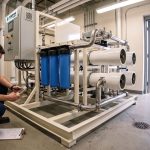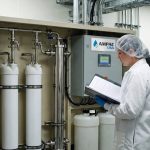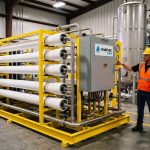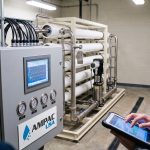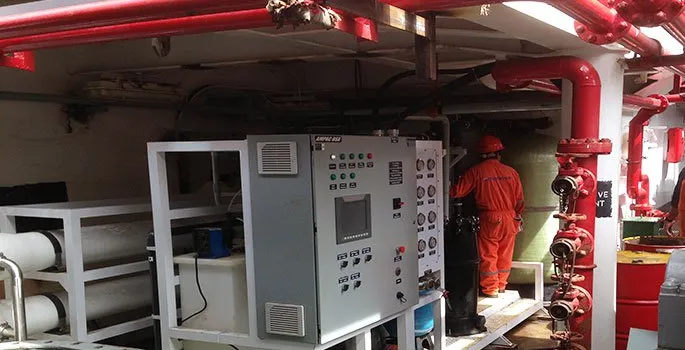

Seawater Desalination has come a long way from being used for oceangoing ships to solving the water shortage problems today. Even though its application began in the 1950’s, the process has gone through various changes to make it more optimal for use. From the change in method of desalination to applications and more, this article by AMPAC USA discusses the most recent advancement of seawater desalination.
Description:
The ancient Greek philosopher Aristotle observed the natural process of desalination and documented it in his work. Today, thousands of years later, seawater desalination is a source for the daily supply of water to millions of people all over the world. Earlier, it was executed using the traditional distillation process. After the innovation of Reverse Osmosis, the process gained more popularity as it came with many advantages.
- It didn’t use combustible fuels, which avoided the exploitation of natural resources
- It is fairly an automatic process and doesn’t require manual supervision that frequently
- The quality offered can be customized according to the purpose of the resulting water.
However, it did have some setbacks until a few years ago. Efficiency, energy consumption, membrane, and cost-related challenges prevented the procedure to be used in desalination plants all over the globe. These challenges are a topic of research and intense study today as Reverse Osmosis itself has a lot of advantages to offer. Given below are a few of the advances that have helped make the method even better.
Channel Based Membranes
Currently, the RO Membranes employed in operation use the solution-diffusion mechanism to separate solutes (majorly contaminates) from the solution. This is a transport method where the components first dissolve in the membrane matrix and then diffuse across it by transiently jumping between pores. Biological membranes, on the other hand, offer a channel-based option in which the selected molecules are transported straight through the protein channels, also called membrane proteins. These MP channels are usually 4nm in length as compared to various unconnected pores in the thick RO membrane which 20-200nm active layers.
Another innovation is inspired by these biological channels and is more scalable. The development of artificial water channels and proposals that develop membranes around them. These channels are synthetically developed using organic synthesis but are still a topic of research before the operation.
Foul Resistant Membranes
One of the bigger challenges in reverse osmosis for seawater desalination is the rapid or frequent fouling of membrane which increases costs for repair and maintenance. It is when the colloidal materials and organic macromolecules deposit on the surface of the membrane and cause irreversible adsorption, cake formation and organic biofilm that makes the surface unable to filter. It causes immense consumption of energy to filter against the increase in resistance to flow.
Over the years, several membrane advancement strategies have been considered to reduce the amount of fouling in the RO Systems. Some of the options suggested are:
Grafting of super hydrophilic or amphiphilic molecules to prevent the adsorption process of biological cells and macromolecules
- Use of nanoparticles, carbon-based materials, graphene oxide flakes for biocidal properties
- Use of magnetically actuated or electroactive surfaces for prevention of deposition
- Any method that interrupts the cell-to-cell communication is also being considered.
Desalination By Renewable Energy
Before, even for distillation, coal was used which is a non-renewable source of energy. For RO powered Seawater Desalination, electricity is required which in turn comes from powerhouses powered by coal, again. This was another challenge to overcome in order to make RO a sustainable option. Because of its energy-intensive nature, desalination was never considered compatible with renewable sources of energy. But with the rapid advances in RO membranes that require less energy, complimenting some desalination units with solar or wind energy generators is being considered. For now, the applications are limited to small plants and for off-the-grid applications.
Cost Of Desalination
Various factors over the years have helped reduce the operational expenditure and capital expenditure of desalination systems. Erik Hanson, the desalination global product manager at GE Power & water says, “This ongoing improvement in cost is driven both by improvements to technology that lower operating costs and by improvements in manufacturing practices that have significantly lowered the initial capital investment required to build a desalination plant.”
Hanson says that the operating costs have fallen over the last 20 years from an average of US$1.25-2.50 per meter cube to less than $0.75 per meter cube. He listed pre-treatment, better performing membranes, higher efficiency pumps, and energy recovery devices as the reason behind the cost decline.
About The Author:
AMPAC USA is a water treatment systems manufacturer for 30 years. They provide Reverse Osmosis systems for seawater desalination in every industry.
Frequently Asked Questions
What specific advancements have improved Reverse Osmosis membranes for seawater desalination?
Recent advancements include the development of channel-based membranes, inspired by biological systems, which transport molecules directly through 4nm protein channels. This contrasts with traditional RO membranes using solution-diffusion across 20-200nm active layers. Further innovation involves synthetically developed artificial water channels, aiming for more scalable and efficient desalination.
What were the primary obstacles to widespread adoption of Reverse Osmosis desalination in the past?
Historically, the main challenges hindering global adoption of Reverse Osmosis desalination included issues with overall efficiency, high energy consumption, membrane durability, and significant operational costs. These factors made the procedure less viable for widespread use until recent technological breakthroughs addressed these limitations.
How does modern Reverse Osmosis desalination offer advantages over traditional distillation methods?
Modern Reverse Osmosis (RO) desalination offers significant advantages over traditional distillation by eliminating the need for combustible fuels, thus avoiding natural resource exploitation. RO is also a largely automatic process requiring less frequent manual supervision, and it allows for customized water quality tailored to specific purposes.
What are channel-based membranes and how do they enhance desalination efficiency?
Channel-based membranes are an innovative advancement inspired by biological membranes, designed to transport selected molecules directly through specialized protein channels, typically 4nm in length. This method offers a more efficient and targeted separation mechanism compared to the solution-diffusion process of conventional RO membranes, which rely on transient jumps between larger pores.
Where are advanced seawater desalination systems, like those from AMPAC USA, typically deployed?
Advanced seawater desalination systems are deployed globally in diverse, demanding environments where fresh water is scarce or critical. AMPAC USA’s systems, for instance, are found on offshore oil rigs, military bases, luxury resorts, municipalities, and food & beverage plants across over 150 countries, reflecting their robust and reliable performance.
Related Articles
- AMPAC USA Describes The Latest Seawater Desalination Technique
- The Future of Clean Water: AMPAC USA’s Seawater Desalination System
- AMPAC USA Portable Seawater Desalination Solution for Boats
- AMPAC USA Seawater Desalination Watermakers for Marine Industry
Conclusion
Seawater desalination has moved a long way past its 1950s origins, and newer membrane technology has made the process faster and less energy-intensive than the distillation methods it replaced. That efficiency gain is what’s pushing desalination into more markets than it could reasonably serve a decade ago. We look at where this technology is headed next in our post on the future of clean water and seawater desalination. Contact our team at info@ampac1.com or (909) 548-4900 to discuss a desalination system built around current membrane technology.
AMPAC USA engineers custom water purification systems for commercial, industrial, and emergency applications — from 500 GPD to multi-million GPD. Trusted by municipalities, military, and industry worldwide.