
NSF/ANSI 58 is the certification standard for point-of-use reverse osmosis systems intended for drinking water. If a supplier tells you their RO system is “NSF certified,” NSF/ANSI 58 is what they’re referring to — and what that certification actually covers matters for purchasing decisions, regulatory compliance, and liability.
What NSF/ANSI 58 Covers
The standard has three components:
- Structural integrity: The system must withstand pressure testing, temperature extremes, and simulated long-term use without failure. Components can’t leach materials at levels that would create a health concern.
- Materials safety: All components in contact with drinking water — membranes, housings, tubing, fittings, adhesives — are evaluated for extractables. No material can contribute contaminants to product water above established limits.
- Contaminant reduction claims: If a manufacturer claims the system reduces a specific contaminant (lead, nitrates, PFOA/PFOS, arsenic, etc.), that claim must be validated by certified testing under standard test conditions.
The third component is the most important for buyers. NSF certification doesn’t mean an RO system removes everything — it means the specific claims on that certified product have been tested and verified.
Scope: Point-of-Use, Not Industrial
NSF/ANSI 58 applies specifically to point-of-use (POU) systems — countertop, under-sink, or similar units designed for individual use. Industrial and commercial RO systems above a certain size are not subject to NSF/ANSI 58 certification requirements.
For commercial applications, the relevant NSF standards are:
- NSF/ANSI 61: Covers drinking water system components — pipes, fittings, valves, and other components that contact drinking water in larger distribution and treatment systems. Most large commercial and industrial RO components are certified to NSF/ANSI 61.
- NSF/ANSI 60: Covers treatment chemicals (antiscalants, disinfectants) used in potable water treatment.
Common Contaminant Reductions Validated Under NSF/ANSI 58
| Contaminant | Challenge Concentration | Typical RO Reduction | Notes |
|---|---|---|---|
| Total dissolved solids (TDS) | 750 mg/L | 75–98% | Primary performance metric for most POU systems |
| Lead | 0.15 mg/L | >95% | Both ionic and particulate lead |
| Nitrate | 27 mg/L NO3-N | 60–95% | Reduction varies significantly by membrane type and recovery |
| Fluoride | 8 mg/L | 90–95% | Tested independently from TDS reduction |
| Arsenic V | 0.05 mg/L | >95% | Arsenic III requires oxidation pre-treatment for comparable removal |
| Barium | 10 mg/L | >97% | Often tested alongside radium as a surrogate |
| PFOA / PFOS | 1.5 µg/L each | >96% | Added to NSF/ANSI 58 in 2020; validated reductions vary by membrane |
PFAS and NSF/ANSI 58: What Changed in 2020
NSF International added PFOA and PFOS reduction claims to NSF/ANSI 58 in 2020, creating a certification pathway for manufacturers who want to validate PFAS removal performance. Systems certified for PFOA/PFOS reduction have been tested to achieve greater than 96% reduction at the challenge concentration.
The standard uses a challenge concentration of 1.5 micrograms per liter (µg/L) for both PFOA and PFOS — substantially higher than the EPA’s 2024 maximum contaminant levels of 4 parts per trillion (0.004 µg/L) for PFOA and PFOS individually. Systems that pass the NSF test typically achieve product water PFAS concentrations well below the EPA limits in real-world conditions.
PFAS certification under NSF/ANSI 58 applies only to the specific compounds tested (PFOA and PFOS as of the original addition). The EPA’s broader PFAS MCLs also cover PFHxS, PFNA, HFPO-DA (GenX), and PFBS/PFHxS combinations. NSF certification for these additional compounds is being developed.
How to Read an NSF Certification
NSF certification is product-specific, not company-wide. A manufacturer can have one certified model and twenty uncertified ones. When evaluating a claim:
- Ask for the NSF listing number: Every certified product has a specific listing that can be verified on the NSF Product and Service Listings website.
- Verify the specific claims listed: Certification covers only what was tested. A system certified for TDS reduction is not necessarily certified for PFOA/PFOS reduction unless that claim appears on the specific listing.
- Check the listed test conditions: NSF/ANSI 58 tests are conducted under standard conditions — specific water chemistry, temperature, and pressure. Performance at your actual site may differ.
NSF/ANSI 58 vs. WQA Gold Seal
The Water Quality Association (WQA) Gold Seal is an alternative third-party certification to NSF/ANSI 58. WQA certifies to the same ANSI standard — NSF/ANSI 58 — so a WQA Gold Seal on a POU RO system carries the same regulatory weight as NSF certification. Some manufacturers pursue both certifications; others pursue one or the other.
What NSF/ANSI 58 Does Not Certify
The standard doesn’t certify:
- Long-term durability beyond its accelerated test protocol
- Performance on your specific source water chemistry
- Contaminants not tested under the specific product’s certified claims
- Commercial or industrial systems outside its scope
For commercial RO buyers, NSF/ANSI 58 certification on a supplier’s residential POU line doesn’t tell you much about their commercial product quality. Commercial and industrial systems should be evaluated on NSF/ANSI 61 component certification, membrane manufacturer specifications (FILMTEC, Hydranautics, or Toray published rejection data), and factory test documentation provided with the system at delivery.
Factory Test Documentation: What to Ask For
For commercial and industrial RO systems above the scope of NSF/ANSI 58, the equivalent assurance comes from factory performance testing. A reputable commercial RO manufacturer should provide:
- Factory wet test report: Actual flow rate, TDS rejection, and recovery ratio measured at the factory before shipment.
- Membrane data sheets: Published specifications from the membrane manufacturer (FILMTEC, Hydranautics) for the specific element models used in the system.
- NSF/ANSI 61 certifications: For all components in contact with potable water, if the application is drinking water.
AMPAC USA: Factory-Tested Commercial RO Systems
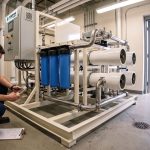
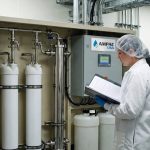
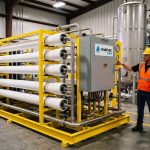
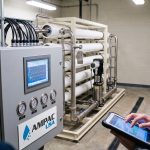
Every AMPAC USA commercial and industrial RO system ships with a factory test report documenting measured flow rate and TDS rejection. Our systems use FILMTEC membranes — the same membranes specified by municipal and military procurement — and all wetted components meet NSF/ANSI 61 requirements for potable water contact. Made in Woods Cross, UT since 1994.
Frequently Asked Questions
What does NSF/ANSI 58 certification actually cover?
Structural integrity under pressure and temperature testing, materials safety for all water-contact components, and validated contaminant reduction claims for whatever the manufacturer specifically claims the system reduces. It does not mean the system removes everything.
Does NSF/ANSI 58 apply to commercial or industrial RO systems?
No. NSF/ANSI 58 covers point-of-use systems only, such as countertop or under-sink units. Commercial and industrial systems are instead evaluated under NSF/ANSI 61 for component safety, along with membrane manufacturer specifications and factory test documentation.
Does NSF certification cover PFAS removal?
Since 2020, NSF/ANSI 58 includes a certification pathway for PFOA and PFOS reduction, requiring greater than 96 percent reduction at a 1.5 ug/L challenge concentration. This covers only those two specific compounds, not the EPA broader list of regulated PFAS.
What should I ask for instead of NSF certification on a commercial RO system?
A factory wet test report showing actual measured flow rate and TDS rejection, published membrane data sheets from the manufacturer, and NSF/ANSI 61 certification for all components in contact with potable water.