

In short: microbial desalination cells (MDCs) are a bioelectrochemical technology that uses bacteria to strip salt from water while generating a small amount of electricity as a byproduct. The best lab results show up to 96% salt removal and power densities in the low single-digit watts per cubic meter. That’s a genuinely interesting result. It’s also nowhere close to what a commercial desalination facility needs. Reverse osmosis, the technology municipalities and industrial plants actually run today, desalinates seawater at scale for roughly $0.40 to $2.70 per cubic meter and now approaches specific energy consumption under 2 kWh/m³ at the most efficient plants. MDCs haven’t been demonstrated past small pilot units. If you need water today, RO is the answer. If you’re curious about where desalination research might go next, MDCs are worth watching.
Every few years a new desalination technology gets a wave of press coverage that makes it sound like reverse osmosis is about to be obsolete. Microbial desalination cells are the current version of that story. The science behind them is real and worth understanding. The gap between what’s published in a journal and what’s bolted into a working treatment plant, though, is still enormous, and it’s worth being straight about that gap before anyone builds a procurement decision around it.
What Is a Microbial Desalination Cell, Exactly?
A microbial desalination cell is a three-chamber bioelectrochemical device. Bacteria in the anode chamber break down organic matter in wastewater and release electrons as they do it. Those electrons flow through a circuit to a cathode chamber, generating a small electrical current along the way. Sitting between the two is a middle chamber filled with saline water, separated by ion-exchange membranes. As current flows, salt ions get pulled out of that middle chamber toward the anode and cathode sides, leaving desalinated water behind.
In plain terms: the same bacteria that treat wastewater are doing double duty, cleaning organic waste and pushing salt out of a separate stream, while producing a trickle of usable electricity. It’s an elegant idea, essentially combining a microbial fuel cell with a desalination unit in one device. That elegance is exactly why it keeps showing up in academic reviews and why it’s easy to overstate in a headline.
How Well Does It Actually Work Right Now?
Recent lab studies report real progress, but the numbers are still small-scale. A 2025 study published in Scientific Reports found MDCs achieving up to 96% salt removal efficiency under optimized conditions, with peak power density around 0.143 mW/cm². Another 2025 experimental study measured maximum power density as high as 6.22 W/m³, roughly six times better than earlier comparison systems, with average output voltage around 742 mV. Earlier bench work has shown salt concentration drops from roughly 29 mg/L down to 7 mg/L in a single pass, alongside strong organic matter removal (97% to 99.9% total organic carbon removal at the anode and cathode).
Those are legitimate improvements over the technology’s earlier generations. But there’s a catch that shows up in nearly every review paper on the subject: there’s an inverse relationship between how much organic matter the system removes and how much salt it removes. Optimizing for one tends to cost you the other. That trade-off is one of the core unsolved engineering problems, and it’s part of why MDCs remain confined to bench and small pilot reactors rather than full treatment trains.
Has Anyone Actually Run an MDC at Commercial Scale?
Not yet. A comprehensive review on upscaling MDC technology and a separate state-of-the-art review both point to the same conclusion: only a handful of pilot-scale units have ever been evaluated, and no large-scale, continuously operating MDC installation has been published in the literature. The barriers aren’t mysterious, they’re the usual ones that stop lab chemistry from becoming infrastructure: installation, operation, and maintenance costs that don’t pencil out yet, pH control across chambers that gets harder as reactors scale up, weak desalination driving power compared to what a real plant needs, and membrane fouling that requires cleaning protocols nobody has fully solved at volume.
Cost reduction is repeatedly flagged as the single biggest barrier to commercialization. Some of the electro-catalyst materials used to boost performance in lab settings are themselves expensive or not practical to source at scale, which somewhat undercuts the technology’s appeal as a low-cost alternative.
How Does That Compare to Reverse Osmosis Desalination Today?
This is where the honest comparison gets uncomfortable for MDC enthusiasm. Reverse osmosis isn’t a promising future technology. It’s the backbone of a mature global industry. As of 2024, there were more than 22,000 operational desalination plants worldwide, with global capacity around 91.5 million cubic meters per day and total committed capacity approaching 105 million m³/day. Seawater RO alone makes up over 60% of all desalination capacity globally.
The cost and efficiency numbers back up why RO won that race. Modern SWRO plants with energy recovery devices produce fresh water for roughly $0.40 to $0.80 per cubic meter at large scale, with a broader global range of about €0.35 to €2.70/m³ depending on local energy costs and plant design. Energy consumption has fallen steadily too. Typical SWRO plants run 2.5 to 4.0 kWh/m³, best-in-class facilities now operate closer to 2.0 to 3.0 kWh/m³, and a record-setting plant in the Canary Islands hit 1.794 kWh/m³ in early 2025, a Guinness World Record for the technology. None of that happened overnight. It’s the result of decades of membrane science, energy recovery engineering, and real operational data from thousands of plants, exactly the kind of track record MDCs are still years, possibly decades, away from building.
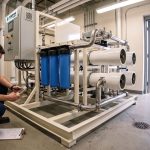
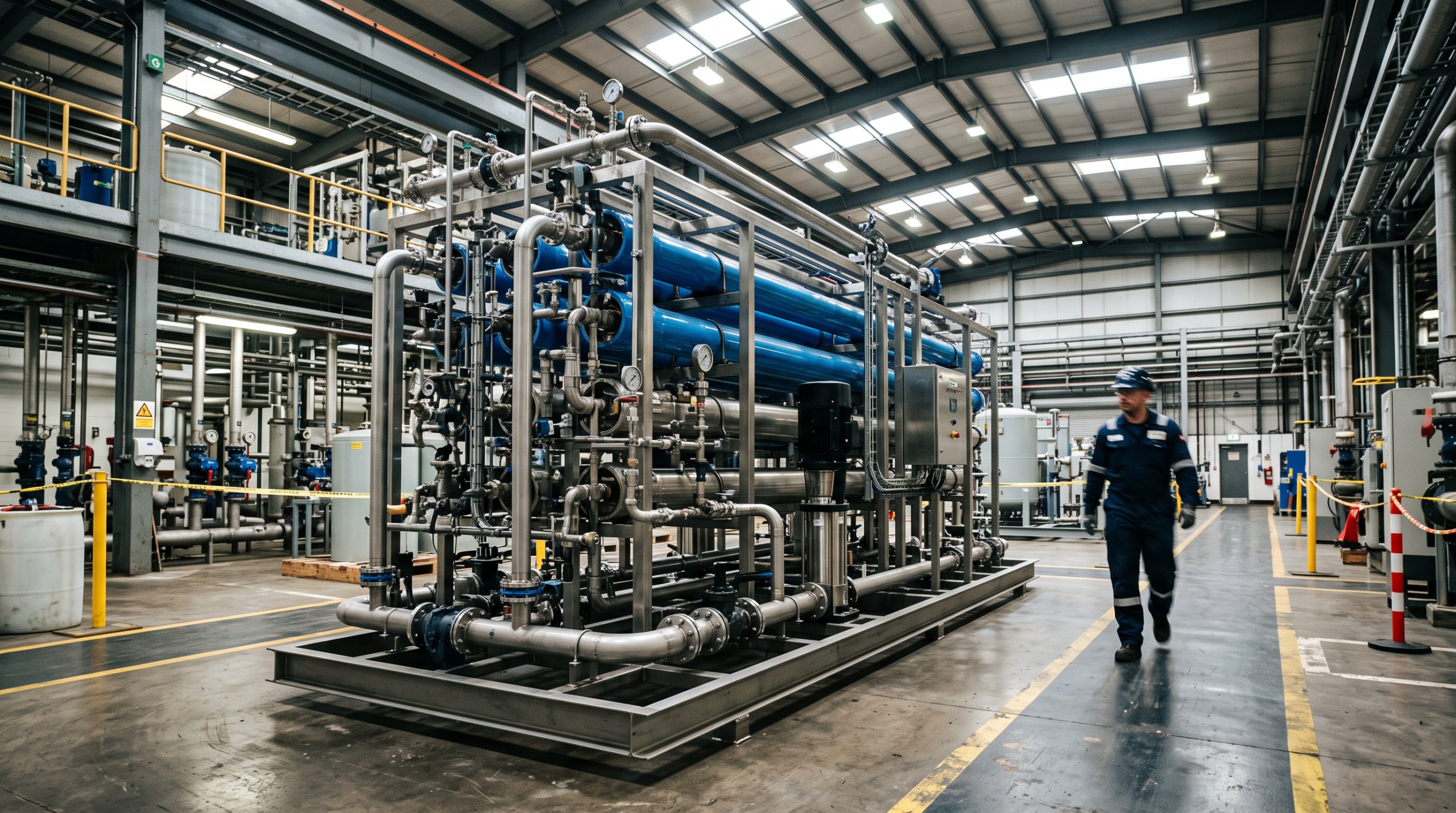
For facilities that actually need reliable seawater desalination now, whether that’s a coastal industrial site, a resort, or an emergency response deployment, seawater desalination watermakers built on proven RO membranes are the equipment doing the job today, not a bioelectrochemical cell still confined to a university lab bench.
Could Microbial Desalination Cells Ever Replace RO?
Probably not as a direct replacement, and most researchers in the field don’t frame it that way. The more realistic trajectory, based on how the review literature discusses it, is MDCs finding a role as a pretreatment or energy-offset step ahead of conventional desalination, particularly in wastewater-heavy applications where the organic-matter treatment side of the process has real value on its own. Using bacteria to partially desalinate water while simultaneously treating wastewater and shaving a bit of energy off the front end of an RO system is a more plausible near-term outcome than MDCs desalinating seawater on their own at municipal or industrial volume.
That’s a legitimate, interesting research direction. It’s just not the same claim as “microbial desalination cells could replace reverse osmosis,” which is the version of the story that tends to circulate outside the academic papers themselves.
What Should Facility Planners and Water Managers Actually Do With This Information?
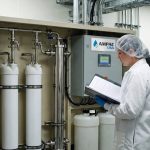
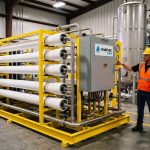
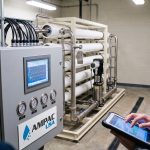
Track the research if you’re curious, but don’t wait on it. If your facility needs desalinated water, brackish or seawater, for process use, cooling, or potable supply, reverse osmosis remains the only technology with the operating history, cost data, and scale to plan a real project around. AMPAC USA designs and builds industrial reverse osmosis systems specifically because that’s the technology with decades of field performance behind it, not because it’s the only idea that’s ever been proposed. Emerging technologies like MDCs are genuinely worth watching as research areas, especially anywhere wastewater treatment and desalination overlap. But there’s a real difference between a bioelectrochemical process that works in a liter-scale reactor under controlled lab conditions and a system engineered to run continuously against real seawater, real fouling, and real maintenance schedules for twenty years. Right now, only one of those exists at the scale industrial and municipal water users actually need.
Frequently Asked Questions
What is a microbial desalination cell in simple terms?
It’s a device that uses bacteria to treat wastewater and desalinate a separate saline water stream at the same time, generating a small amount of electricity as a byproduct of the bacterial process.
Is microbial desalination cell technology available commercially yet?
No. Review literature on the subject confirms that only limited pilot-scale MDC units have been evaluated, with no large-scale, continuously operating installations published to date. It remains a research and development-stage technology.
How does MDC salt removal compare to reverse osmosis?
Recent lab studies report up to 96% salt removal efficiency for MDCs under optimized conditions. Reverse osmosis, by comparison, routinely achieves 99%+ salt rejection at full commercial scale across tens of thousands of operating plants worldwide, with decades of verified field performance.
Why hasn’t microbial desalination scaled up if the lab results look promising?
Reviewers point to several unresolved engineering issues: high installation and maintenance costs, difficulty controlling pH across reactor chambers at larger volumes, weak desalination driving power relative to commercial needs, and membrane fouling without established large-scale cleaning protocols. Cost reduction is cited as the biggest single barrier to commercialization.
Should a facility consider microbial desalination cells instead of RO right now?
Not for an active water supply project. MDCs may eventually find a role as a pretreatment or energy-offset step alongside conventional desalination, particularly in wastewater-heavy applications, but reverse osmosis is the only desalination technology with the operating history and scale to plan a real facility around today.
Sources: Scientific Reports (Nature); Global Challenges (Wiley, Aber et al. critical review); Desalination journal (ScienceDirect, comprehensive MDC review and upscaling review); Journal of Environmental Chemical Engineering; Guinness World Records / ITC DESAL+ Living Lab; Pumps & Systems; ScienceDirect (Desalination journal, specific energy consumption studies).
AMPAC USA engineers custom water purification systems for commercial, industrial, and emergency applications — from 500 GPD to multi-million GPD. Trusted by municipalities, military, and industry worldwide.