
Spots and streaks on vehicles after a wash are a water quality problem, not a wash process problem. The spots come from dissolved minerals left behind as the rinse water evaporates. No amount of drying, waxing, or chemistry in the wash process eliminates them — the only fix is treating the final rinse water before it touches the vehicle.
Reverse osmosis is the standard solution. It reduces total dissolved solids in the rinse water to below 10 ppm, which is below the threshold where visible spotting occurs. The RO system goes on the spot-free final rinse circuit only — the rest of the wash uses untreated or reclaim water as normal.
Why High-TDS Water Causes Spots
Municipal tap water in most US markets runs 100–500 ppm TDS — primarily calcium, magnesium, sodium, and bicarbonate ions. When this water evaporates from a vehicle surface after the final rinse, those dissolved minerals stay behind as a thin residue of carbonate and sulfate crystals. The faster the water evaporates (warmer weather, direct sun, wind), the more concentrated the deposit. Even at 150 ppm TDS, spotting is visible on dark-colored vehicles in direct sunlight.
Below 10 ppm TDS, the mineral load is low enough that any residue is optically invisible on the paint surface under normal viewing conditions. At 5 ppm or below — what a properly operating commercial RO system reliably produces — the final rinse is genuinely spot-free.
The Spot-Free Rinse RO System: What It Is and Isn’t
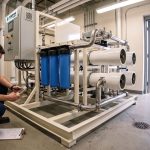
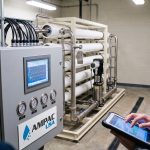
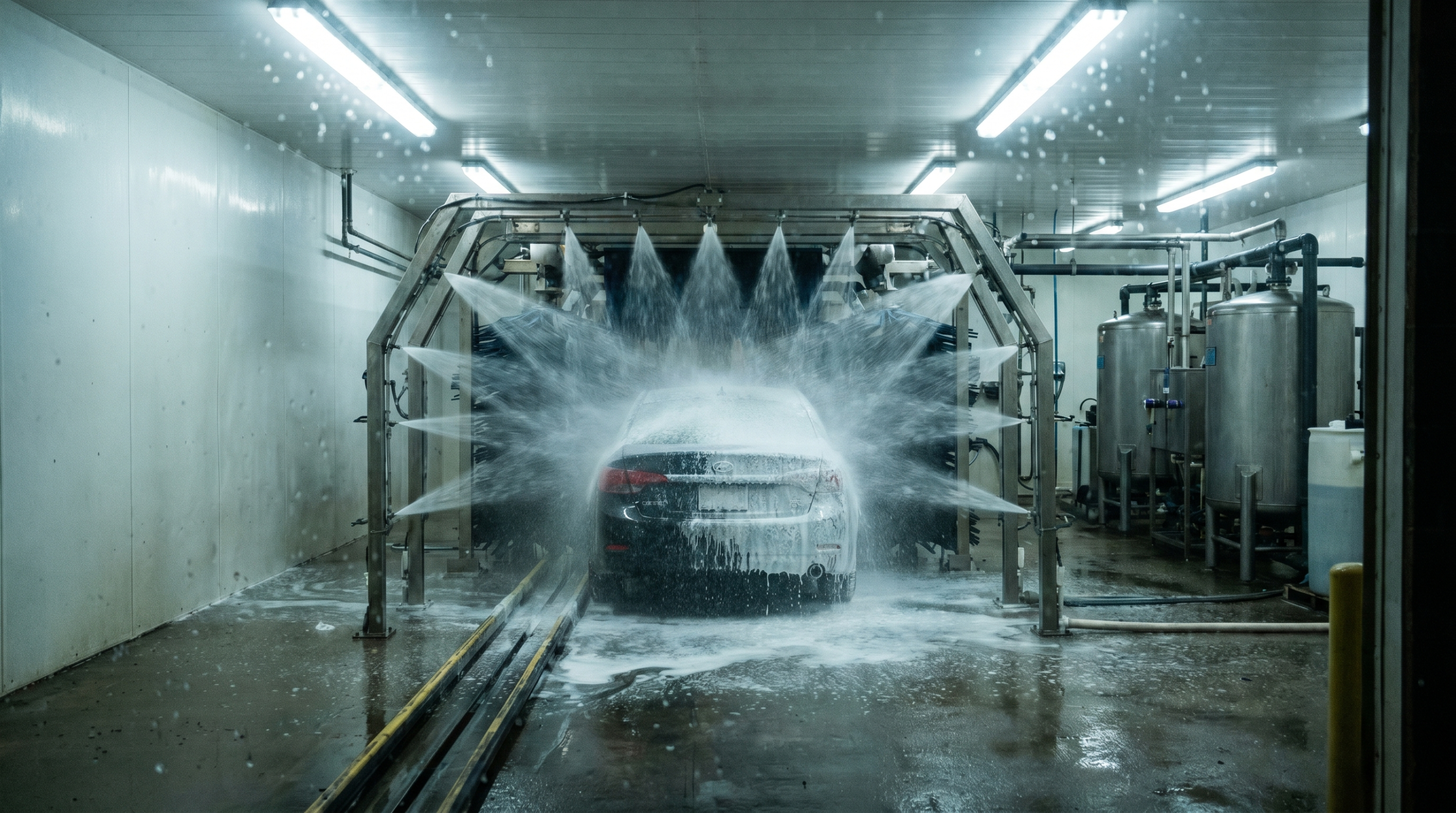
A car wash spot-free RO system is a dedicated commercial RO unit plumbed in parallel with the existing wash water supply, connected only to the final rinse arch or boom. It does not treat all wash water — that would be economically impractical and operationally unnecessary. The pre-soak, detergent, and high-pressure rinse stages use municipal or reclaim water as normal. Only the last 1–3 gallons per vehicle use RO water.
This targeted approach keeps the RO system small and the capital cost reasonable. A car wash doing 200 vehicles per day at 2 gallons of RO water per vehicle uses 400 GPD of RO product water — a system sized at 500–800 GPD handles this with headroom for peak volume and membrane flux decline over time.
Sizing a Car Wash RO System
Step 1: Determine Daily RO Water Demand
Measure or estimate the volume of final rinse water per vehicle. For a standard arch rinse, this is typically 1.5–3 gallons per vehicle. Multiply by average daily vehicle count, then add 25–30% for peak days and system recovery margin.
| Daily Vehicle Count | RO Water per Vehicle | Daily RO Demand | Recommended System Size |
|---|---|---|---|
| 50–100 vehicles/day | 2 gallons | 100–200 GPD | 300–500 GPD RO system |
| 100–250 vehicles/day | 2 gallons | 200–500 GPD | 500–800 GPD RO system |
| 250–500 vehicles/day | 2 gallons | 500–1,000 GPD | 1,000–1,500 GPD RO system |
| 500–1,000 vehicles/day | 2 gallons | 1,000–2,000 GPD | 2,000–3,000 GPD RO system |
| 1,000+ vehicles/day (express/tunnel) | 2 gallons | 2,000+ GPD | 3,000–10,000 GPD RO system |
Step 2: Account for RO Recovery Rate
RO systems produce permeate (product water) and reject (concentrate sent to drain). A typical commercial car wash RO system runs 65–75% recovery — meaning for every 100 gallons of feed water, 65–75 gallons become product water and 25–35 gallons go to drain. Verify your drain capacity and water costs factor this reject stream.
Step 3: Storage Tank Sizing
Most car wash RO systems feed a storage tank rather than operating on-demand. The tank buffers against peak demand periods. A minimum of 1,000 gallons of storage is typical for mid-volume washes; high-volume tunnel operations may run 2,000–5,000 gallons of RO storage with the system running continuously to replenish it.
Pre-Treatment Requirements
Car wash environments present specific pre-treatment challenges. The RO membrane must be protected from:
- Chlorine: Municipal water chlorine above 0.1 ppm degrades polyamide RO membranes over time. Carbon filtration upstream of the RO is required. Replace carbon cartridges on schedule — an exhausted carbon filter passes chlorine to the membrane silently.
- Particulates: A 5-micron sediment pre-filter upstream of the carbon filter prevents particulate fouling of the RO membrane.
- Hardness: Feed water above 15 GPG (approximately 250 ppm as CaCO₃) benefits from a softener upstream of the RO to extend membrane life and reduce scaling potential. Below 15 GPG, antiscalant chemical dosing is typically sufficient.
Car Wash Water Reclaim and RO
Many car wash operations run water reclaim systems to recover and reuse wash water from the tunnel or bay floor. Reclaim water can be used for the pre-soak and detergent stages. It cannot be used for the spot-free rinse — reclaim water TDS is elevated by accumulated soap, dirt, and minerals from vehicle surfaces, and would defeat the purpose of RO-treated final rinse water.
Where reclaim is in use, the RO system feeds only the final rinse with fresh municipal water. The result is a wash operation that uses reclaim for 70–85% of water consumption and RO-treated fresh water for the critical final rinse only — minimizing total water consumption while achieving a genuine spot-free finish.
TDS Monitoring and System Performance
A car wash RO system should have an inline TDS monitor on the product water line. Set an alert at 10–15 ppm — if the product water TDS rises above this level, the membrane is fouling or the pre-filters need replacement. Catching it early prevents membrane damage and customer complaints before they accumulate.
TDS should be checked manually weekly and logged. Membrane performance is best tracked by measuring product TDS and conductivity over time — gradual TDS rise at constant pressure indicates normal membrane aging; sudden TDS increase suggests a membrane breach, O-ring failure, or pre-filter exhaustion.
Commercial Car Wash RO System Costs
| System Size | Suitable For | Equipment Cost | Installation | Annual Operating Cost |
|---|---|---|---|---|
| 300–500 GPD | Self-serve or low-volume in-bay automatic | $1,500–$4,000 | $500–$1,500 | $300–$700 |
| 500–1,500 GPD | Mid-volume in-bay or small tunnel | $3,500–$9,000 | $1,000–$3,000 | $600–$1,500 |
| 1,500–5,000 GPD | High-volume tunnel or express wash | $8,000–$25,000 | $2,000–$6,000 | $1,500–$5,000 |
| 5,000–15,000 GPD | High-throughput express or fleet wash | $22,000–$65,000 | $5,000–$15,000 | $4,000–$12,000 |
Annual operating costs include membrane replacement (every 3–5 years, prorated), pre-filter cartridges (every 3–6 months), electricity (typically $15–$60/month depending on system size), and reject water disposal. Membrane replacement at a mid-size car wash runs $400–$1,500 per event depending on the number and type of elements.
Return on Investment for Car Wash Spot-Free RO
The business case for a car wash RO system runs in two directions:
Revenue protection: A car wash advertising a “spot-free” guarantee that actually delivers it commands a price premium over competitors using untreated water for the final rinse. In markets where spotting complaints are common, the RO system is a differentiator that generates repeat business and positive reviews.
Reduced labor: Detailing operations that hand-dry vehicles after a wash — to prevent spotting from municipal rinse water — can reduce or eliminate that step when RO water is used for the final rinse. At $18–$25/hour labor, this savings adds up quickly for a high-volume operation.
Most mid-volume car wash installations recover RO system cost in 2–4 years through the combination of premium pricing ability and labor reduction.
Spot-Free RO Systems for Car Washes — AMPAC USA
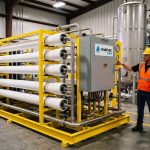
AMPAC USA manufactures commercial RO systems designed for car wash spot-free rinse applications, sized from 300 GPD to 15,000+ GPD. Systems include pre-filtration, antiscalant injection, and inline TDS monitoring as standard. Built in Woods Cross, UT, factory-tested before shipment.
Tell us your daily vehicle count and feed water TDS and we’ll specify the right system.
Get a Car Wash RO Quote View Commercial RO Systems →
Spot-free rinse is the point of AMPAC USA’s work on car wash water treatment.
Frequently Asked Questions
Why does reverse osmosis prevent spotting on cars after a wash?
Spots come from dissolved minerals left behind as rinse water evaporates. RO reduces total dissolved solids in the final rinse to below 10 ppm, and often to 5 ppm or below, which is low enough that residue is optically invisible on the vehicle surface.
How is a car wash RO system sized?
Based on final rinse water volume per vehicle (typically 1.5-3 gallons) multiplied by average daily vehicle count, plus 25-30 percent for peak days. A wash doing 200 vehicles per day at 2 gallons per vehicle needs roughly a 500-800 GPD system.
Does an RO system treat all the water in a car wash?
No. The RO system is plumbed only into the final rinse circuit. Pre-soak, detergent, and high-pressure rinse stages continue to use municipal or reclaim water as normal, which keeps the RO system small and cost-effective.
How much does a commercial car wash RO system cost?
Equipment costs range from about 1,500 dollars for a 300-500 GPD self-serve system up to 65,000 dollars for a 5,000-15,000 GPD high-throughput express or fleet wash system, with most mid-volume installations paying back in 2-4 years.