
Pharmaceutical water is the most tightly regulated utility in drug manufacturing. The water grade your process requires – and the system that produces it – is not a purchasing decision; it’s a regulatory one. Getting it wrong means failed batch testing, 483 observations, and potential production shutdown. Getting it right means a validated, documented water system that satisfies both USP and FDA expectations for the life of the facility.
This guide covers what each pharmaceutical water grade requires, which systems produce them, how to specify a compliant system, and what a pharma-grade RO installation actually costs.
USP Water Grades: What Each One Requires
USP (Water for Pharmaceutical Purposes) defines the water quality standards used in drug manufacturing in the United States. The grades, in ascending order of purity:
Purified Water (PW)
- Conductivity: ≤1.3 µS/cm at 25°C (Stage 1); ≤2.1 µS/cm (Stage 2 offline test)
- TOC: ≤500 ppb
- Microbial action limit: 100 CFU/mL (alert); 200 CFU/mL (reject)
- Production method: Ion exchange, reverse osmosis, distillation, or combinations
- Uses: Non-sterile dosage form manufacturing, cleaning of non-sterile equipment, laboratory reagent preparation
Water for Injection (WFI)
- Conductivity: Same as Purified Water (≤1.3 µS/cm at 25°C)
- TOC: ≤500 ppb
- Endotoxin: ≤0.25 EU/mL
- Microbial action limit: 10 CFU/100 mL
- Production method (US): Distillation only per USP. The EU Pharmacopoeia (Ph.Eur.) permits membrane-based processes (RO + EDI) as of 2017 – but FDA still requires distillation for WFI in the US.
- Uses: Sterile product manufacturing, parenteral preparation, final equipment rinse before sterilization
Sterile Water for Injection (SWFI) and Others
SWFI is WFI that has been sterilized and packaged. Additional grades include Sterile Purified Water, Bacteriostatic Water for Injection, and Water for Hemodialysis – each with specific USP monographs. These are finished products, not production water grades.
Which Systems Produce Pharmaceutical-Grade Water
Reverse Osmosis (RO)
RO is the core purification step for Purified Water systems. A properly designed pharmaceutical RO system removes 95-99.5% of TDS, eliminates bacteria and endotoxins from the feed water, and reduces conductivity to 2-5 µS/cm. This is not sufficient alone for USP Purified Water conductivity requirements – a polishing step is needed.
Double-pass RO (two RO stages in series) can achieve conductivity of 0.5-1 µS/cm at the permeate outlet, which may meet USP PW limits in some conditions, but pharmaceutical facilities standardly follow RO with EDI rather than relying on double-pass RO alone.
Electrodeionization (EDI)
EDI uses ion exchange resin beds continuously regenerated by an applied electric field. It produces ultrapure water at 0.05-0.1 µS/cm (18 megohm-cm) without chemical regeneration. Placed downstream of RO, EDI is the standard polishing step for pharmaceutical Purified Water systems. The combination – RO + EDI – produces water that comfortably meets USP PW conductivity requirements with a validated, chemical-free continuous process.
Distillation
Multi-effect distillation (MED) or vapor compression distillation is the FDA-required production method for WFI in the US. Distillation removes all non-volatile impurities and produces pyrogen-free water. Capital cost is higher than membrane systems, and energy consumption is significant (2-5 kWh per cubic meter), but it is the only path to USP WFI compliance in a US pharmaceutical facility.
Ultraviolet Disinfection
UV at 185 nm (TOC reduction) and 254 nm (microbial) is used at two points in pharmaceutical water systems: upstream of EDI for TOC reduction (to protect the EDI resin), and in the distribution loop for continuous bioburden control. UV is not a primary purification step – it does not remove dissolved solids or reduce conductivity.
Pharmaceutical Water System Design: The Full Treatment Train
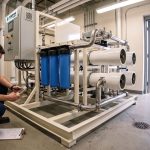
A typical pharmaceutical Purified Water system is a multi-stage treatment train, not a single piece of equipment. Standard design for a US facility using municipal feed water:
- Pre-treatment: Multimedia filtration → activated carbon → water softener → 5-micron pre-filter. Removes particulates, chlorine/chloramine, and hardness that would foul or degrade downstream equipment.
- Reverse osmosis: Single or double-pass RO at 100-400 psi. Removes 95-99.5% of TDS, reduces conductivity to 2-10 µS/cm. Bacteria and endotoxins are rejected at the membrane.
- UV (TOC reduction): 185 nm UV upstream of EDI to photooxidize organic compounds below the 500 ppb TOC limit.
- Electrodeionization (EDI): Polishes RO permeate to ≤0.1 µS/cm, continuously. No chemical regeneration required.
- Distribution loop: Continuous circulation loop at 1+ m/s flow velocity (turbulent, to prevent biofilm formation), maintained at ambient temperature (cold loop) or 80°C+ (hot loop for continuous sanitization). UV disinfection in the loop. Stainless steel (316L) distribution piping, electropolished to Ra ≤0.5 µm to reduce biofilm attachment.
- Monitoring: Continuous online conductivity and TOC monitoring at the final point before use. Periodic microbiological testing at use points per the validated sampling plan.
cGMP Compliance Requirements
A pharmaceutical water system is not just equipment – it’s a validated utility that must comply with FDA’s Current Good Manufacturing Practice (cGMP) regulations (21 CFR Parts 210/211). Key compliance elements:
- Design qualification (DQ): Documentation that the system design meets the User Requirements Specification (URS) and applicable USP/regulatory requirements before procurement.
- Installation qualification (IQ): Verification that installed equipment matches the approved design, specifications, and drawings.
- Operational qualification (OQ): Testing that the system operates within defined parameters across its operating range.
- Performance qualification (PQ): Three-phase, one-year monitoring program demonstrating consistent USP-compliant water quality across seasons and operating conditions. Phase 1 (2-4 weeks): daily sampling at every use point. Phase 2 (additional weeks): weekly sampling. Phase 3 (ongoing): routine monitoring per validated schedule.
- Change control: Any modification to the water system – piping changes, component replacement, operating parameter changes – requires documented change control review before implementation.
- Sanitization: Regular chemical or thermal sanitization of the distribution loop per validated SOPs. Frequency and method documented in the validation protocol.
Pharmaceutical Water System Costs
| System Type | Flow Rate | Equipment Cost | Installation and Validation | Annual Operating Cost |
|---|---|---|---|---|
| Small pharma PW system (RO + EDI + hot loop) | 50-200 GPD | $15,000 – $45,000 | $20,000 – $60,000 | $3,000 – $8,000 |
| Mid-size pharma PW system | 200-2,000 GPD | $45,000 – $150,000 | $50,000 – $150,000 | $8,000 – $25,000 |
| Large pharma PW system | 2,000-20,000 GPD | $150,000 – $600,000 | $150,000 – $400,000 | $25,000 – $100,000 |
| WFI distillation system | 50-5,000 GPD | $80,000 – $800,000 | $100,000 – $500,000 | $15,000 – $150,000 |
Installation and validation costs often exceed equipment cost, particularly for smaller systems. The validation package (DQ, IQ, OQ, PQ protocols and reports) is a significant documentation effort even for a straightforward small-facility PW system.
Laboratory Water: A Simpler Case
Research and QC laboratories require high-purity water that may or may not fall under pharmaceutical cGMP requirements. ASTM and CLSI define laboratory water grades:
- Type I (ultrapure): Resistivity ≥18 MΩ·cm, TOC <10 ppb, used for sensitive analytical methods (HPLC, ICP-MS, cell culture)
- Type II: Resistivity ≥1 MΩ·cm, used for general laboratory reagent preparation and glassware rinsing
- Type III: Resistivity ≥0.05 MΩ·cm, used for glassware washing and non-critical applications
Laboratory water systems (RO + polishing cartridge or RO + EDI + UV) typically cost $3,000 – $30,000 for the equipment, with much simpler installation than a cGMP-validated pharmaceutical system. Validation is not required, but documented performance testing is recommended.
Specification Checklist for a Pharmaceutical Water System
- USP water grade required (PW, WFI, other)
- Daily volume requirement and peak flow rate (GPM at use points)
- Number and location of use points
- Distribution loop temperature (ambient cold loop vs. hot loop ≥80°C)
- Piping material (316L SS standard; 304 SS or other materials require justification)
- Required certifications: FDA compliance, ASME BPE (for sanitary fittings), USP
- Monitoring: online conductivity and TOC required; bacterial monitoring frequency per validation plan
- Validation package required: DQ/IQ/OQ protocols and reports
- Feed water chemistry (municipal, well, or other)
Pharmaceutical-Grade Water Systems – AMPAC USA
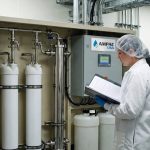
AMPAC USA designs and manufactures pharmaceutical water purification systems including USP Purified Water RO/EDI systems and laboratory ultrapure water systems. Systems are built in Woods Cross, UT, factory-tested before shipment, and configured to your validated flow rate and quality targets. We supply system documentation packages suitable for IQ/OQ validation use.
Frequently Asked Questions
What is the difference between USP Purified Water and Water for Injection (WFI)?
Purified Water requires conductivity of 1.3 uS/cm or less at 25C and can be produced by ion exchange, reverse osmosis, or distillation. WFI has the same conductivity requirement plus an endotoxin limit, and in the US must be produced by distillation.
Can reverse osmosis alone meet USP Purified Water requirements?
A single RO pass typically reduces conductivity to 2-5 uS/cm, which is not sufficient on its own. Pharmaceutical facilities standardly follow RO with electrodeionization (EDI), which polishes the water to 0.05-0.1 uS/cm and reliably meets USP Purified Water conductivity limits.
What does cGMP compliance require for a pharmaceutical water system?
A validated system with documented Design, Installation, Operational, and Performance Qualification (DQ/IQ/OQ/PQ), regular change control review for any modification, and a validated sanitization schedule for the distribution loop.
How much does a pharmaceutical-grade water system cost?
A small pharma Purified Water system (RO plus EDI plus hot loop) at 50-200 GPD runs 15,000 to 45,000 dollars in equipment plus 20,000 to 60,000 dollars for installation and validation. Large systems at 2,000-20,000 GPD can run 150,000 to 600,000 dollars in equipment alone.