

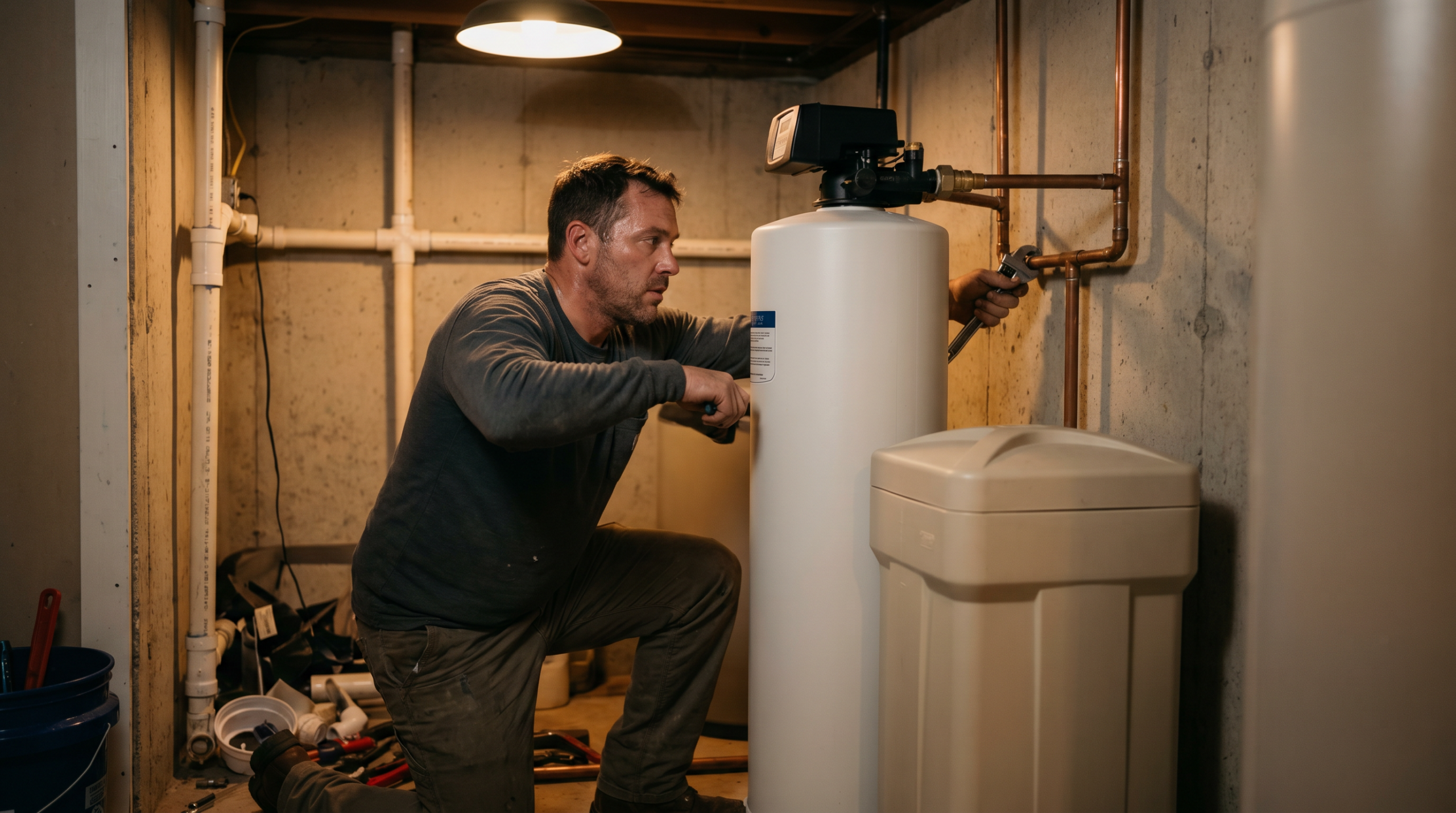

Water softeners and reverse osmosis systems are often confused as doing the same thing. They don’t. A water softener removes hardness (calcium and magnesium) through ion exchange. A reverse osmosis system removes 95–99% of everything dissolved in water — including hardness, but also heavy metals, nitrates, PFAS, arsenic, chlorine, and TDS. Understanding what each system actually does makes the choice straightforward for most applications. In many cases, the right answer is both.
What a Water Softener Does (and Doesn’t Do)
A salt-based water softener uses a cation exchange resin to swap calcium (Ca²⁺) and magnesium (Mg²⁺) ions for sodium (Na⁺) ions. The result: soft water with negligible hardness that won’t scale pipes, water heaters, or appliances.
What a water softener removes:
- Calcium and magnesium (hardness) — up to 99%
- Some dissolved iron — effective below 2–3 mg/L ferrous iron
- Some barium and radium
What a water softener does NOT remove:
- Total dissolved solids (TDS) — sodium replaces calcium, so TDS may actually increase slightly
- Nitrates, PFAS, arsenic, lead, fluoride, chromium-6
- Chlorine, chloramines, VOCs
- Bacteria, viruses, or cysts
- Taste and odor compounds
A softener also adds sodium to the water in proportion to the hardness removed. At 25 GPG hardness (very hard water), a softener adds approximately 380 mg/L sodium — relevant for people on low-sodium diets or for applications where sodium is problematic (certain manufacturing processes, irrigation of sodium-sensitive crops).
What a Reverse Osmosis System Does
An RO system forces water through a semi-permeable membrane under pressure, physically rejecting dissolved solids, ions, and most contaminants. A well-maintained RO system removes:
- 90–99% of TDS (all dissolved minerals, including hardness)
- 90–99% of PFAS (PFOA, PFOS, and related compounds)
- 92–97% of arsenic (As(V)), lead, chromium-6, nitrates, fluoride
- 95–99% of heavy metals (barium, cadmium, copper, mercury)
- Chlorine and chloramines (via pre-filter carbon block)
- Bacteria and most viruses (physical size exclusion; membranes are rated at 0.0001 micron)
What RO does NOT do as efficiently as a softener:
- High-flow whole-house scale prevention — RO systems produce water at rates of 50–6,000 GPD; a whole-house RO for hardness alone is expensive where a softener costs a fraction as much
- Point-of-entry scale protection for large plumbing systems — softeners are more economical for this single purpose
Head-to-Head Comparison
| Factor | Water Softener | Reverse Osmosis |
|---|---|---|
| Removes hardness | ✅ Yes (99%) | ✅ Yes (95–99%) |
| Removes TDS | ❌ No (may increase sodium) | ✅ Yes (90–99%) |
| Removes nitrates | ❌ No | ✅ Yes (85–95%) |
| Removes PFAS | ❌ No | ✅ Yes (90–99%) |
| Removes arsenic | ❌ No | ✅ Yes (92–96%) |
| Removes lead | ❌ No | ✅ Yes (95–99%) |
| Removes chlorine/taste | ❌ No | ✅ Yes (via pre-filter) |
| Adds sodium | ⚠️ Yes (proportional to hardness) | ❌ No |
| Whole-house scale protection | ✅ Economical | ⚠️ Possible but expensive |
| Drinking water quality | ❌ Not designed for this | ✅ Primary purpose |
| Wastewater produced | Regeneration brine (salt water) | Reject/concentrate (15–25% of feed) |
| Ongoing cost | Salt (~$5–20/month) | Pre-filters + membrane ($100–300/year) |
| Flow rate | High (whole house) | Lower (50 GPD to 6,000+ GPD) |
When to Choose a Water Softener
A water softener is the right choice when:
- Hardness is the only problem. Your water tests show high hardness (above 7 GPG / 120 mg/L as CaCO₃) but otherwise good quality — low TDS, no detected contaminants. Scale protection on water heaters, dishwashers, and plumbing is the goal.
- Whole-house scale protection at high flow rate. A softener handles household peak flow (5–10 GPM) economically. A whole-house RO system at the same flow rate costs significantly more.
- Laundry and skin feel are priorities. Soft water requires less detergent and leaves skin and hair feeling different. These are genuine quality-of-life benefits for all water in the home, not just the drinking tap.
When to Choose Reverse Osmosis
RO is the right choice when:
- Drinking water quality is the goal. You want to remove contaminants — not just hardness — from the water you drink and cook with. Softened water still contains everything a softener doesn’t remove.
- Contaminants are present. Your water test shows nitrates, PFAS, arsenic, lead, fluoride, or high TDS. A softener won’t address any of these.
- Private well water with multiple issues. Well water often has hardness plus TDS plus specific contaminants. RO addresses all of them in one system (with appropriate pre-treatment for iron and hardness).
- Process or product water quality requirements. Brewing, food manufacturing, laboratory, commercial printing — applications where TDS, mineral content, and specific contaminant limits matter.
- Sodium restrictions. People on medically low-sodium diets, or operations where sodium in water is a process problem (cannabis cultivation, some food formulations), need softener-free water treatment.
When You Need Both
The combination of water softener + reverse osmosis is often the optimal solution — particularly for well water or applications where scale protection across the whole facility and high-purity water for specific applications are both required:
- Sequence: Softener first, RO second. The softener removes hardness (protecting the RO membrane from calcium carbonate scaling), and the RO system delivers high-purity permeate for drinking, cooking, or process use.
- Well water with hardness above 15 GPG: Very hard well water scaling RO membranes rapidly without softener pre-treatment. Softener + RO dramatically extends membrane life.
- Hotels and hospitality: A typical hotel uses a softener for laundry and guestroom water (scale protection, softer towels) and a separate RO system for kitchen, coffee, ice, and beverage applications (taste quality). Both systems serve different purposes.
- Breweries: Some brewers use a softener to remove excess hardness from very hard well water, then RO to achieve near-zero TDS before building the target water profile with brewing salts.
Cost Comparison
| System | Initial Cost (Residential) | Annual Operating Cost | Lifespan |
|---|---|---|---|
| Water softener (whole house) | $800–$2,500 installed | $100–$300 (salt) | 10–20 years (resin replacement at 10 years) |
| Under-sink RO (point of use) | $300–$800 installed | $100–$250 (pre-filters + membrane) | 10–15 years |
| Whole-house RO (200–1,000 GPD) | $2,500–$8,000 installed | $300–$600 (pre-filters + membrane) | 10–15 years |
| Softener + under-sink RO (combined) | $1,100–$3,300 installed | $200–$550 | 10–20 years |
AMPAC USA Systems for Both Applications
AMPAC USA manufactures commercial and industrial reverse osmosis systems from 500–20,000+ GPD for all the applications where RO is the right choice. For applications where a softener + RO combination is optimal, our engineering team can specify the pre-treatment sequence and RO system as a coordinated package.
Not sure which system fits your situation? Share your water test results and application — contact AMPAC USA and we’ll tell you what you actually need. We don’t oversell. If a softener alone solves your problem, we’ll say so. One business day response.
Related: Commercial RO System Sizing Guide | Whole House RO Systems | RO Water Quality: TDS, pH, and Conductivity
Related Articles
- Whole House Reverse Osmosis vs Water Softener: Which Do You Need?
- Ensure Safe drinking water with Ampac USA 4 Stage Reverse Osmosis System
- How Reverse Osmosis Works: The Complete Technical Guide | AMPAC USA
- The Pros and Cons of Reverse Osmosis Filtration Process-Ampac USA
Frequently Asked Questions
What’s the difference between a water softener and a reverse osmosis system?
A water softener removes hardness (calcium and magnesium) through ion exchange but does nothing for TDS, nitrates, PFAS, arsenic, or chlorine. A reverse osmosis system removes 95-99 percent of everything dissolved in water, including hardness, but at a much lower flow rate than a softener.
Does a water softener add sodium to drinking water?
Yes. A softener swaps calcium and magnesium for sodium in proportion to the hardness removed. At 25 GPG hardness, a softener adds approximately 380 mg/L sodium, which matters for people on low-sodium diets.
When do I need both a water softener and reverse osmosis?
When well water has hardness above 15 GPG along with other contaminants like TDS or specific chemicals. The softener protects the RO membrane from calcium carbonate scaling, and the RO system delivers high-purity permeate for drinking, cooking, or process use.
Which is more cost-effective for whole-house scale protection?
A water softener. It handles household peak flow (5-10 GPM) economically at 800 to 2,500 dollars installed, while a whole-house RO system at the same flow rate costs 2,500 to 8,000 dollars and is not the most economical single-purpose solution for scale prevention alone.
