
Picking the right commercial reverse osmosis system isn’t about just buying the biggest unit you can afford. It’s an engineering task. You start with how much water you need daily, what’s in your source water, and the exact quality your process demands. This guide walks you through every sizing detail. We’ll explain the pre-treatment choices that make your membranes last 3 years or 7, and give you a real-world cost breakdown to compare different quotes.
- Sizing a commercial RO system means calculating your peak daily water demand (GPD) and adding a 20% safety buffer.
- The TDS, temperature, and SDI of your feed water directly impact how many membranes you need, operating pressure, and recovery rate.
- A 5,000 GPD commercial RO system usually needs 3-5 membranes and a 2-5 HP pump.
- Good pre-treatment (sediment, carbon, softener) is crucial. Skip it, and your membranes could last half as long.
- AMPAC USA offers free sizing consultations for commercial and industrial setups.
What Is a Commercial Reverse Osmosis System?
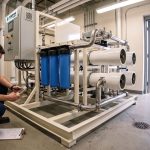
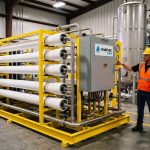
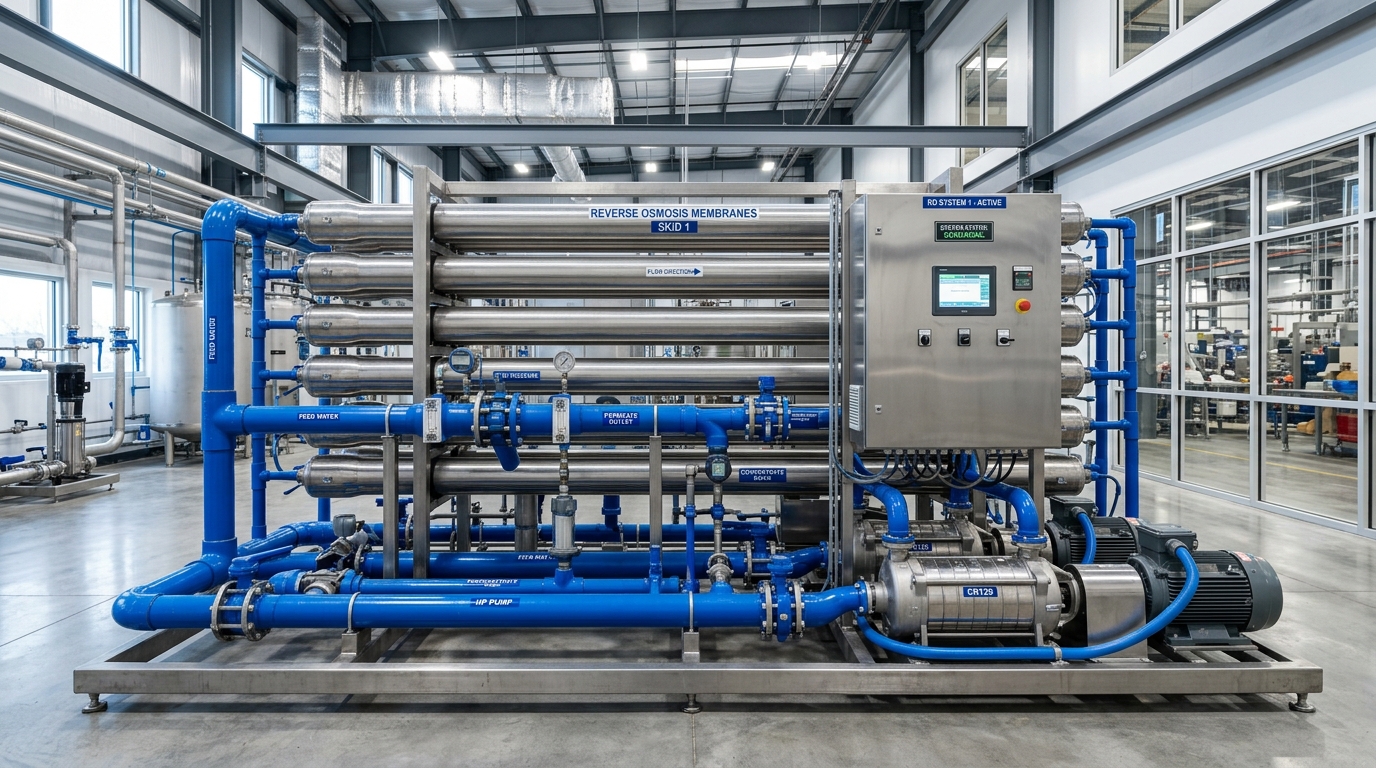
A commercial reverse osmosis (RO) system is a multi-stage water purification unit. It’s built for steady, high-volume water output in places like businesses, not homes. Unlike small residential filters, commercial RO systems make hundreds to thousands of gallons every day. They serve many different points at once and are designed to run constantly, not just when you turn on a tap.
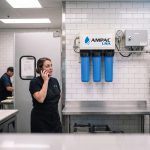
You’ll find commercial RO systems in all sorts of industries: restaurants needing consistent water for ingredients, hotels with big laundry or kitchen needs, car washes protecting their spot-free rinse systems, dental offices, pharmaceutical compounding, lab facilities, and light manufacturing that needs water free of dissolved solids, hardness, or chlorine.
The main part of the system is a special membrane. Water molecules can pass through it under pressure, but it blocks dissolved salts, heavy metals, organics, bacteria, and most other contaminants. A well-designed commercial system will remove 95-99% of total dissolved solids (TDS).
Step 1: Calculate Your Daily Water Demand
The first question for sizing is simple: how many gallons of purified water do you need each day, and when do you need them? RO systems are rated by gallons per day (GPD) at standard conditions (77-F / 25-C feed water). In the real world, the actual output is almost always lower because of feed water temperature, pressure, and TDS.
Demand Calculation by Application
| Application | Typical Daily Demand | Recommended System Size |
|---|---|---|
| Restaurant (50 covers) | 150-300 GPD | 400-600 GPD rated |
| Restaurant (200 covers) | 500-800 GPD | 1,200-1,500 GPD rated |
| Hotel (100 rooms) | 2,000-5,000 GPD | 3,000-7,500 GPD rated |
| Car wash (spot-free) | 500-2,000 GPD | 800-3,000 GPD rated |
| Dental office (4 chairs) | 50-100 GPD | 150-200 GPD rated |
| Light manufacturing | Varies widely | Engineering assessment required |
Here’s a key design rule: always size your system to produce 150-200% of your peak daily demand. This covers the membrane’s actual output, which drops with temperature and age. It also accounts for your storage tank capacity and ensures you won’t run out of purified water during unexpected demand spikes.
Step 2: Analyze Your Source Water
Getting your source water analyzed isn’t an option, it’s a must. The EPA’s National Primary Drinking Water Regulations set minimum tap water quality, but municipal water quality can vary wildly by region. The things that directly affect your system’s design are:
- TDS (Total Dissolved Solids): Most municipal water has 100-800 ppm. Higher TDS means you’ll need higher operating pressure and will create more concentrate waste.
- Hardness (calcium and magnesium): If your water is hard (over 7 grains per gallon / 120 ppm), you’ll need pre-treatment like a softener or antiscalant dosing. This stops membranes from scaling, which is the top reason they fail early.
- Chlorine/Chloramine: Thin-film composite (TFC) membranes, found in almost all modern commercial RO systems, get ruined by chlorine. If your municipal water uses chlorine or chloramine, an activated carbon pre-filter isn’t just a good idea, it’s essential.
- Iron and Manganese: Levels above 0.05 ppm will quickly foul your membranes. Well water with high iron needs an oxidation filter or greensand pre-treatment before it reaches the RO membranes.
- SDI (Silt Density Index): This measures how many suspended particles are in your water. If your SDI is above 3, you’ll need multimedia filtration pre-treatment. Above 5, your system will need more aggressive pre-treatment and more frequent cleaning.
- Silica: Too much silica (over 20 ppm) can cause permanent membrane scaling. You’ll need specific antiscalant and careful management of your recovery rate.
The American Water Works Association (AWWA) Membrane Technology manual recommends a full water analysis, not just TDS, before you specify any membrane system. Why guess?
Step 3: Choose the Right Pre-Treatment Train
The membrane is the most expensive part of a commercial RO system. Pre-treatment is there solely to protect it. Skipping or underspending on pre-treatment is the most common mistake buyers make. It’s also the one that voids membrane warranties and causes systems to underperform just months after installation.
Standard Pre-Treatment Stack
- 5-micron sediment filter: This removes particles that would wear down pump seals and clog your carbon bed. You’ll change it every 3-6 months, depending on how cloudy your source water is.
- Activated carbon block filter: This removes chlorine, chloramines, and organic compounds that harm TFC membranes. If your carbon filter doesn’t have enough contact time (meaning the flow rate is too high for its size), it won’t fully remove chloramines. Make sure it’s sized correctly for your flow rate.
- Water softener or antiscalant dosing pump: You’ll need one of these if your source water has over 7 GPG hardness. Softeners are better for very hard water. Antiscalant dosing works well for moderate hardness and avoids the hassle of salt regeneration.
- 1-micron polishing filter: This is the last step before the membrane. It catches any carbon fines or tiny particles that got past the earlier filters.
Additional Pre-Treatment for Problem Water
- Iron removal filter: Necessary for well water with over 0.05 ppm iron.
- Greensand filter: For removing iron, manganese, and hydrogen sulfide.
- UV disinfection: Pre-membrane UV kills bacteria before they can create biofilm on the membrane surface.
- pH adjustment: For source water below pH 6.5 or above pH 8.0, which can affect membrane performance and how pure your water is.
Step 4: Understand Recovery Rates and Waste Water
Commercial RO systems create two types of water: permeate (the purified water) and concentrate (the reject or waste water). The recovery rate tells you what percentage of your feed water becomes purified permeate. For example, a system running at 75% recovery makes 3 gallons of purified water for every 1 gallon it sends to waste as concentrate.
Typically, commercial systems recover 65-80% of the water. Higher recovery means less water wasted, but it also concentrates scaling ions, which increases the risk of membrane fouling. Lower recovery is safer for water sources with high TDS or hardness, but you’ll use more water.
In places where water is scarce or expensive, concentrate recycling systems can help. These recirculate a portion of the concentrate back into the feed water, pushing recovery to 85% or more, as long as you manage antiscalant properly. The Water Quality Association (WQA) offers guidelines for recovery rates in commercial use.
Step 5: Total Cost of Ownership
The upfront price of a commercial RO system is usually only 20-35% of its total cost over five years. The rest? Those are operating and maintenance expenses. These costs can change a lot depending on the system’s quality and how good your pre-treatment is.
| Cost Component | Annual Estimate (1,000 GPD system) |
|---|---|
| Pre-filter cartridges (replace 4x/year) | $200-$400 |
| Carbon filter replacement (2x/year) | $150-$300 |
| Membrane replacement (every 3-5 years) | $400-$1,200/event |
| Electricity (pump operation) | $120-$360 |
| Water cost (concentrate waste) | $300-$900 |
| Annual service/inspection | $200-$500 |
| Total Annual Operating Cost | $1,370-$3,660 |
Systems with poor pre-treatment often need new membranes every 12-18 months instead of every 3-5 years. That triples your membrane cost and usually voids the manufacturer’s warranty.
AMPAC USA Commercial RO Systems
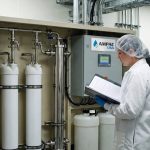
AMPAC USA designs and builds commercial reverse osmosis systems from 400 GPD up to 150,000 GPD. We don’t just sell off a standard spec sheet. Every system we make is tailored to your specific source water analysis and application needs. Our commercial systems come with matched pre-treatment, ASME-rated pressure vessels, and system controllers that automatically monitor everything.
For more technical info, check out our guides on packaged vs. traditional RO systems, water treatment plant RO system design, and understanding RO water conductivity.
Frequently Asked Questions
What are the primary factors to consider when sizing a commercial RO system?
The foundational sizing factors are your daily water demand (GPD), the specific chemistry of your source water, and the exact quality of purified water your process requires. These variables dictate the system’s capacity, membrane configuration, and necessary pre-treatment decisions. AMPAC USA offers free consultations to accurately assess these needs.
How crucial is pre-treatment for the longevity of commercial RO membranes?
Proper pre-treatment, including sediment filtration, carbon filtration, and often water softening, is essential for extending membrane lifespan. Skipping these steps can halve membrane lifespan from an optimal 7 years down to 3, leading to increased operational costs and downtime due to fouling and scaling.
What are the typical components and performance for a 5,000 GPD commercial RO system?
A 5,000 GPD commercial RO system typically requires 3 to 5 membranes and is powered by a 2 to 5 HP pump. Such a system is engineered for continuous operation, achieving 95-99% rejection of total dissolved solids (TDS) under optimal feed water conditions.
Why might a commercial RO system’s actual water output be lower than its rated GPD?
Commercial RO systems are rated in GPD at standard conditions (77°F / 25°C feed water). In real-world applications, actual output is almost always lower due to variations in feed water temperature, pressure, and total dissolved solids (TDS), which directly affect membrane performance and recovery rates.
How does feed water chemistry influence commercial RO system design and efficiency?
Feed water chemistry, specifically parameters like TDS (Total Dissolved Solids), temperature, and SDI (Silt Density Index), directly determines the number of membranes, operating pressure, and the system’s recovery rate. High TDS or low temperature, for instance, may necessitate more membranes or higher pressure to achieve desired output and purity.
Citations and References
- U.S. Environmental Protection Agency. National Primary Drinking Water Regulations. EPA. epa.gov
- American Water Works Association. Microfiltration and Ultrafiltration Membranes for Drinking Water (M53). AWWA. awwa.org
- Water Quality Association. Reverse Osmosis Treatment Process. WQA. wqa.org
- NSF International. NSF/ANSI Standard 58: Reverse Osmosis Drinking Water Treatment Systems. NSF. nsf.org
- EPA Office of Water. PFAS National Primary Drinking Water Regulation. 2024. epa.gov
Conclusion
This post explored how reverse osmosis technology delivers high-purity water across a wide range of residential, commercial, and industrial applications. For businesses and organizations requiring reliable RO purification, AMPAC USA engineers custom systems tailored to your specific water quality requirements and flow demands. Contact our team at info@ampac1.com or (909) 548-4900 to discuss your water treatment needs.
Ready to size your system? Browse our full line of commercial reverse osmosis systems, 200 to 100,000+ GPD.
AMPAC USA engineers custom water purification systems for commercial, industrial, and emergency applications — from 500 GPD to multi-million GPD. Trusted by municipalities, military, and industry worldwide.