


If you’ve been searching for whole house water treatment, you’ve probably run into both reverse osmosis systems and water softeners — and wondered which one actually solves your problem. They’re often confused, occasionally combined, and frequently oversold. Here’s a straight comparison.
The Core Difference
A water softener does one thing: removes calcium and magnesium (hardness minerals) through ion exchange, replacing them with sodium. That’s it. It doesn’t filter contaminants, lower TDS, or improve taste.
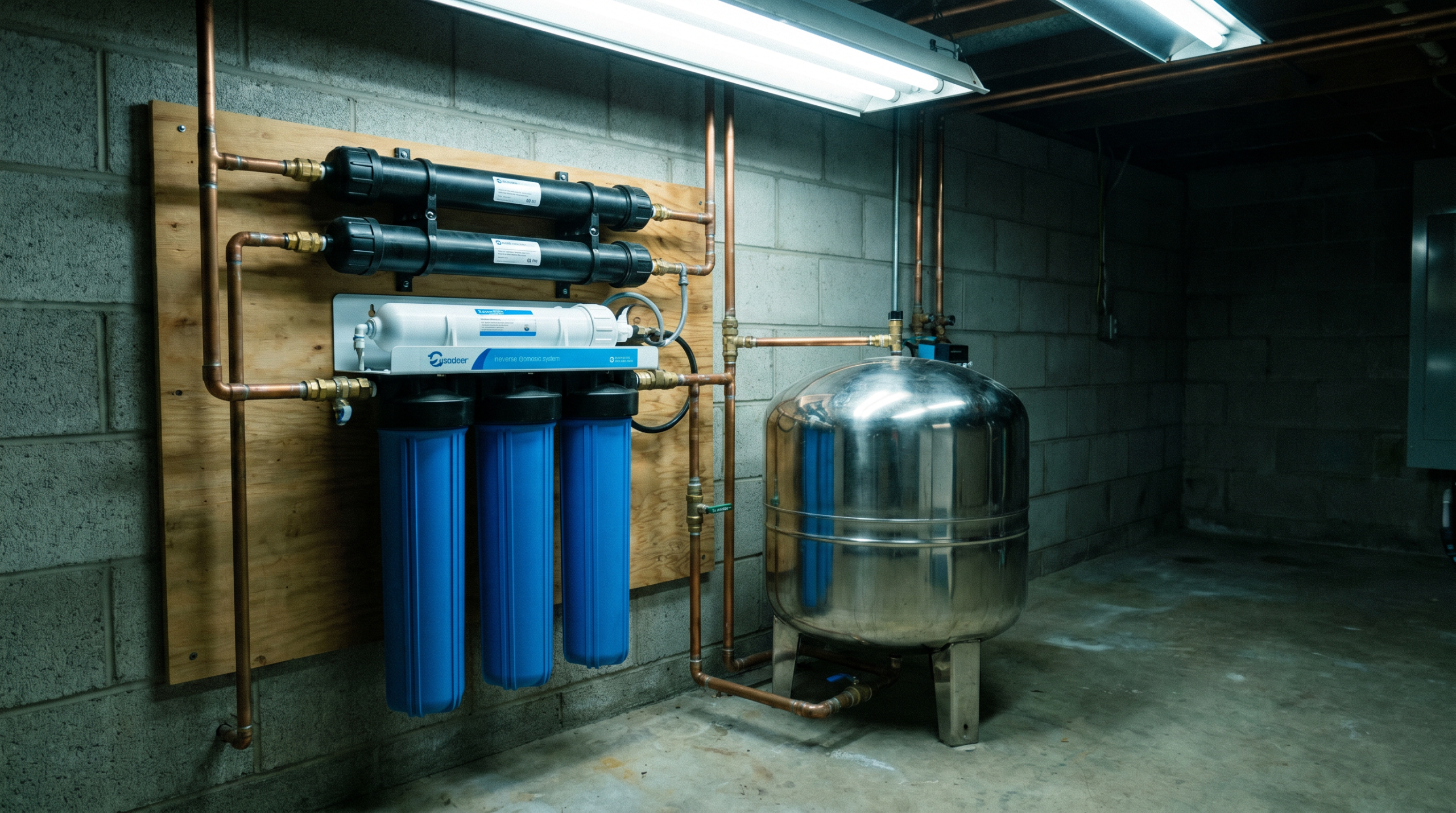
A whole house reverse osmosis system pushes water through a semi-permeable membrane at pressure, rejecting 96-99% of dissolved solids — including hardness minerals, chlorine, nitrates, fluoride, heavy metals, and most other contaminants. It does what a softener does and much more.
Side-by-Side Comparison
| Feature | Water Softener | Whole House RO |
|---|---|---|
| Removes hardness (Ca/Mg) | Yes | Yes |
| Removes chlorine/chloramines | No | Yes |
| Removes nitrates | No | Yes |
| Removes heavy metals (lead, arsenic) | No | Yes |
| Reduces TDS | Minimal (adds sodium) | 96-99% reduction |
| Improves taste/odor | Sometimes | Yes |
| Water waste | 10-25 gal per regeneration | 20-40% concentrate discharge |
| Salt required | Yes (ongoing cost) | No |
| Typical flow rate | Full house flow | Full house flow (with storage tank) |
| Maintenance | Add salt, resin cleaning | Annual membrane/filter replacement |
| Cost (installed) | $800-$2,500 | $3,500-$12,000+ |
When a Water Softener Is the Right Choice
If your only problem is hard water — scale buildup on fixtures, soap that won’t lather, spots on dishes — a softener is the cost-effective solution. Your municipal water is otherwise safe and you just want to protect appliances and plumbing. Most urban US water supplies fall into this category.
Signs softener-only is enough:
- City water supply (tested and treated at the municipal level)
- Hardness above 7 gpg (grains per gallon) but no other contaminant concerns
- Budget under $2,000
- You’re not concerned about sodium addition to water
When Whole House RO Is the Right Choice
If you’re on well water, live in an agricultural area with nitrate runoff risk, or have lead pipes in an older home, a softener alone won’t fix your problem. Whole house RO is the right tool when hardness is just one of several issues.
Signs you need RO:
- Well water source (bacteria, nitrates, iron, sediment risk)
- Detectable nitrates above 5 ppm (softeners don’t remove nitrates)
- Lead or arsenic detected in a water test
- High TDS above 500 ppm and you want drinking-quality water at every tap
- Agricultural or industrial area with runoff concerns
- Immunocompromised household members requiring purified water throughout the home
Can You Use Both?
Yes — and it’s often the right answer for well water with both high hardness and multiple contaminants. Run the softener first (upstream) to protect the RO membrane from scaling, then RO to remove everything else. The softener extends membrane life significantly in high-hardness areas (above 10 gpg).
AMPAC whole house RO systems include pre-treatment configurations that account for source water hardness. Our engineering team sizes the pre-treatment to your specific water report — call or use the RO sizing calculator to get a recommendation based on your flow requirements.
The Verdict
Hard water only on city supply: softener. Well water or multiple contaminants: whole house RO. Both problems and high hardness: softener upstream of RO.
If you’re not sure what’s in your water, that’s the first step. Take our water quality quiz or request a free water analysis consultation from AMPAC USA — we’ve been solving water treatment problems from our Woods Cross, UT facility since 1994.
AMPAC USA engineers size and configure whole house RO and softener systems for your exact source water conditions. Made in the USA, 30-year track record, ships factory-tested.
Frequently Asked Questions
What’s the main difference between a water softener and whole house RO?
A water softener only removes hardness minerals (calcium and magnesium) through ion exchange and adds sodium in the process. A whole house RO system rejects 96-99 percent of dissolved solids, including hardness, chlorine, nitrates, fluoride, and heavy metals.
When is a water softener alone the right choice?
When your only problem is hard water on a municipal supply that’s otherwise safe, hardness is above 7 GPG with no other contaminant concerns, and budget is under 2,000 dollars.
When do I need whole house RO instead of just a softener?
When you’re on well water, have detectable nitrates above 5 ppm, lead or arsenic in a water test, TDS above 500 ppm, or live in an agricultural or industrial area with runoff concerns. A softener alone won’t address any of these.
Can a water softener and whole house RO be used together?
Yes, and it’s often the right answer for well water with both high hardness and multiple contaminants. The softener runs first to protect the RO membrane from scaling, extending membrane life significantly above 10 GPG hardness.
