
Choosing the right industrial water purification technology directly impacts product quality, equipment lifespan, regulatory compliance, and operating costs. The four primary technologies – reverse osmosis, distillation, ultraviolet disinfection, and ultrafiltration – each have distinct strengths and limitations. This guide provides a data-driven comparison to help engineers, facility managers, and procurement teams select the optimal solution for their application.
The Four Major Industrial Water Purification Technologies
Reverse Osmosis (RO)
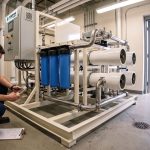
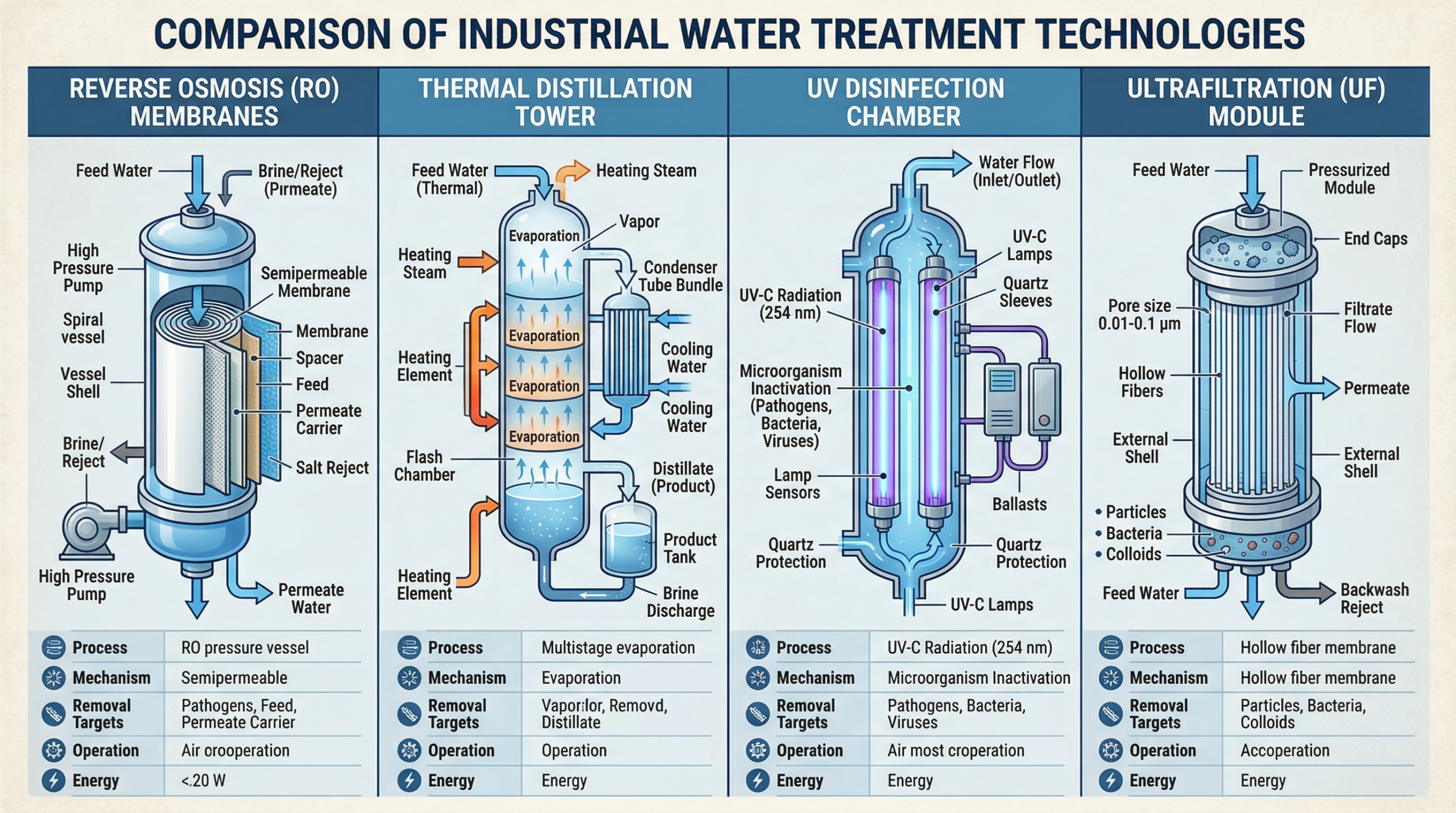
Reverse osmosis uses semipermeable membranes with 0.0001-micron pores to separate dissolved solids from water under pressure (150-600 PSI for brackish water, 800-1,200 PSI for seawater). Modern industrial RO systems achieve 75-85% water recovery and 95-99% salt rejection. AMPAC USA industrial RO systems are available from 10,000 GPD to over 1,000,000 GPD with PLC automation and remote monitoring.
Distillation
Distillation evaporates water and condenses the steam, leaving contaminants behind. Multi-effect distillation (MED) and mechanical vapor compression (MVC) are the most common industrial variants. Distillation produces extremely high purity water (>99.9% contaminant removal) but at significantly higher energy cost – 40-60 kWh per 1,000 gallons compared to 3-6 kWh for RO.
Ultraviolet (UV) Disinfection
UV systems expose water to ultraviolet light at 254 nm wavelength, inactivating bacteria, viruses, and protozoa by damaging their DNA. UV is highly effective for microbial control (99.99% inactivation at proper dose) but does not remove dissolved solids, chemicals, or particulate matter. It is almost always used as a complementary technology alongside RO or other filtration.
Ultrafiltration (UF)
Ultrafiltration uses membranes with 0.01-0.1 micron pores – 100-1,000x larger than RO membranes. UF effectively removes suspended solids, bacteria, viruses, colloids, and some large organic molecules, but passes dissolved salts and small molecules. UF operates at low pressure (10-30 PSI) and is commonly used as pretreatment before RO systems.
Head-to-Head Comparison: RO vs. Distillation vs. UV vs. UF
| Parameter | Reverse Osmosis | Distillation | UV Disinfection | Ultrafiltration |
|---|---|---|---|---|
| TDS Removal | 95-99% | 99.9% | 0% | 5-15% |
| Bacteria Removal | 99.99% | 99.99% | 99.99% | 99.99% |
| Virus Removal | 99.98% | 99.99% | 99.99% | 99.9% |
| Chemical Removal | 95-99% | 95-99% | 0% | 10-30% |
| Energy (kWh/1000 gal) | 3-6 | 40-60 | 0.5-1 | 1-3 |
| Cost per Gallon | $0.002-$0.005 | $0.05-$0.15 | $0.001 | $0.003 |
| Max Throughput | Millions GPD | Thousands GPD | Millions GPD | Millions GPD |
| Footprint | Compact | Large (evaporators) | Very compact | Compact |
| Maintenance | Moderate (membrane replacement every 3-7yr) | High (scaling, corrosion) | Low (lamp replacement annually) | Moderate (membrane cleaning/replacement) |
| Chemical Use | Low (antiscalant, CIP chemicals) | High (descaling, anticorrosion) | None | Low (cleaning chemicals) |
Recommended Technology by Industry
| Industry | Primary Technology | Supporting Technology | Target Water Quality |
|---|---|---|---|
| Pharmaceutical | RO + EDI (or double-pass RO) | UV (TOC reduction) + 0.2um filter | USP Purified Water: <1.0 uS/cm, <500 ppb TOC |
| Food & Beverage | RO | UV + carbon polishing | TDS <50 ppm, chlorine-free, microbe-free |
| Semiconductor | Double-pass RO + EDI | UF + UV + mixed-bed DI polisher | 18.2 megohm-cm resistivity |
| Power Generation | RO (or RO + EDI) | Softener pretreatment | TDS <5 ppm for boiler feed |
| Healthcare/Dialysis | RO (double-pass for dialysis) | Carbon + UV + UF | AAMI standards: TDS <10 ppm, endotoxin <2 EU/mL |
| Cosmetics | RO | UV + DI polishing | USP Purified Water grade |
| Municipal | UF + RO (for desalination/reuse) | Chlorination + UV | EPA drinking water standards |
In nearly every industrial sector, reverse osmosis serves as the core treatment technology. The differences lie in what complementary technologies are added – UV for microbial control, EDI for ultra-high purity, UF for pretreatment, or carbon for organics removal.
When to Choose Each Technology
Choose Reverse Osmosis When:
- You need comprehensive dissolved solids removal (TDS reduction)
- Energy cost is a significant concern (RO uses 3-6 kWh/1000 gal vs 40-60 for distillation)
- You need scalable capacity (RO systems scale easily from 1,000 to 1,000,000+ GPD)
- Feed water has moderate to high TDS (200-35,000 ppm)
- Space is limited (RO has the smallest footprint per gallon of purified water produced)
Choose Distillation When:
- Regulatory requirements mandate distillation specifically (some WFI specifications)
- Feed water contains high levels of volatile organic compounds that pass through RO
- Energy cost is not a primary concern (waste heat is available from other processes)
- Throughput requirements are relatively low (hundreds to low thousands GPD)
Choose UV When:
- Microbial control is the primary objective and water is otherwise clean
- Chemical-free disinfection is required (no chlorine residual)
- As a polishing step after RO to ensure microbiological safety
- TOC reduction is needed (185 nm UV oxidizes organics)
Choose Ultrafiltration When:
- Suspended solids, turbidity, and bacteria removal is the primary objective
- As pretreatment before RO to protect RO membranes and extend their life
- Feed water has high turbidity or biological content
- Low-pressure operation is preferred (UF operates at 10-30 PSI)
Combined Treatment Systems: The Industrial Best Practice
In practice, most industrial water treatment plants use multiple technologies in sequence. The most common configurations include:
- Standard Industrial: Softener → Carbon → RO → Storage → Distribution
- Pharmaceutical: Multimedia → Softener → Carbon → RO → EDI → UV → 0.2um → Loop
- Semiconductor: UF → RO → RO (2nd pass) → EDI → UV → Mixed Bed DI → UF (final)
- Food & Beverage: Multimedia → Softener → Carbon → RO → UV → Storage
- Desalination: Intake → Multimedia → UF → Cartridge → SWRO → Remineralization → Chlorination
AMPAC USA industrial RO systems are designed for integration with complementary treatment technologies. Our engineering team designs complete treatment trains from raw water intake to final distribution, ensuring each stage is optimized for the specific application.
📚 References & Further Reading
- AWWA: Water Treatment Plant Design
- EPA: Industrial Wastewater Treatment Technologies
- Water Research Foundation: RO vs UV vs UF Comparison
- AMPAC USA – Industrial Water Purification
Frequently Asked Questions
What is the most energy-efficient method for industrial water purification?
Industrial Reverse Osmosis (RO) is the most energy-efficient primary purification method, typically consuming 3-6 kWh per 1,000 gallons. In contrast, distillation can require 40-60 kWh per 1,000 gallons. AMPAC USA RO systems are designed for optimal energy performance while achieving 95-99% contaminant removal.
How effective is UV disinfection for industrial water treatment?
UV disinfection is highly effective for inactivating microbial contaminants like bacteria, viruses, and protozoa, achieving 99.99% inactivation at the proper dose. However, UV does not remove dissolved solids, chemicals, or particulate matter. It is almost always used as a complementary technology, often alongside RO or other filtration systems, to ensure comprehensive water purity.
What is the primary difference between industrial reverse osmosis and ultrafiltration?
The primary difference lies in membrane pore size and what they remove. Industrial RO uses 0.0001-micron membranes to separate dissolved solids (95-99% TDS), while ultrafiltration (UF) uses larger 0.01-0.1 micron membranes. UF effectively removes suspended solids, bacteria, viruses, and colloids, but not dissolved salts.
What are the typical operating costs for industrial reverse osmosis systems?
Industrial reverse osmosis systems offer excellent cost-effectiveness, with typical operating costs ranging from $0.002 to $0.005 per gallon. This cost includes energy consumption (3-6 kWh per 1,000 gallons) and membrane replacement. AMPAC USA designs RO systems for long-term reliability and low operational expenditure.
When is distillation preferred over reverse osmosis for industrial water purification?
Distillation is preferred when extremely high purity water (>99.9% contaminant removal) is absolutely critical, such as for specific laboratory or pharmaceutical applications. While it achieves higher purity than RO, it comes at a significantly higher energy cost, typically 40-60 kWh per 1,000 gallons, compared to RO’s 3-6 kWh. For most industrial needs, RO provides the optimal balance of purity and efficiency.
Engineer the Right Solution for Your Facility
Every industrial water treatment application has unique requirements. AMPAC USA’s engineering team designs, manufactures, and commissions complete water treatment systems tailored to your specific feed water, flow rate, and purity standards.
Contact AMPAC USA for a free engineering consultation. Call (909) 762-8020 or submit your specifications online for a custom system proposal.
Related Articles
- Effective Reverse Osmosis Water Filter for Microplastics in Industrial Applications
- Boiler Feed Water Treatment: Why Industrial Facilities Need Reverse Osmosis
- Industrial Reverse Osmosis Systems & Water Treatment Systems
- Why Industrial Reverse Osmosis Treatment Is Vital for Pure Water Supply
Conclusion
None of these four technologies wins outright — RO handles dissolved salts and organics that UV can’t touch, UV kills pathogens that RO membranes don’t need to worry about, and most industrial facilities end up running two or three of them together rather than picking just one. The comparison above should make it clear which technology matches your contaminant profile and throughput needs, whether that’s RO for TDS reduction, distillation for ultra-high purity, or UF as a pretreatment step ahead of RO. AMPAC USA engineers combined systems around these exact tradeoffs rather than defaulting to a single method. Contact our team at info@ampac1.com or (909) 548-4900 to discuss the right combination of industrial water purification technology for your facility.